Why Iški Morost Nature Reserve stands out
Iški Morost is best known as a stronghold for the corncrake (Crex crex), a globally declining meadow bird whose presence has shaped both the reserve's protection status and its day-to-day management. The site is recognized as the most important refuge for this species within a wider Ljubljana Marsh whose overall habitat quality has suffered in recent decades. The reserve is equally famous for preserving the largest intact block of wet meadows of the Ljubljansko barje. These open, regularly mown wetlands represent a vanishing type of central Slovenian lowland landscape, and their continued existence here depends on careful coordination between conservation organizations and local farmers using bird-friendly mowing practices.
Iški Morost Nature Reserve history and protected-area timeline
Iški Morost became formally recognized as a nature reserve within the framework of Slovenia's modern protected-area system, but its real history as a conservation site is closely tied to larger European efforts to protect grassland bird populations. The site's significance escalated with concern over the corncrake (Crex crex), a species that had been disappearing across much of continental Europe as traditional hay meadows were converted to more intensive agricultural uses.
The decisive period came in 2004, when DOPPS, the Slovenian partner organization of BirdLife International, took over responsibility for managing the reserve. Shortly afterwards, the site became a key component of a dedicated LIFE project, titled 'Vzpostavitev dolgoročnega varstva kosca Crex crex v Sloveniji' (Establishment of long-term conservation of the corncrake in Slovenia). The project brought EU-level funding and technical frameworks that helped consolidate the reserve's role as a model site for bird-friendly meadow management.
A guide to the Koščeva učna pot, the reserve's educational trail, was published in 2007 by DOPPS, edited by Eva Vikelič. This publication, together with the trail itself, marked an important step in making the reserve's conservation work visible to visiting farmers, students, conservationists, and the wider public. The reserve's international classification as IUCN Category Ia, alongside its inclusion in a Natura 2000 site under both the EU Habitats Directive and the Birds Directive, further anchored its place within the European conservation network.
Iški Morost Nature Reserve landscape and geographic character
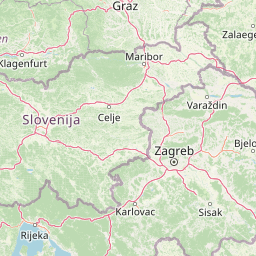
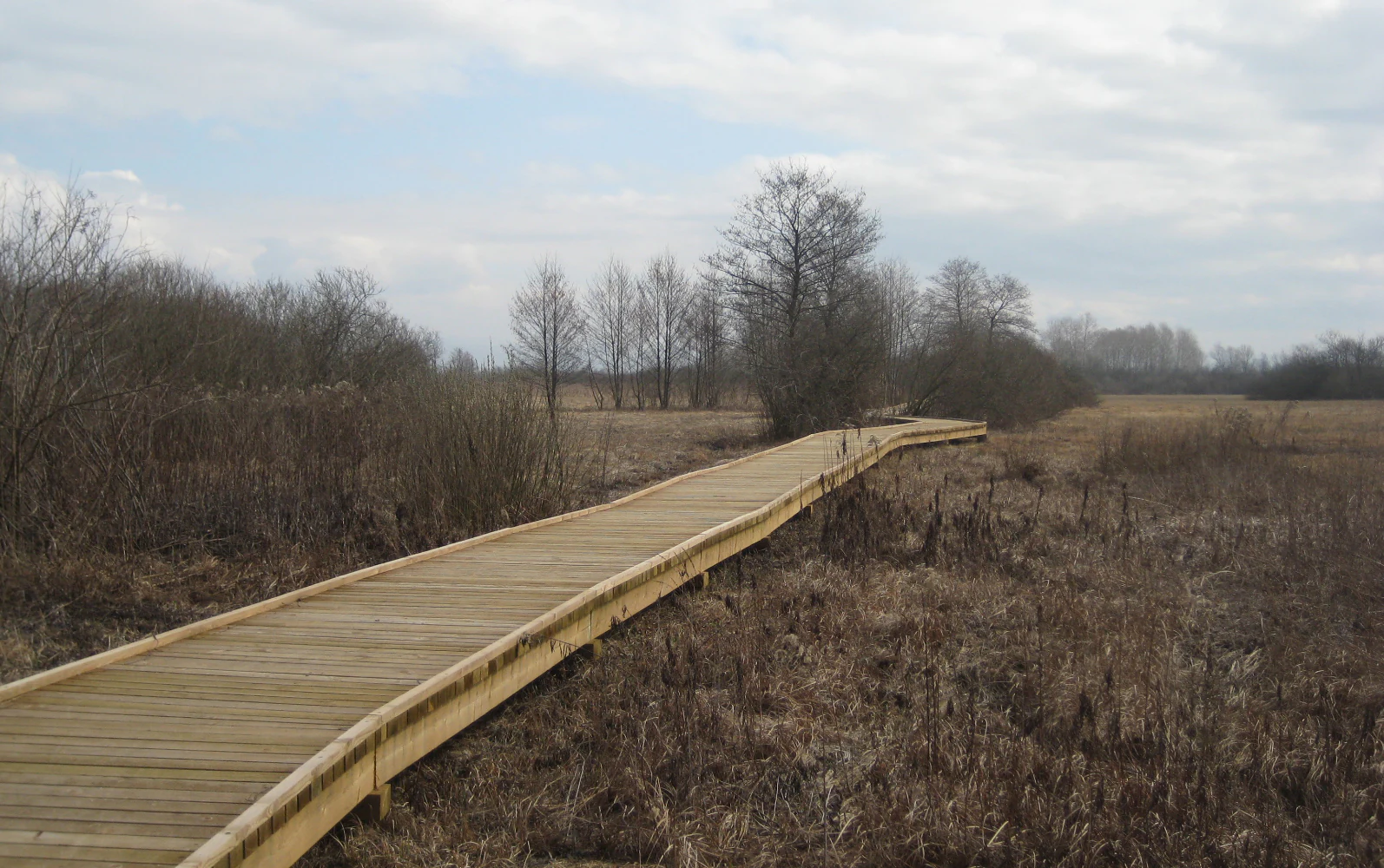
The landscape of Iški Morost is defined by the wide, flat, waterlogged terrain of the Ljubljana Marsh, one of the largest wetland complexes in Slovenia. The reserve sits at an elevation only slightly above sea level, in a basin that has been shaped for millennia by the slow meandering of rivers and by the seasonal rise and fall of groundwater. The result is a soft, low, open landscape where the horizon is unusually broad and the sky dominates the view.
The core feature is the contiguous block of wet meadows themselves. These are not natural wetlands in the strictest sense, but semi-natural habitats that have been maintained for centuries through regular summer mowing, a practice that prevents shrub encroachment and keeps the meadows open. Within the reserve this practice has been revived and refined, so the meadows display a varied mosaic of short grass, slightly taller herbaceous patches, isolated shrubs, and short hedgerows.
Hydrologically, the reserve is shaped by the Iška River, a small right-bank tributary of the Ljubljanica. In its section through the reserve, the Iška has been channelized into a straightened course, though its surrounding floodplain retains much of its characteristic wet meadow character. The interplay between the straightened river, the meadows, and the low surrounding terrain creates the layered ground conditions that support the reserve's distinctive grassland community.
Surrounding the core meadow block, the broader Ljubljana Marsh contains a range of additional features: small settlements on slightly elevated ground, pockets of floodplain forest, and seasonal standing water. Although much of this surrounding landscape is not formally part of the reserve, it forms the wider visual and ecological matrix in which the wet meadows of Iški Morost are situated.
Iški Morost Nature Reserve ecosystems, habitats, and plant life
Ecologically, Iški Morost belongs to the wet meadow habitat type that characterizes the central Slovenian lowlands. These meadows are species-rich grasslands adapted to periodic flooding and high groundwater, and they support a distinctive community of grasses, sedges, and herbaceous plants. The reserve's management strategy, based on traditional mowing at carefully chosen times, maintains this species composition and prevents the encroachment of taller vegetation that would otherwise alter the habitat.
The mosaic character of the meadows is central to their ecological value. Within the reserve, patches of taller herbs and shrubs (steblike, grmišča) alternate with shorter, more open grass, while isolated bushes and hedgerows break up the otherwise continuous sward. Floodplain forest elements appear along parts of the Iška. Together, these features create the gradient of structure and microclimate that the area's specialized fauna depends on.
Because the wet meadows of the wider Ljubljana Marsh have suffered notable degradation over recent decades, the intact block preserved at Iški Morost has taken on disproportionate ecological importance. It functions as a reference site for what the broader marsh's meadows could look like under appropriate management, and as a reservoir of the habitat structure on which the area's most sensitive species depend.
Iški Morost Nature Reserve wildlife and species highlights
The wildlife of Iški Morost is dominated by the corncrake (Crex crex), a medium-sized rail whose dry, repetitive call from deep within tall grass is one of the most characteristic sounds of European farmland that still maintains traditional hay meadows. The presence of a stable, calling population here is the reason the reserve was formally designed, and remains its primary biological justification.
Beyond the corncrake, the reserve supports the broader bird community typical of well-managed wet meadows: meadow pipits, yellow wagtails, whinchats, and a range of other grassland species. The mosaic of short and taller vegetation, hedgerows, and channelized riverine edge provides a variety of nesting and foraging conditions across a small area.
The wet meadows and adjacent habitat patches also host an assemblage of invertebrates, amphibians, and small mammals typical of central Slovenian lowland wetlands. Educational materials at the observation station highlight this broader biodiversity, including the sometimes-overlooked ecological roles of hedgerows, isolated shrubs, and seasonally flooded ground in supporting meadow life.
Iški Morost Nature Reserve conservation status and protection priorities
Iški Morost carries a particularly strong conservation profile in central Slovenia. It is internationally classified as IUCN Category Ia, the strictest category of protected area, which includes a near-complete prohibition on access. At the national level it is designated as a Naravni rezervat, and it lies within a larger Natura 2000 site protected under both the EU Habitats Directive and the EU Birds Directive.
This multi-layered recognition reflects the reserve's role as one of the most important strongholds for the corncrake in a marsh landscape whose overall conservation status has historically been weak. Within the Ljubljana Marsh, where habitat fragmentation, drainage, and intensification of agricultural use have reduced the quality of large parts of the area, Iški Morost represents a coherent, intensively managed refuge. Management is led by DOPPS, the Slovenian BirdLife partner, and supported by a dedicated LIFE project aiming to establish long-term conservation of the corncrake in Slovenia.
The reserve also functions as a demonstration site for bird-friendly mowing and other farmer-friendly conservation practices. By working directly with local farmers to test and showcase management approaches that maintain meadow quality while sustaining agricultural use, Iški Morost influences conservation outcomes well beyond its own 65 hectares.
Iški Morost Nature Reserve cultural meaning and human context
Iški Morost is rooted in the long cultural tradition of hay-making on the Ljubljana Marsh. For centuries, the wet meadows of the region were managed as communal hay resources, with timing of mowing, irrigation, and grazing shaped by generations of local knowledge. The reserve's meadows are not a pristine wilderness but a continuation, under modern conservation management, of an older relationship between local farmers and a flood-prone landscape.
The wider Ljubljana Marsh (Ljubljansko barje) has long been a distinct cultural-geographical unit in central Slovenia, and it is the focus of a dedicated regional landscape park society. Iški Morost sits within this regional identity, contributing to the marsh's reputation as both a working agricultural landscape and a place of high ecological value. The educational trail and observation station make that dual role of cultural heritage and natural heritage explicitly visible to visitors.
Top sights and standout views in Iški Morost Nature Reserve
The reserve's standout feature is its function as the most important refuge for the corncrake within the Ljubljana Marsh, a species whose conservation needs have shaped the site's formal protection status and management regime. Equally distinctive is the reserve's preservation of the largest contiguous block of intact wet meadows still found in the marsh, a habitat type that has largely disappeared elsewhere in the region.
Iški Morost also stands out for its combination of strict protection with thoughtful visitor infrastructure. The Corncrake Educational Trail, the nest-shaped observation station, and guided tours allow access to a site that is otherwise closed to the public. The reserve's role as a demonstration site for bird-friendly farming gives it additional significance as a model for conservation-compatible agriculture in central European lowlands.
Best time to visit Iški Morost Nature Reserve
The wet meadows of Iški Morost are most expressive in late spring and summer, when the corncrake is calling from the tall grass and the meadow vegetation is at its richest. This period also coincides with the main hay-cutting season, when bird-friendly mowing practices coordinated by DOPPS can most directly support breeding success.
For visitors interested in general meadow biodiversity and landscape character, late spring through early summer tends to combine the most active birdlife with the freshest display of meadow flora. Cooler, quieter months offer a different kind of experience: a more subdued landscape under low light, with fewer insects and migrant birds but clearer views across the open marsh. As in any wetland, weather and water levels strongly shape the atmosphere of a visit.