Why Isle Royale National Park stands out
Isle Royale is best known for its unique wolf-moose predator-prey study, one of the longest-running ecological research projects in North America. The island's boreal forest ecosystem supports a remarkable diversity of wildlife despite the island's isolation, hosting only about one-third of the mainland mammal species. The park is also famous for its ancient copper mining history, with evidence of indigenous copper extraction dating back at least 6,500 years. The rugged, roadless wilderness character and the dramatic Precambrian volcanic geology of the Greenstone Ridge provide a striking backdrop for backcountry recreation.
Isle Royale National Park history and protected-area timeline
The history of Isle Royale spans thousands of years of human interaction with the island's copper-rich landscape. Indigenous peoples from nearby Minnesota and Ontario visited the island for centuries to mine copper, leaving behind hundreds of pits and trenches up to 65 feet deep, particularly in the McCargoe Cove area. Carbon-14 testing indicates these mining activities date back at least 6,500 years. The island was known to the Ojibwa as Minong or Menong, a name reflected in contemporary place names. Following the 1842 Treaty of La Pointe, the Ojibwa ceded the island to the United States, though British control persisted until after the War of 1812. Modern copper mining attempts began in the 1840s after Michigan's first state geologist Douglass Houghton documented copper deposits, leading to the establishment of the Minong Mine and Island Mine between 1873 and 1881. Commercial logging also extensively deforested the island during the late 19th century. The island was established as a national park on April 3, 1940, after which exploitive activities ceased and the forest began regenerating. The park gained wilderness designation in 1976 and was added to the National Register of Historic Places in 2019 as the Minong Traditional Cultural Property.
Isle Royale National Park landscape and geographic character
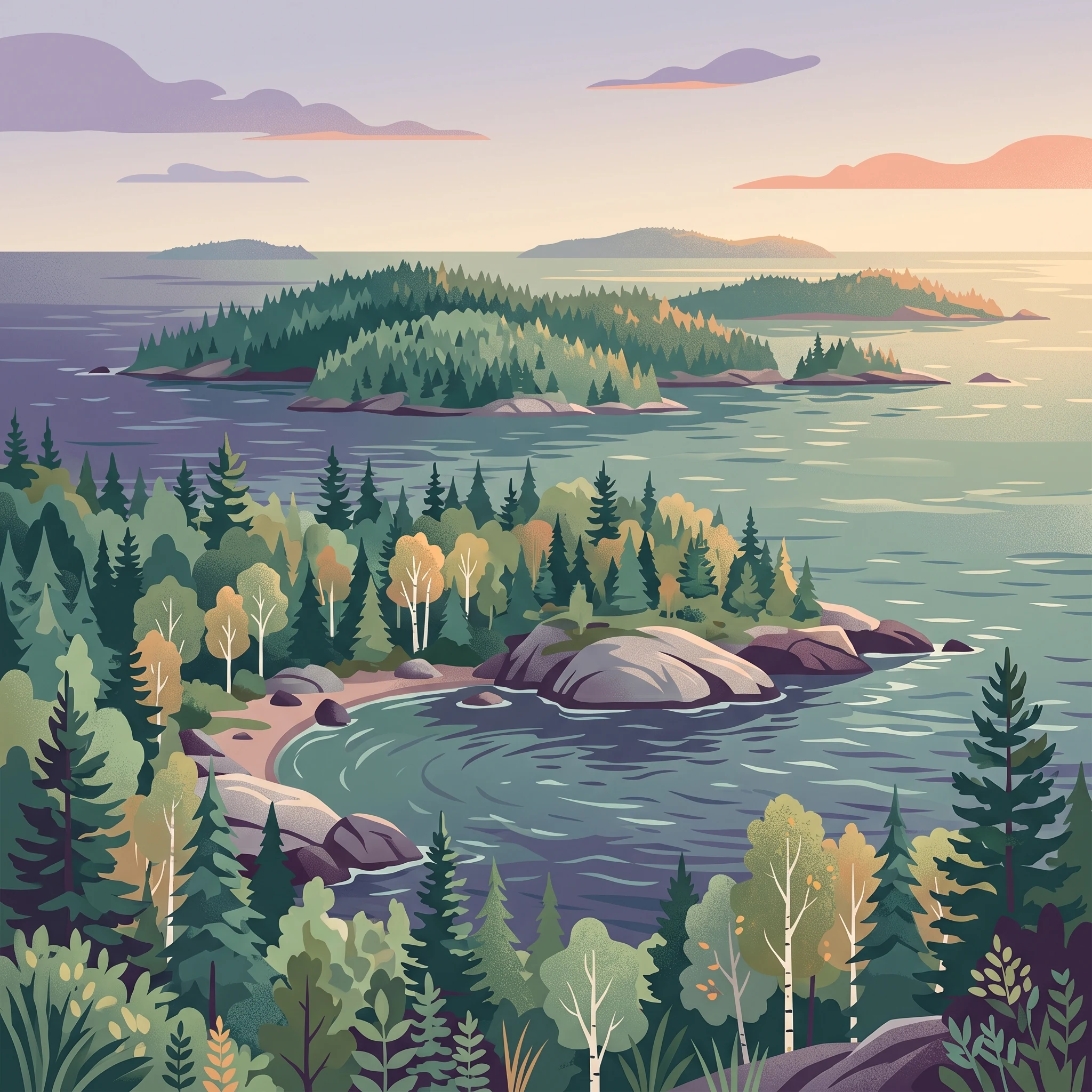
The landscape of Isle Royale is defined by its Precambrian volcanic geology and the dramatic glacial carving of the Lake Superior basin. The island is composed primarily of two rock assemblages: the Portage Lake Volcanics, consisting of ophitic flood basalts with at least 100 individual flows totaling over 10,000 feet in thickness, and the Copper Harbor Conglomerate in the southwestern portion. These ancient rocks, approximately one billion years old, form a series of ridges running roughly southwest-to-northeast across the island. The Greenstone Ridge, over 1,000 feet high in many places, forms the island's central spine and carries the longest trail in the park. The highest point is Mount Desor at 1,394 feet above lake level. Glacial erosion accentuated the pre-existing ridge and valley topography, creating features such as drumlins west of Siskiwit Lake and recessional moraines west of Lake Desor. The island contains numerous interior lakes, with Siskiwit Lake being the largest and containing Ryan Island, the largest island within a lake on the island. The thin topsoil favors trees with horizontal root patterns such as balsam fir, white spruce, and black spruce.
Isle Royale National Park ecosystems, habitats, and plant life
The ecological character of Isle Royale reflects its position within the Laurentian Mixed Forest Province, a transition zone between the true boreal forest to the north and the Big Woods to the south. The predominant habitats include boreal forest similar to neighboring Ontario and Minnesota, with coniferous forests of jack pine, black and white spruce, and balsam fir mixed with deciduous species including quaking aspens, red oaks, paper birches, red and sugar maples. The island also features unique habitats including upland balds with exposed bedrock and hardy vegetation, marshes created by beaver activity, and conifer bogs. The climate is heavily influenced by the cold waters of Lake Superior, with the Plant Hardiness Zone rated as 4b. Over 600 species of flowering plants have been documented on the island, including wild sarsaparilla, marsh-marigold, wood lily, and prickly wild rose. The island supports only about one-third of the mammal species found on the mainland due to its isolation.
Isle Royale National Park wildlife and species highlights
Isle Royale is renowned for its wolf and moose populations, which have been the subject of one of the longest-running predator-prey studies in North America. Moose colonized the island sometime between 1905 and 1912, likely introduced by humans for a private hunting preserve, and their population has fluctuated dramatically over the decades. Wolves arrived in the 1950s and established a population that cycled with moose numbers. However, genetic inbreeding caused the wolf population to decline to just two individuals by 2016, prompting the National Park Service to relocate 19 wolves from Minnesota, Michigan, and Ontario between 2018 and 2019. Other common mammals include red foxes, beavers, red squirrels, ermine, mink, muskrats, and several bat species. The island's reptile and amphibian populations include eastern garter snakes, painted turtles, northern redbelly snakes, six frog species, and three salamander species. Historically, the island was home to boreal woodland caribou and Canada lynx before they were extirpated by direct human actions in the early 20th century.
Isle Royale National Park conservation status and protection priorities
Isle Royale National Park holds significant conservation value through its multiple protected designations and unique ecological characteristics. The park's wilderness area designation in 1976 provides the highest level of federal protection, prohibiting motorized equipment and mechanical transport except for wheelchairs. Its designation as a UNESCO International Biosphere Reserve in 1980 recognizes its importance for ecological research and conservation. The wolf-moose predator-prey system, studied continuously since 1959, represents one of the most important long-term ecological studies in North America and has provided foundational insights into population dynamics, predator-prey relationships, and ecosystem regulation. The park's isolation and protection from development have allowed the boreal forest ecosystem to regenerate following historical logging and mining, though the ecosystem remains simplified compared to mainland environments. The 2019 addition to the National Register of Historic Places recognizes the island's cultural significance as the Minong Traditional Cultural Property, preserving the indigenous heritage of copper mining that spans millennia.
Isle Royale National Park cultural meaning and human context
Isle Royale holds deep cultural significance for the Ojibwa people, who called the island Minong or Menong and considered it their territory. The island was a common hunting ground for native peoples from nearby Minnesota and Ontario, with the west end reachable by a thirteen-mile canoe voyage from the mainland. Archaeological evidence reveals extensive indigenous copper mining activity dating back at least 6,500 years, with hundreds of mining pits and trenches left behind, particularly around McCargoe Cove. The Ojibwa ceded the island to the United States through the 1842 Treaty of La Pointe, though the Grand Portage Band was unaware that neither they nor Isle Royale were in British territory. Historical European-American activities included copper mining attempts in the 19th century and commercial logging that extensively altered the island's forests. The island was once the site of several lake trout and whitefish fisheries, with the historic Edisen Fishery continuing to operate today. About 12 families maintain lifetime leases for cabins on the island, maintaining connections to the island's heritage.
Top sights and standout views in Isle Royale National Park
The Greenstone Ridge Trail offers a spectacular 40-mile backcountry experience crossing the island's central spine, passing through northwoods wilderness, inland glacial lakes, and scenic shorelines to the summit of Mount Desor. The wolf-moose predator-prey dynamic provides extraordinary wildlife viewing opportunities in one of North America's few places where these species coexist without bears. Ancient indigenous copper mining sites offer a tangible connection to the island's millennia of human history. The park's 36 wilderness campgrounds provide backcountry camping opportunities accessible by trail, canoe, or kayak. The historic Edisen Fishery represents a living connection to the island's fishing heritage. Shipwrecks along the western tip attract scuba divers to the well-preserved remains of vessels lost on the treacherous Lake Superior shipping routes. The lack of roads creates a pristine wilderness experience unreachable by vehicle.
Best time to visit Isle Royale National Park
The optimal time to visit Isle Royale is during the summer months from mid-June through August, when ferry and floatplane services operate regularly and temperatures are most comfortable for hiking. July and August offer the warmest conditions and longest daylight hours for exploring the island's 170 miles of trails. The park is open from mid-April through October, but the shoulder seasons of May and September offer fewer visitors and opportunities to witness the boreal forest in its autumn colors or spring awakening. The park closes entirely from November 1 through April 15 due to extreme winter conditions and safety concerns, making it the only American national park to fully close for the winter. Fall visitors should be aware that the ferry schedule becomes less frequent after Labor Day. Winter conditions on Lake Superior are severe, with ice bridges occasionally forming between the island and mainland.