Why Kalbarri National Park stands out
Kalbarri National Park is best known for its spectacular Murchison River gorge, where the river has carved a nearly 80-kilometre canyon through ancient Tumblagooda sandstone, creating one of Western Australia's most impressive inland geological wonders. The park's coastal section is equally renowned for its dramatic cliffs exceeding 100 metres in height, punctuated by wind and water-carved formations including sea stacks and the famous Natural Bridge rock arch. The iconic Nature's Window, a naturally formed rock arch through which the Murchison River can be viewed, has become one of the most photographed features in Western Australia. The park's floral significance is exceptional, with over 800 wildflower species documented and 21 endemic plant species found exclusively within its boundaries, including the rare Kalbarri catspaw and several orchid species found nowhere else on Earth.
Kalbarri National Park history and protected-area timeline
Kalbarri National Park was established in 1963, formalising protection for a landscape that had long been recognised for its outstanding natural values. The region's significance extends far beyond its modern park boundaries, with the Murchison River and its gorge system having shaped the development of the surrounding region and the small town of Kalbarri that now serves as the gateway to the park. The area's indigenous heritage is significant, with the local Nanda people having lived in this region for thousands of years, their connection to the land reflected in various cultural sites throughout the park. Development of visitor facilities and infrastructure has occurred gradually over the decades, with the construction of walking tracks, viewing platforms, and more recently the Kalbarri Skywalk, which now offers visitors dramatic elevated views over the Murchison River gorge. The park's management has evolved alongside changing approaches to conservation, with the Department of Parks and Wildlife now overseeing protection of both the geological formations and the remarkable biodiversity that the landscape supports.
Kalbarri National Park landscape and geographic character
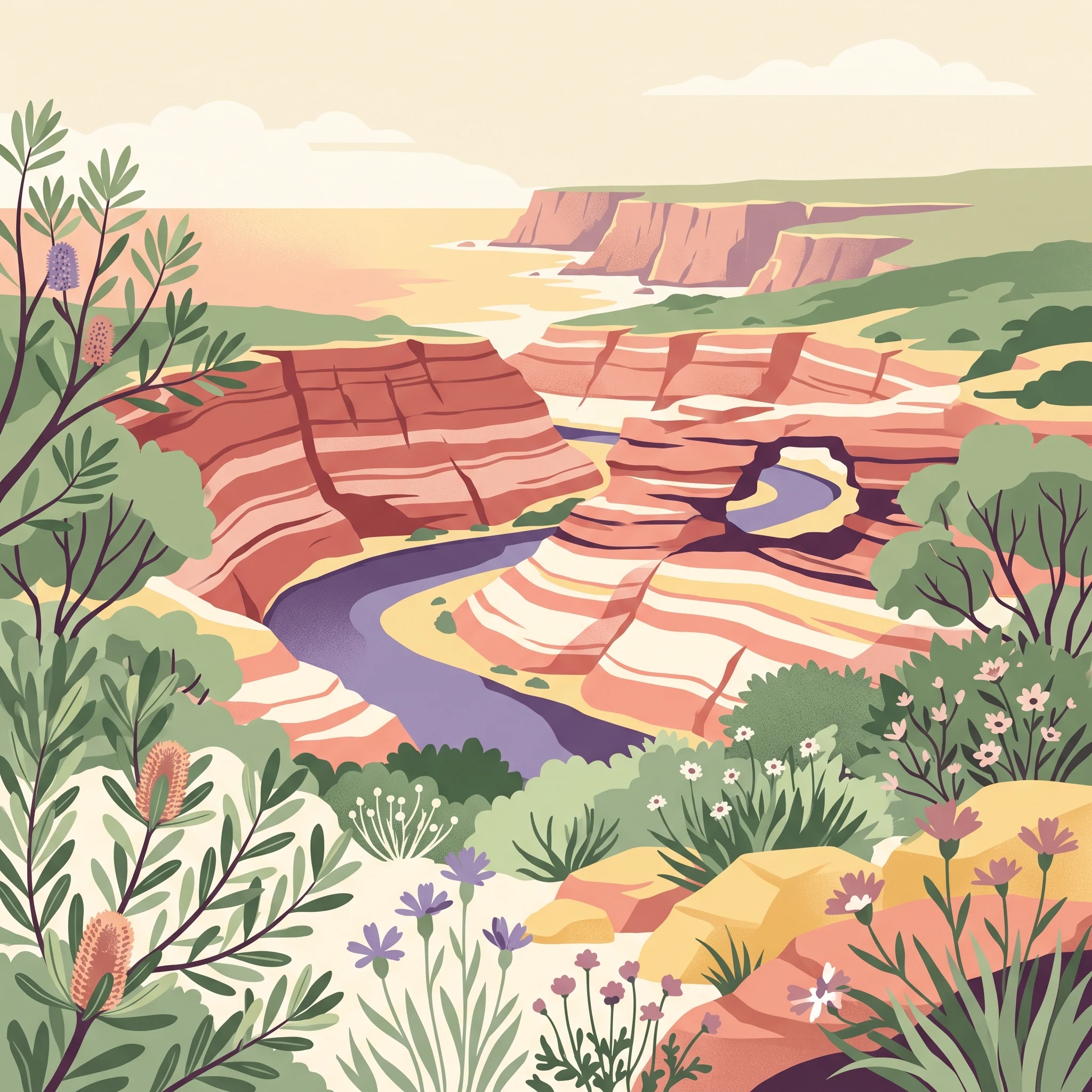
The landscape of Kalbarri National Park is defined by a dramatic contrast between two spectacular geological environments. The inland portion of the park showcases the results of the Murchison River cutting through ancient Tumblagooda sandstone, creating a gorge system that extends for nearly 80 kilometres with cliff faces rising dozens of metres above the river below. The sandstone itself displays distinctive red and white banding that creates a visually striking palette, particularly during sunrise and sunset when the colours seem to glow. Notable features along the gorge include the famous Nature's Window, a natural arch that frames views of the river, the sharp meander known as the Z Bend, and viewpoints like Ross Graham Lookout that offer sweeping perspectives of the canyon. The coastal section presents a completely different character, where the same ancient rock formations meet the Indian Ocean in cliffs that soar more than 100 metres above sea level. Wave action and wind erosion have carved the cliffs into a succession of shapes including sea stacks, natural arches, and narrow passages, with features like Red Bluff, Mushroom Rock, and Rainbow Valley providing memorable landmarks along the coast. Meanarra Hill dominates the view at the mouth of the river, marking the transition from the inland gorge to the open ocean.
Kalbarri National Park ecosystems, habitats, and plant life
The ecological character of Kalbarri National Park reflects its position at the intersection of several different environmental zones, creating a surprising diversity of habitats within what might appear to be a relatively uniform semi-desert landscape. The park is renowned for its extraordinary wildflower displays, with more than 800 species recorded across the region. The bloom begins in late winter and continues through early summer, reaching peak intensity in August and September when the landscape transforms into a tapestry of colour. Twenty-one plant species are found exclusively within the park's boundaries, making it a significant site for botanical endemism. Among the most notable is the Kalbarri catspaw, a small yellow or red plant that appears prominently on recently burnt areas, and several orchid species including the Kalbarri spider orchid and the Murchison hammer orchid. The re-discovery of the small-petalled Beyeria in 1994 was particularly significant, as it had previously been thought extinct and is now known from only three populations worldwide, with the Kalbarri population being one of the most important. The Murchison River corridor acts as a linear oasis through the arid landscape, supporting vegetation communities quite different from the surrounding country and providing crucial water and habitat in an otherwise dry environment.
Kalbarri National Park wildlife and species highlights
The wildlife of Kalbarri National Park demonstrates the park's role as a refuge in a generally arid landscape, with the Murchison River corridor and the coastal zone supporting notably different assemblages of species. Approximately 200 animal species have been recorded in the inland areas along the river, while the coastal region and surrounding areas host more than 400 species, reflecting the additional habitat diversity provided by the ocean environment. Birdlife is particularly diverse, with around 150 species observed including emu, osprey, wedge-tailed eagle, and Australian pelican. Mammals of the inland areas include western grey kangaroo, short-beaked echidna, and the tiny spinifex hopping mouse, while the only bat species recorded is Finlayson's cave bat. The park's reptile population includes several species characteristic of arid Australia, such as the thorny devil, western bearded dragon, and central netted dragon. The threatened tammar wallaby was historically present in the area, though recent observations have been lacking. Amphibians are represented primarily by Günther's toadlet, while approximately 30 arthropod species have been documented, including the Pilbara tiger dragonfly.
Kalbarri National Park conservation status and protection priorities
Kalbarri National Park represents a significant conservation outcome in Western Australia's Mid West, protecting a landscape of exceptional geological and ecological value. The park safeguards one of the most impressive river gorge systems in the state's arid interior, preserving not only the dramatic landforms but also the ecological processes that sustain the river and its riparian corridor. The protection of 21 endemic plant species underscores the park's botanical significance, with several species facing considerable conservation pressure outside protected areas. The discovery and ongoing monitoring of the Beyeria population highlights the importance of the park for species of conservation concern, with this species known from only three locations globally. The coastal cliffs and offshore islands provide important habitat for seabirds and marine species, adding another dimension to the park's conservation values. Management focuses on maintaining the natural values while providing sustainable visitor access, with particular attention to managing fire regimes that are important for many of the park's plant species, including the fire-dependent Kalbarri catspaw.
Kalbarri National Park cultural meaning and human context
The landscape of Kalbarri National Park holds significance for the Nanda people, the traditional owners of the land on which the park is situated. The Murchison River and its gorge would have held spiritual and practical importance for indigenous communities over thousands of years, with the landscape providing resources, travel routes, and cultural connections. While the specific details of indigenous heritage sites are not extensively documented in available sources, the broader region has evidence of Aboriginal occupation extending deep into prehistory. The modern town of Kalbarri, which serves as the primary access point for the park, developed as a small coastal settlement in the mid-twentieth century, with its economy historically based on fishing and mining in the surrounding region. The relationship between the town and the national park is close, with tourism related to the park forming a significant part of the local economy and community identity.
Top sights and standout views in Kalbarri National Park
Kalbarri National Park offers two distinct but complementary landscapes within a single protected area. The inland section features the spectacular Murchison River gorge, where the iconic Nature's Window arch provides one of Western Australia's most recognisable natural views, and the dramatic Z Bend showcases the power of water to shape the landscape. The Loop and Hawks Head represent other notable viewpoints along the gorge, each offering different perspectives of the river and its canyon. The coastal section presents equally impressive scenery, with the towering cliffs at Red Bluff, the wave-carved formations of Pot Alley, and the Natural Bridge demonstrating the ongoing interaction between land and sea. The recent addition of the Kalbarri Skywalk platforms has created new opportunities for visitors to experience the scale of the gorge from elevated viewing structures. The wildflower displays from late winter through spring provide an additional highlight, transforming the often-seen arid landscape into a garden of colour.
Best time to visit Kalbarri National Park
The optimal time to visit Kalbarri National Park depends on what visitors hope to experience, with the park offering different attractions across the seasons. Autumn and winter, from May through September, bring more moderate temperatures that make outdoor activities comfortable, with daytime temperatures typically ranging from the high teens to mid-twenties Celsius. This period coincides with the peak wildflower season, when the park's famous floral displays are at their most impressive, particularly in August and September when the greatest variety of species can be observed. Summer months from December through April can bring extreme heat, especially inland where temperatures frequently exceed 40 degrees Celsius, making midday activities dangerous and limiting the appeal of hiking in the gorge. However, the coastal section remains more moderate due to sea breezes. Visitors should be aware that summer thunderstorms can cause rapid and significant rainfall, potentially closing roads to the gorge areas. Spring offers a good compromise between comfortable temperatures and the tail end of the wildflower season, while still avoiding the extreme summer heat.