Why Khao Sam Roi Yot National Park stands out
Khao Sam Roi Yot is best known for its striking limestone karst landscape rising dramatically from the Gulf of Thailand, the iconic Phraya Nakhon Cave with its historic pavilion built for King Chulalongkorn in 1890, and Thailand's largest freshwater marsh system. The park's dramatic coastline features two white sand beaches, Hat Laem Sala and Hat Sam Phraya, accessible by boat or hiking trails. The Phraya Nakhon Cave is particularly famous for the Khuha Kharuehat Pavilion, where sunlight directly illuminates the structure at certain times of year, creating a memorable visual spectacle that has become a provincial symbol. The mangrove-lined Klong Khao Daeng stream and the presence of rare wildlife including fishing cats and Irrawaddy dolphins further distinguish this coastal protected area.
Khao Sam Roi Yot National Park history and protected-area timeline
The historical significance of Khao Sam Roi Yot extends far beyond its designation as a national park in 1966. The area is believed to be where King Mongkut (Rama IV) hosted European guests on August 18, 1868, to observe a total solar eclipse. The king's personal interest in astronomy led him to calculate the date and location of the eclipse, and his predictions proved more accurate than those of French astronomers by approximately two seconds. Tragically, Mongkut contracted malaria during this event and died on October 1 of that year. The national park was formally created on June 28, 1966, with an initial area of approximately 61 square kilometers. On April 1, 1982, the park was significantly enlarged by adding another 37 square kilometers. Archaeological investigations continue to reveal the site's ancient significance, with cave paintings dating back 2,000 to 3,000 years discovered in 2020, adding a new dimension to the park's historical identity.
Khao Sam Roi Yot National Park landscape and geographic character
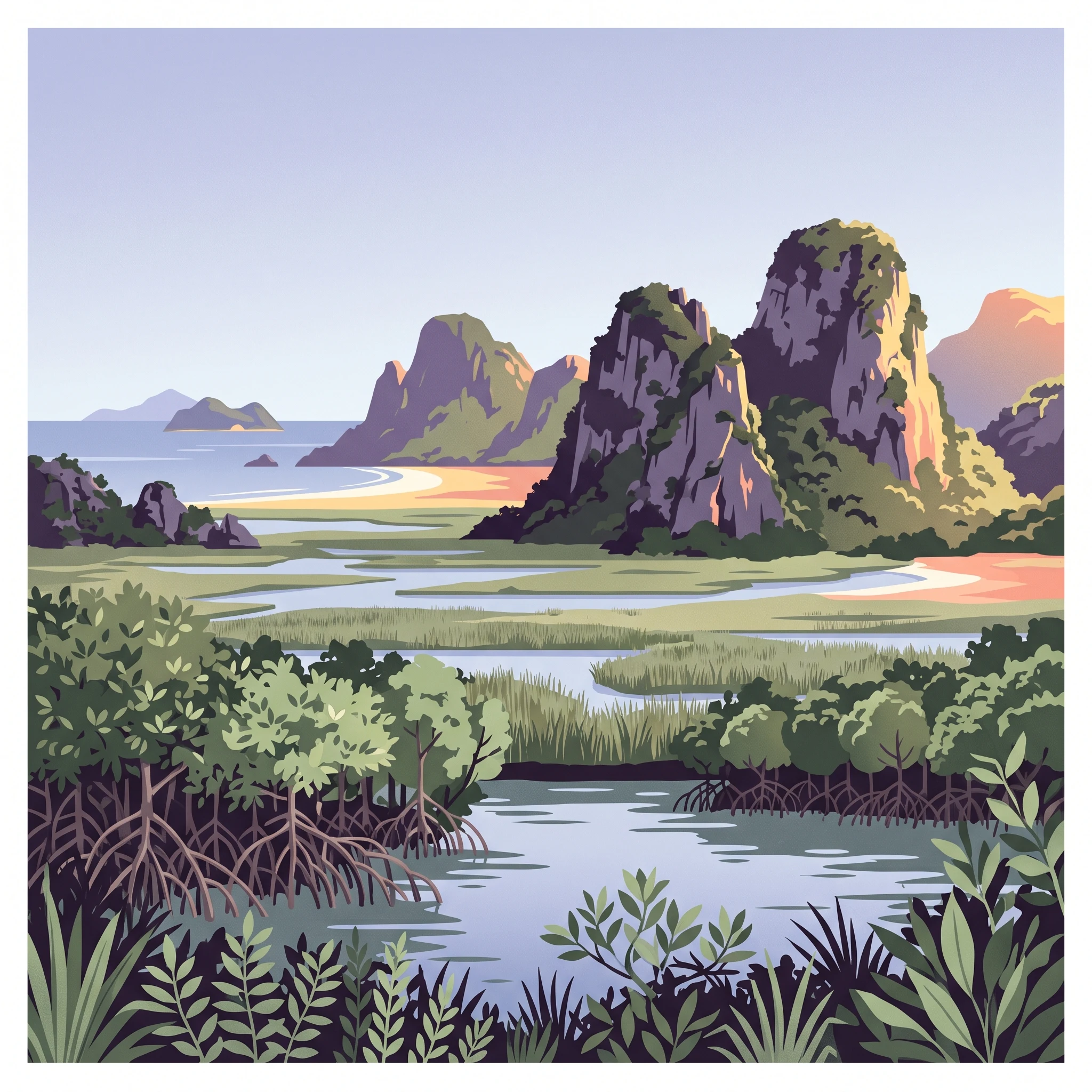
The landscape of Khao Sam Roi Yot is defined by its dramatic limestone karst topography rising abruptly from the coastal plain. The hills, reaching their highest point at Khao Krachom at 605 meters above sea level, create a spectacular backdrop of jagged peaks and steep cliffs. These limestone formations have been shaped by millions of years of erosion, resulting in caves, tunnels, and natural arches. Between the hills, the terrain flattens into extensive freshwater marshes that represent Thailand's largest such wetland system. The park's coastline features two notable white sand beaches: Hat Laem Sala, situated about 17 kilometers from park headquarters and accessible by boat from Ban Pu village, and Hat Sam Phraya. Five uninhabited islands lie just offshore, adding to the coastal scenery. The Klong Khao Daeng stream runs for approximately 4 kilometers through mangrove forests, where fresh and saltwater meet at its mouth, creating a unique estuarine environment.
Khao Sam Roi Yot National Park ecosystems, habitats, and plant life
The nature of Khao Sam Roi Yot encompasses a remarkable diversity of ecosystems within a relatively compact area. The park protects Thailand's largest freshwater marsh, a habitat of significant ecological importance that supports numerous species and provides critical flood regulation and water filtration functions. The mangrove forests along Klong Khao Daeng and other coastal areas contain several species including grey mangrove, red mangrove, and herbaceous seepweed, creating complex intertidal environments that serve as nurseries for fish and crustaceans. The marine areas within the park's boundaries support coral communities and provide habitat for marine mammals. The limestone hills themselves harbor specialized flora adapted to the rocky, well-drained conditions. The ecosystem diversity, from montane limestone forest through freshwater marsh to marine environments, makes this park particularly valuable for biodiversity conservation in peninsular Thailand.
Khao Sam Roi Yot National Park wildlife and species highlights
The wildlife of Khao Sam Roi Yot reflects the park's diverse habitats, with notable populations of both terrestrial and marine species. The bird community is particularly rich, with common kingfisher, black-capped kingfisher, collared kingfisher, little heron, little egret, and Javan pond-heron commonly observed throughout the park. The mangrove environments support a variety of crustaceans and fish including mudskippers, fiddler crabs, snapping shrimp, and mud creepers, while oysters thrive in the estuarine waters. Mammals found in the park include the crab-eating macaque, while rare species such as the mainland serow, dusky langur, and fishing cat occupy the more remote hill forest habitats. At sea, Irrawaddy dolphins are occasionally observed in the Gulf of Thailand waters adjacent to the park. The 2020 discovery of rock art depicting animals including what appears to be a serow provides evidence of the long-standing relationship between wildlife and this landscape.
Khao Sam Roi Yot National Park conservation status and protection priorities
Khao Sam Roi Yot holds significant conservation importance as Thailand's first coastal national park and as a designated Ramsar Wetland site. The park's Ramsar designation in 2008, under the official name Khao Sam Roi Yot Wetland, recognizes the international significance of its marsh and coastal ecosystems. The protected area safeguards critical habitat for numerous species, including several threatened mammals and important bird populations. However, the park faces ongoing conservation challenges. Of the approximately 69 square kilometers of marshes that historically existed in the area, only about 35 square kilometers fall within park boundaries, with significant portions converted to shrimp aquaculture. Efforts to expand the Ramsar designation to additional marsh areas continue. The protection of the limestone hills, beaches, marine areas, and offshore islands creates a comprehensive coastal conservation framework that addresses both terrestrial and marine biodiversity.
Khao Sam Roi Yot National Park cultural meaning and human context
The cultural context of Khao Sam Roi Yot extends from ancient times through the modern era of Thai conservation. The cave paintings discovered in 2020, dating back 2,000 to 3,000 years, provide evidence of prehistoric human presence and artistic expression in the region. More recently, the area gained prominence in Thai royal history when King Mongkut chose the location to observe the 1868 solar eclipse, demonstrating the site's significance for astronomical observation and its accessibility to the royal court. The most enduring cultural landmark is Phraya Nakhon Cave, where King Chulalongkorn (Rama V) visited in 1890 and for which the Khuha Kharuehat Pavilion was constructed. This elegant structure has become the symbol of Prachuap Khiri Khan Province, and subsequent kings including Vajiravudh and Bhumibol Adulyadej have also visited the cave. The park's name itself carries cultural weight, with local interpretation offering several origin stories including 'mountain with 300 peaks,' a reference to survivors from a Chinese junk, or a connection to a local plant species.
Top sights and standout views in Khao Sam Roi Yot National Park
Khao Sam Roi Yot offers visitors a compelling combination of natural beauty, geological wonders, and historical significance within a single protected area. The iconic Phraya Nakhon Cave, with its natural opening allowing sunlight to flood the interior and illuminate the historic Khuha Kharuehat Pavilion, represents the park's most celebrated feature. The dramatic limestone peaks, particularly when viewed from the beaches or as silhouettes against sunrise or sunset, provide outstanding photographic opportunities. The extensive marsh system, Thailand's largest, supports exceptional birdwatching, while boat trips to the offshore islands offer snorkeling and wildlife observation. The mangrove-lined Klong Khao Daeng provides a different ecosystem experience, where visitors can observe the meeting of fresh and saltwater and the specialized species that inhabit this transition zone. The recently discovered ancient cave paintings add an archaeological dimension that few other Thai national parks can claim.
Best time to visit Khao Sam Roi Yot National Park
Khao Sam Roi Yot can be visited year-round, though the optimal period falls during the cool dry season from November through February when temperatures range from 18 to 25 degrees Celsius and rainfall is minimal. This season offers the most comfortable conditions for hiking to Phraya Nakhon Cave, exploring the beach areas, and navigating the park's trails. The summer months from March to May bring warmer temperatures between 23 and 32 degrees Celsius, but still present good conditions for visitors willing to endure the heat. The monsoon season from June through September sees temperatures between 20 and 30 degrees Celsius with increased rainfall, which can limit some activities but also brings lush green landscapes and fewer crowds. Regardless of season, visitors planning to explore Phraya Nakhon Cave should consider that the famous sunlight illumination of the pavilion occurs at specific times during certain months, making advance research advisable for those seeking this experience.