

Mori Atlas logo
National parkLower Glenelg National Park

Trace the Glenelg River's ancient limestone gorge and discover unique subterranean cave systems.

Lower Glenelg National Park: Protected Landscape, Gorge Geography, and Cave Exploration

Lower Glenelg National Park in Victoria, Australia, presents a striking protected landscape defined by the Glenelg River's dramatic gorge carved through ancient limestone terrain. Established in 1969, this national park offers a unique glimpse into millions of years of geological formation, from its steep cliff walls to the accessible Princess Margaret Rose Cave system. Explore the mapped boundaries of this significant natural area and understand its position within the broader regional geography, a key destination for atlas-based landscape discovery.

Gorge landscapesLimestone cavesRiver ecosystemsWetland habitatsBushwalking trailsRamsar sites

Lower Glenelg National Park

National park

Park overview

Structured park overview, official facts, and landscape profile for Lower Glenelg National Park

Lower Glenelg National Park park facts, protected area profile, and essential visitor context
Review the core facts for Lower Glenelg National Park, including designation, size, terrain, visitor scale, habitats, and operating context in one park-focused overview.

About Lower Glenelg National Park

Lower Glenelg National Park occupies a significant place in Victoria's system of protected areas, preserving a stretch of the Glenelg River as it traverses the transition between the state's western uplands and the Southern Ocean coast. The park's terrain is dominated by the river gorge, which in places reaches depths of 60 metres, exposing limestone and sandstone geological formations that record millions of years of erosional history. The gorge environment supports distinct microclimates and specialised plant communities adapted to the cliff faces and shaded valley floors, contrasting with the more open woodlands that cover the surrounding plateau areas.

Princess Margaret Rose Cave represents one of the park's most accessible and visually striking features, with the cave system containing examples of nearly every type of speleothem formation found in limestone caves. The cave's formation began approximately 800,000 years ago as groundwater slowly dissolved the limestone bedrock, depositing calcium carbonate minerals that built the intricate structures visible today. The cave is open to visitors through managed tours that explain the geological processes and the cultural history associated with the site.

The park's recreational infrastructure centres on walking tracks that allow visitors to experience the gorge landscape, with the Great South West Walk providing the most comprehensive route through the park. This long-distance trail follows the river through the gorge, connects to the cave access areas, and continues toward the coast at Discovery Bay. The walking network includes shorter loop tracks suitable for day visitors, while the broader trail supports multi-day hiking experiences. The park receives approximately 200,000 visitors annually, drawn primarily by the gorge scenery and cave attractions.

Quick facts and research context for Lower Glenelg National Park

Lower Glenelg National Park occupies 273 square kilometres in Victoria's Western District, established in 1969 and managed by Parks Victoria. The park's defining features include the Glenelg River gorge with its steep limestone and sandstone cliffs, and Princess Margaret Rose Cave featuring ancient speleothem formations. The Great South West Walk traverses much of the park, providing access to the gorge, cave, and surrounding landscapes. The park was listed as a Ramsar wetland site in February 2018, protecting the Glenelg Estuary and Discovery Bay coastal system. The nearest population centre is Nelson, a small town positioned adjacent to the park boundary.

Park context

Deeper park guide and search-rich context for Lower Glenelg National Park

Lower Glenelg National Park history, landscape, wildlife, and travel context
Explore Lower Glenelg National Park through its history, landscape character, ecosystems, wildlife, conservation priorities, cultural context, and seasonal travel timing in a structured park guide built for atlas discovery and search intent.

Why Lower Glenelg National Park stands out

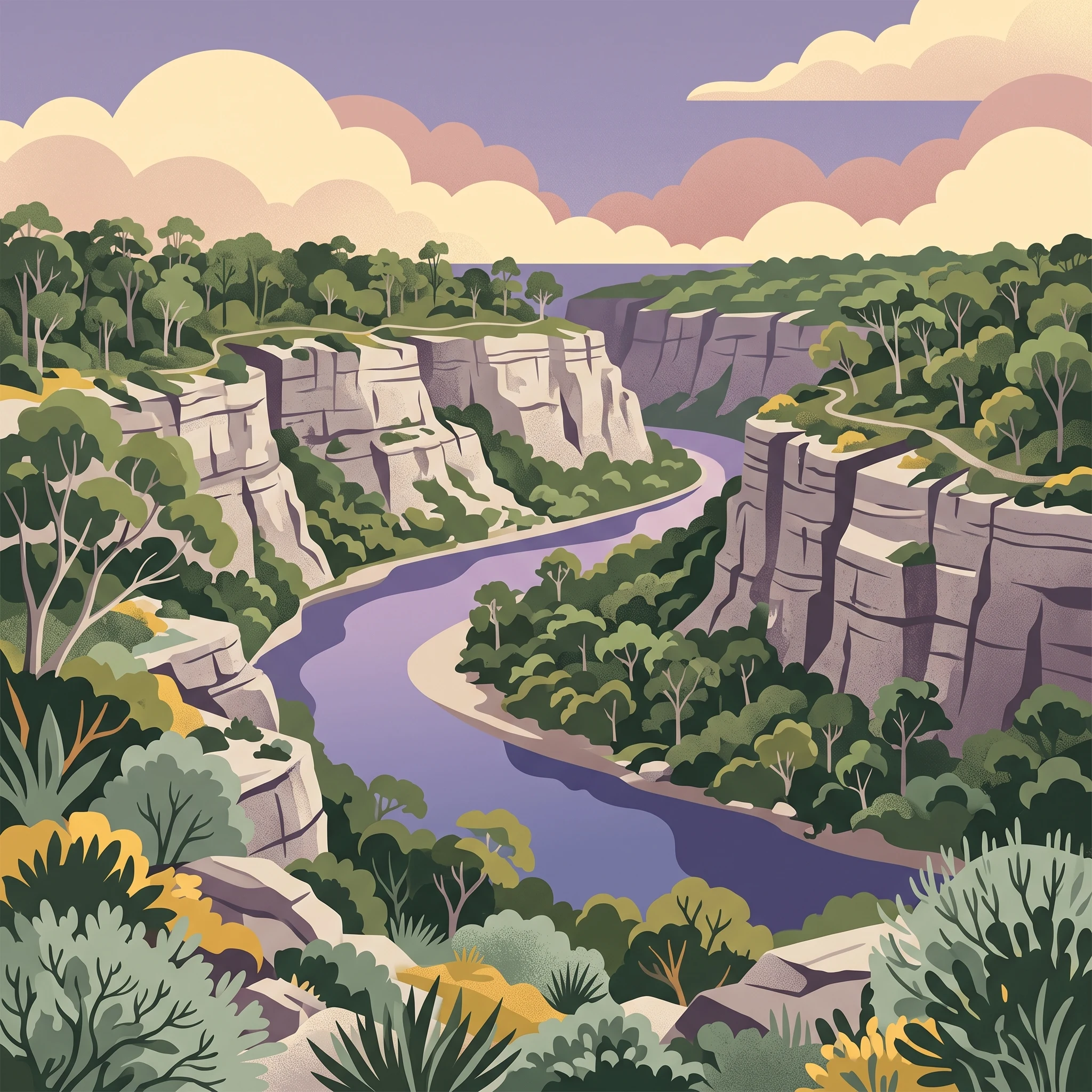
Lower Glenelg National Park is best known for its dramatic river gorge, where the Glenelg River has cut a winding canyon through ancient limestone terrain, creating a landscape of steep cliffs, hidden coves, and scenic lookouts. The park is also renowned for Princess Margaret Rose Cave, a visually impressive limestone cavern that can be accessed via guided tours and displays thousands of years of geological formation in its decorative mineral deposits. The combination of the gorge's dramatic topography, the cave system's accessibility and visual appeal, and the park's location along a major walking trail makes it a distinctive protected area in Victoria's western landscape.

Lower Glenelg National Park history and protected-area timeline

Lower Glenelg National Park was established in 1969 as part of Victoria's expanding national park network during a period of increased environmental consciousness and protected area development. The declaration of the park came after decades of forest clearing and selective logging had occurred in the region, with the establishment providing formal protection for the remaining significant natural landscapes along the Glenelg River gorge. The park's declaration also acknowledged the scientific and scenic value of Princess Margaret Rose Cave, which had been known to local communities and had received some protection prior to the national park designation.

The park's management under Parks Victoria has involved ongoing track development and visitor facility improvements, particularly around the Princess Margaret Rose Cave area where infrastructure was developed to allow safe public access to the underground system. The Great South West Walk, one of Victoria's prominent long-distance hiking routes, was established with significant portions routed through the park, enhancing the region's profile as a destination for bushwalking and nature-based tourism. More recently, the inclusion of the park's coastal wetland components within the Glenelg Estuary and Discovery Bay Ramsar Site in 2018 reflected growing understanding of the international significance of the estuary and coastal marsh environments that connect to the park's southern boundaries.

Lower Glenelg National Park landscape and geographic character

The landscape of Lower Glenelg National Park is defined by the Glenelg River gorge, a dramatic incision through the western Victorian upland terrain. The river follows a winding course, with the gorge walls reaching heights of up to 60 metres in places, exposing horizontal layers of limestone and sandstone that represent different geological periods of sediment deposition. The cliff faces support scattered vegetation including eucalypts and she-oaks that cling to rock ledges, while the valley floor contains riparian woodland dominated by river red gums and wattles that follow the watercourse.

Away from the gorge, the park encompasses gently undulating terrain covered by remnants of the original vegetation, with stringybark eucalypt forests, heathy woodlands, and occasional wetlands providing habitat diversity. The southern parts of the park grade into the coastal wetland system of Discovery Bay, where the river mouth forms an estuary environment with mudflats, saltmarsh, and adjacent sand dunes. This transition from gorge to coastal wetland creates a landscape gradient that supports distinct ecological communities across a relatively short distance. The park's interface with the Southern Ocean is marked by the Discovery Bay Coastal Park, which extends along the coast and provides coastal scenery separate from but connected to the inland gorge landscape.

Lower Glenelg National Park ecosystems, habitats, and plant life

The nature of Lower Glenelg National Park encompasses several distinct habitat types that support biodiversity across the park's elevation gradient from the gorge to the coast. The riparian zone along the Glenelg River contains dense stands of river red gum and swamp gum, providing habitat for arboreal mammals and bird species associated with permanent watercourses. The gorge walls and cliff faces support specialised plant communities adapted to the shaded, moister microclimate of the canyon, including ferns and mosses that are more typical of wetter forests in other parts of Victoria.

The woodland and forest habitats on the surrounding plateau contain species typical of Victoria's drier western forests, includinggrey box, yellow gum, and stringybark eucalypts, with an understorey of grass-trees, wattles, and various shrubs. These habitats support populations of honeyeaters, parrots, and woodland birds, while the tree hollows provide nesting sites for cockatoos and owls. The coastal wetland component, while technically part of a separate Ramsar designation, forms an ecological continuum with the park's southern areas, supporting significant populations of waterbirds including migratory shorebirds that use the estuary as a staging area during their annual movements between the southern hemisphere and Arctic breeding grounds.

Lower Glenelg National Park wildlife and species highlights

Lower Glenelg National Park supports wildlife populations across its range of habitats, with the combination of gorge, woodland, and wetland environments providing resources for diverse species groups. The river and its associated pools provide habitat for fish species including the Australian bass and river blackfish, while the riparian zone supports platypus and water rats that forage along the water's edge. The cliff faces and rock outcrops provide nesting habitat for wedgetailed eagles and other raptors that can be observed soaring above the gorge.

The woodland habitats support populations of mammals including koalas that occur in the eucalypt forests, as well as possums and gliders that use tree hollows for shelter. The reptile community includes several snake species and skinks that occupy both the forest floor and rocky areas, while the cave system provides habitat for bats that roost in the darker chambers. The coastal wetlands and estuary support significant populations of waterbirds including ducks, swans, herons, and migratory shorebirds, with the Ramsar designation reflecting the international importance of these wetland habitats for species that travel along the East Asian-Australasian Flyway.

Lower Glenelg National Park conservation status and protection priorities

The conservation significance of Lower Glenelg National Park is underscored by its Ramsar designation in 2018, which recognised the international importance of the Glenelg Estuary and Discovery Bay wetland system. This designation places obligations on Australia to protect the wetland values and report on their condition through the Ramsar Convention, an international treaty for the conservation of wetlands. The park protects representative examples of the Western District's biodiversity, including species and communities that have been affected by clearing and modification of the broader landscape.

The park's protection of the Glenelg River corridor is significant because the river is one of the few remaining relatively unmodified river systems in Victoria's western region, providing a reference site for understanding pre-colonial riverine ecology. The protection of Princess Margaret Rose Cave ensures the preservation of a significant geological formation and its scientific and educational values. The park also contributes to a larger network of protected areas along the Victoria-South Australia border, with the connection to the Lower Glenelg River Conservation Park and other reserves creating a cross-border conservation corridor that facilitates wildlife movement across the state boundary.

Lower Glenelg National Park cultural meaning and human context

The Lower Glenelg region has been home to Aboriginal people for thousands of years, with the Glenelg River providing resources and travel routes for Indigenous communities. The cave system within the park holds cultural significance, and while the specific traditional associations are not extensively documented in available sources, the presence of the cave in the landscape suggests ongoing connection to the land by local Aboriginal communities. The naming of Princess Margaret Rose Cave reflects historical naming practices rather than Indigenous heritage.

European settlement of the region began in the nineteenth century, with the town of Nelson established near the river mouth as a service centre for the surrounding pastoral district. The development of walking tracks and visitor facilities reflects the park's use for recreation and education purposes over recent decades, with the Great South West Walk representing a more recent phase of cultural engagement with the landscape as a destination for bushwalking and environmental appreciation. The Ramsar designation in 2018 represented an additional layer of recognition that acknowledges the continuing ecological values of the coastal wetlands and their importance for both biodiversity and traditional land management practices.

Top sights and standout views in Lower Glenelg National Park

Lower Glenelg National Park's combination of dramatic gorge scenery, accessible cave exploration, and extensive walking opportunities makes it a distinctive protected area in Victoria's western region. The Glenelg River gorge provides a scenic landscape of steep cliffs and river bends that can be experienced from multiple lookouts and walking tracks throughout the park. Princess Margaret Rose Cave offers a tangible connection to geological processes spanning hundreds of thousands of years, with the cave's formations accessible through guided tours suitable for visitors of varying abilities. The Great South West Walk traverses the park and connects these key features into a longer walking experience, while shorter visitors can access highlights through more compact回路 tracks. The Ramsar designation highlights the wetland values at the park's southern boundary, where the estuary supports internationally significant populations of migratory waterbirds.

Best time to visit Lower Glenelg National Park

The park can be visited throughout the year, though the seasons influence the experience and conditions. Autumn and spring typically offer comfortable temperatures for walking, with mild days and cooler nights suitable for the multi-hour walks that explore the gorge and trail network. These seasons also correspond with bird activity in the woodland areas and the chance to observe migratory waterbirds at the estuary during their respective migration periods. Summer months can bring hotter conditions, particularly on exposed sections of the walking tracks, though the gorge areas often provide shade and the cave maintains a constant temperature year-round. Winter brings quieter visitation and the opportunity to experience the landscape with fewer other visitors, though some tracks may be muddy after rain and the shorter daylight hours limit time available for longer walks. The cave tours operate throughout the year and provide a consistent experience regardless of external weather conditions.
Park location guide

Geography guide, regional context, and park location map for Lower Glenelg National Park

Lower Glenelg National Park park geography, regions, and map view in Australia
Understand where Lower Glenelg National Park sits in Australia through a broader geographic reading of the surrounding landscape, nearby location context, and its mapped position within the national park landscape.

How Lower Glenelg National Park fits into Australia

Australia is a constitutional monarchy and federal parliamentary democracy comprising six states and ten territories. With a population of nearly 28 million, it is one of the world's most urbanised countries, with most people concentrated on the eastern seaboard. The country has a high Human Development Index and is known for its cultural diversity, ancient Aboriginal heritage, and unique wildlife.

Wider geography shaping Lower Glenelg National Park in Australia

Australia occupies the entire Australian continent, the island of Tasmania, and numerous smaller islands. It is the world's flattest and driest inhabited continent, featuring vast deserts in the interior (the Outback), tropical rainforests along the eastern coast, and a coastline bordering the Indian and Pacific Oceans.

Map view of Lower Glenelg National Park

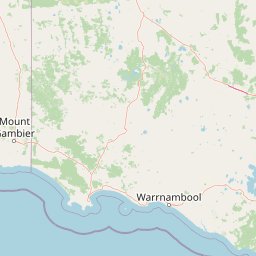
Use this park location map to pinpoint Lower Glenelg National Park in Australia, understand its exact geographic position, and read its mapped placement within the surrounding landscape more clearly.

Pigeon | © OpenStreetMap contributors
Park atlas

Compare the diverse protected landscapes, river systems, and coastal wetlands in the regional context of Lower Glenelg National Park.

National Parks and Protected Areas: Explore Beyond Lower Glenelg National Park
After exploring Lower Glenelg National Park, browse surrounding national parks and protected areas, mapping the regional spread of river ecosystems, limestone terrain, and coastal wetlands in Southwest Victoria. Compare these adjacent conservation landscapes to understand their shared geography and discover unique protected features across the broader border region.
National parkBarwon South West

Cobboboonee National Park: A Protected Landscape in Australia's Barwon South West Region

Explore its mapped geography and natural terrain.

Cobboboonee National Park represents an important protected area within the Barwon South West region of Australia. This destination offers users a deep dive into the park's specific geography, providing context on its mapped boundaries and the surrounding natural landscapes. It is designed for exploration of the park's protected-area identity and its place within the regional geography, offering structured data for landscape context.

Area
185.1 km²
Established
2008
IUCN
II
Climate
Temperate
National park

Mount Richmond National Park: Protected Area Atlas and Southwest Victoria Landscape

Explore mapped terrain and coastal woodland ecosystems.

Mount Richmond National Park is a vital protected area in Victoria's southwest, safeguarding coastal woodland and heath remnants on the region's volcanic plains. As a component of Victoria's national park system, it provides a geographically specific example of a protected landscape, contributing to the regional atlas of natural environments. Its landscape character is defined by eucalyptus woodlands and coastal influences, offering context for understanding conservation corridors and the mapped natural terrain of the southwestern Victorian coast. The park’s inclusion in long-distance walking routes also underscores its value for exploring protected natural areas.

Area
17.33 km²
Established
1960
IUCN
II
Relief
Mixed relief
National park

Discovery Bay Marine National Park: Victoria's Protected Coastal Marine Landscape

Mapped protected waters adjacent to Cape Bridgewater's unique geography.

Discover the geographic scope and protected landscape identity of Discovery Bay Marine National Park, an important marine national park located in Victoria, Australia, near Portland. This protected area safeguards a crucial stretch of the country's southern coastline, contributing to the ecological significance of the Southern Ocean marine region. Its position adjacent to the Discovery Bay Coastal Park highlights an integrated conservation approach, offering users a detailed view of its mapped marine boundaries and the distinctive geological context of the Cape Bridgewater area for atlas exploration.

Area
27.7 km²
Established
2002
IUCN
II
Climate
Temperate
National park

Budj Bim National Park: Ancient Volcanic Landscapes and World Heritage Protected Area

Explore the unique geography of Budj Bim National Park's crater lakes and lava tubes.

Budj Bim National Park offers an exceptional exploration of volcanic geography and ancient human ingenuity. This protected area features a dramatic landscape dominated by volcanic cones, lava tubes, and the picturesque Lake Surprise crater lake. Its significance is amplified by the presence of sophisticated Aboriginal aquaculture systems, developed thousands of years ago by the Gunditjmara people, which have contributed to its UNESCO World Heritage status. Discover the mapped terrain and protected land context of this geologically and culturally rich Australian national park.

Area
54.7 km²
Established
1960
IUCN
II
Relief
Mixed relief
National parkSouth Australia

Canunda National Park: South Australia's Protected Landscape and Geographic Atlas

Explore mapped boundaries and regional natural geography.

Canunda National Park in South Australia is presented here as a distinct protected landscape. This detail page focuses on its geographic setting, providing insights into its mapped boundaries and its role within the regional atlas context. Understand the park's natural geography and its protected status for informed exploration.

Area
96.24 km²
Established
1959
IUCN
VI
Relief
Lowland
National parkSouth Australia

Naracoorte Caves National Park: Detailed Map and Protected Landscape Context in South Australia

Explore its unique protected geography and natural terrain.

Naracoorte Caves National Park represents a vital protected area within the diverse geography of South Australia. This entry provides an atlas-driven perspective, highlighting its identity as a national park, its mapped landscapes, and its regional significance. Engage with structured information detailing the park's protected status and geographic features, offering a clear view of its contribution to South Australia's natural heritage.

Area
6.6 km²
Established
2001
IUCN
II
Visitors
90.8K annual
National park

Grampians National Park National Park: Sandstone Ranges and Aboriginal Heritage Atlas

Explore its mapped protected landscape and regional geography.

Grampians National Park stands as a testament to Victoria's natural and cultural heritage, featuring striking sandstone mountain ranges and an exceptional concentration of Aboriginal rock art sites. This protected area offers a deep dive into the region's unique geology, from its ancient sedimentary rock formations to its dramatic cliff faces and peaks. Understanding the park's mapped boundaries and its place within the broader geography provides essential context for appreciating its protected landscape identity and its millennia-long human history.

Area
1,672.19 km²
Established
1984
IUCN
II
Relief
Mountain
National park

Little Desert National Park: Victoria's Semi-Arid National Park and Protected Landscape

Explore mapped boundaries and unique mallee heathland ecosystems.

Delve into the protected landscape of Little Desert National Park, a significant national park covering over 1,300 square kilometers of Victoria's semi-arid western region. This area is characterized by its deep sandy soils, mallee heathlands, and diverse wildlife, including important populations of native birds. Understanding its geographic setting and mapped boundaries provides crucial insight into Australia's conservation efforts and the preservation of unique desert ecosystems.

Area
1,326.47 km²
Established
1988
IUCN
II
Visitors
50K annual

Common questions about visiting, size, designation, and location context for Lower Glenelg National Park

Lower Glenelg National Park FAQs for park facts, access, geography, and protected area context
Find quick answers about Lower Glenelg National Park, including protected-area facts, park geography, trail and visitor context, and how the park fits into its surrounding country and regional landscape.
MoriAtlas Explorer

Continue Your Protected Areas Search Across the Global Atlas

Deepen your exploration by continuing the structured search for national parks and protected areas worldwide. Utilize the comprehensive filtering capabilities to compare different conservation landscapes and refine your understanding of global park geography. Discover more about the distribution and characteristics of protected natural areas.

Global natural geography