Why Mapesu Private Game Reserve stands out
Mapesu is best known for its exceptional bird diversity against a backdrop of mopane-dominated bushveld in a remote corner of Limpopo, and for functioning as a southern buffer and extension of the Mapungubwe World Heritage Site. The combination of arid western species, tropical Lowveld species, and Limpopo River migrants gives Mapesu a uniquely mixed avifaunal character, while its mopane woodlands and ancient baobabs define its landscape identity. The reserve is also recognized for its role as a private Big Five conservation area adjoining a World Heritage Site, adding cheetah reintroduction and future African wild dog plans to its conservation profile, and embedding the property within a larger transboundary landscape vision for the greater Mapungubwe area.
Mapesu Private Game Reserve history and protected-area timeline
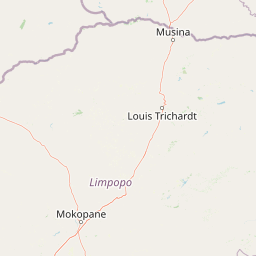
Mapesu Private Game Reserve was established in 2014 as a privately managed conservation area in the Limpopo Province of South Africa. From its inception, the reserve was conceived not as a stand-alone property but as a complement to the adjacent Mapungubwe National Park, sharing a 12.5-kilometre common border along its northern edge.
The reserve has been identified as a future component of the Greater Mapungubwe Transfrontier Conservation Area, intended to form part of the proposed Limpopo Valley Game Reserve in the second phase of that transboundary initiative. This places Mapesu within a longer-term regional strategy that links protected landscapes across the South Africa, Zimbabwe, and Botswana border triangle.
In 2017, the reserve reintroduced cheetah as part of the Endangered Wildlife Trust's cheetah metapopulation project, marking a notable step in its conservation development. Plans have also been announced for the release of African wild dog on the property, extending its role as an active reintroduction site for threatened predators across the wider Limpopo valley landscape.
Mapesu Private Game Reserve landscape and geographic character
The landscape of Mapesu Private Game Reserve is defined by gently undulating to strongly irregular plains typical of the Musina Mopane Bushveld, with open woodland grading into more closed shrubland on the lower, clay-rich bottomlands. Sandy flats support a more open savanna character, while isolated hills and ridges that rise above the plains add topographic variety and lighter, well-drained soils.
A complex network of drainage lines cuts across the property, channeling seasonal runoff from the higher ground toward the Limpopo River system and breaking the broader mopane woodland into a patchwork of microhabitats. This subtle topography produces remarkable vegetation diversity despite an outwardly homogeneous appearance, with thirteen distinct plant communities identified across the reserve.
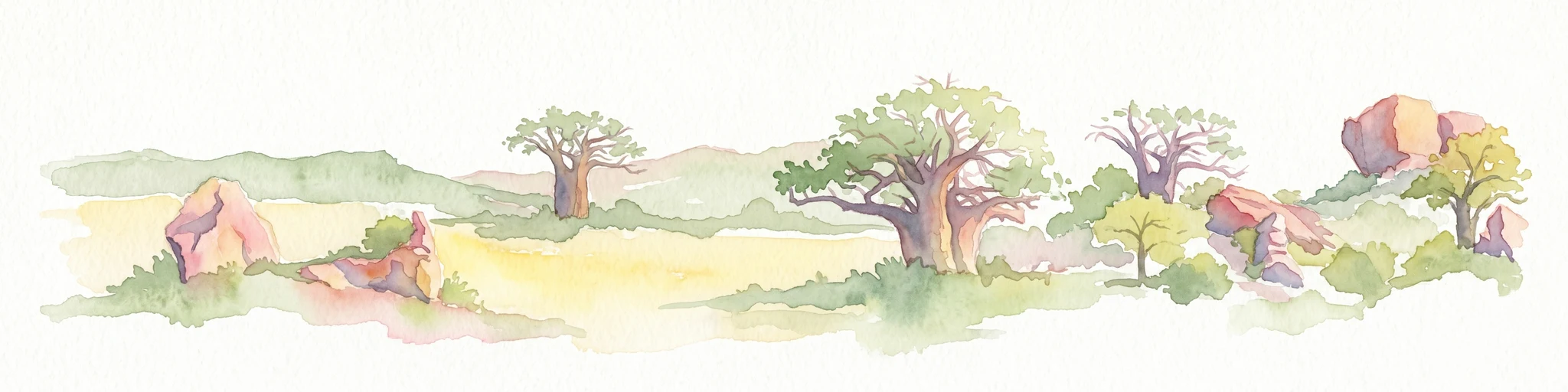
The most visually arresting landscape feature is the presence of very large baobabs scattered through the savanna, including a specimen with approximately fifteen metres of trunk circumference. Mature mopane woodland, riverine fringes, and rocky outcrops together shape a classic, gently varied African bushveld scene that frames the reserve's ecological identity.
Mapesu Private Game Reserve ecosystems, habitats, and plant life
Mapesu lies within the Savanna bioregion and more specifically the Musina Mopane Bushveld vegetation type, an ecosystem dominated by Colophospermum mopane on the heavier clay soils and Combretum apiculatum on the elevated hills. Deeper sandy soils support more open savanna forms of the same mopane community, while a system of drainage lines and seasonal watercourses introduces additional riparian and wetland habitats into the reserve.
The mosaic of soil types and topographic positions produces thirteen discrete vegetation communities within a relatively compact area, combining open mopane woodland, denser shrubland, riverine fringes, sandy savanna, and rocky hill vegetation. Among the supporting tree species are vlei thorn, three hook thorn, num num, purple cluster leaf, fever trees, camel thorn, sweet thorn, shepherd's tree, illala palm, apple leaf, and lead wood, alongside the occasional giant baobab.
This habitat diversity is the ecological engine of the reserve, supporting an unusually rich mammal and bird fauna for an area of its size. The blend of dry western vegetation patterns, moister Lowveld elements, and riverine influences gives Mapesu an ecological profile that bridges otherwise distinct regional biomes.
Mapesu Private Game Reserve wildlife and species highlights
Mapesu Private Game Reserve is a Big Five game reserve, with elephant, Cape buffalo, leopard, white rhino, and lion present on the property and regularly seen on guided game drives. Beyond the Big Five, the reserve supports blue wildebeest, zebra, waterbuck, bushbuck, impala, eland, kudu, steenbok, duiker, klipspringer, oryx, giraffe, bush pig, warthog, vervet monkey, baboon, porcupine, civet, serval, caracal, honey badger, aardvark, spotted hyena, brown hyena, and African leopard.
In 2017, cheetah were introduced to Mapesu under the Endangered Wildlife Trust's cheetah metapopulation initiative, and the release of African wild dog has also been planned, positioning the reserve as an active reintroduction site for two of Africa's most threatened large carnivores.
The reserve's avifauna is exceptionally diverse, with more than 380 species recorded on the property and over 430 known in the surrounding region. African hawk-eagle density is notably high in the undulating landscape, while summer brings an influx of up to eleven cuckoo species, including the Diederic cuckoo and Jacobin cuckoo. Dry western species such as southern pied babbler, crimson-breasted shrike, and black-faced waxbill occur alongside tropical Lowveld birds like yellow-bellied greenbul, Meve's starling, black-backed puffback, and tropical boubou. Owls including barn owl, African scops, white-faced scops, Verreaux's eagle-owl, pearl-spotted owlet, and the rare Pel's fishing owl are resident, and a reserve dam attracts little bittern, knob-billed duck, black stork, woolly-necked stork, Egyptian geese, white-faced whistling duck, and Malachite kingfisher. The Limpopo River boundary channels a remarkable influx of intra-African migrants between October and March.
Reptile life includes black mamba, puff adder, night adder, side-striped sand snake, spotted bush snake, African python, Mozambique spitting cobra, snouted cobra, boomslang, and horned adder, alongside rock and water monitor lizards, giant plated lizard, rainbow skink, ground agama, and speckled thick-toed gecko.
Mapesu Private Game Reserve conservation status and protection priorities
Mapesu Private Game Reserve was conceived as a conservation-focused extension of the protected landscape around Mapungubwe National Park, with the explicit goal of bolstering the ecological value of the UNESCO-listed Mapungubwe World Heritage Site and surrounding area. Its long shared boundary with Mapungubwe creates a continuous protected zone across land-use types, and its planned inclusion in the second phase of the Greater Mapungubwe Transfrontier Conservation Area situates the reserve within a broader transboundary conservation strategy for the South Africa, Zimbabwe, and Botswana tri-border region.
The reserve's conservation significance also lies in its biodiversity value. A single property of roughly 12,500 hectares supports thirteen vegetation communities, more than 380 bird species, a full Big Five mammal assemblage, and viable populations of cheetah with planned additions of African wild dog. The reintroduction of cheetah in 2017 through the Endangered Wildlife Trust's metapopulation framework connects Mapesu directly to one of the most important species-based conservation networks in southern Africa.
By protecting mopane bushveld habitat and riparian corridors linked to the Limpopo River system, the reserve also contributes to the maintenance of ecological connectivity in a part of South Africa where agricultural pressure and infrastructure development have historically fragmented landscapes. Its management model combines private wildlife economy with formal protected-area outcomes, helping to extend the conservation footprint beyond state-run reserves.
Mapesu Private Game Reserve cultural meaning and human context
Mapesu Private Game Reserve lies in the broader cultural landscape of the Mapungubwe area, which is internationally recognized for the Iron Age civilization centered on Mapungubwe Hill and the associated World Heritage Site. While the reserve itself is a relatively young private property, its geographic placement places it within a region of deep historical significance, where communities along the Limpopo valley developed complex societies more than a thousand years ago.
The reserve also operates within the contemporary cultural and economic context of Musina and the surrounding Limpopo valley, a region where conservation, livestock farming, and cross-border communities intersect. Its development as a private Big Five reserve reflects the modern South African model of converting agricultural land into wildlife-based conservation areas, blending rural land use transformation with the safeguarding of natural heritage.
Top sights and standout views in Mapesu Private Game Reserve
Among Mapesu's most distinctive qualities is the extraordinary bird richness packed into a relatively compact mopane landscape, with more than 380 recorded species enriched by Limpopo River migrants and dry-country endemics. The reserve's thirteen vegetation communities and the rare blend of arid western and tropical eastern elements create a habitat mosaic that supports both big game and unusual birdlife in the same view.
Equally distinctive is the reserve's role as a southern neighbour to Mapungubwe National Park, extending the protected footprint of a World Heritage Site and laying the groundwork for inclusion in a future transfrontier conservation area. Add to this its Big Five mammal presence, its growing cheetah population from the Endangered Wildlife Trust metapopulation initiative, and its ancient giant baobabs, and Mapesu emerges as a young but ecologically rich reserve at the cross-border heart of southern Africa.
Best time to visit Mapesu Private Game Reserve
The character of a visit to Mapesu shifts with the seasons in ways typical of the Limpopo valley bushveld. The dry winter months from May through August offer clearer skies, easier game viewing around permanent water sources, and cooler temperatures that make extended game drives more comfortable. Vegetation is at its thinnest during this period, improving the chances of spotting predators and other mammals.
The summer months from October to March bring the southern African wet season and a dramatic transformation of the bird life in particular. This is the period of peak migrant activity, including the influx of Limpopo River migrants and the wave of summer cuckoo species that makes the reserve famous among birders. Lush green bushveld and occasional dramatic thunderstorms define this season, though heat and humidity can be intense during the middle of the day.