Why Quttinirpaaq National Park stands out
Quttinirpaaq is best known for its position as one of Earth's northernmost terrestrial protected areas, its extensive glacial systems covering much of the highlands, and the stark polar desert landscape that defines the high Arctic environment. The park protects Barbeau Peak, Nunavut's highest summit, and the Lake Hazen region, which despite the surrounding extreme conditions maintains a relatively milder microclimate supporting greater biodiversity. The park's extreme isolation, with only about 50 annual visitors, offers a wilderness experience unmatched in North America. The dramatic seasonal light cycles, with continuous daylight from May through August and complete darkness from November to February, define the visitor experience and shape all ecological processes within the park.
Quttinirpaaq National Park history and protected-area timeline
Quttinirpaaq National Park emerged from Canada's broader initiatives to establish comprehensive national park coverage across its northern territories. The area was designated as Ellesmere Island National Park Reserve in 1988, initially under the national parks system while Nunavut was still being negotiated. When Nunavut was created as a territory in 1999, the park was renamed Quttinirpaaq to reflect its Inuktitut identity and was formally established as a national park in 2000. The park's remote location on Ellesmere Island meant that significant human presence was never characteristic of the region, though archaeological evidence indicates that Inuit peoples utilized the Tanquary Fiord to Lake Hazen corridor for approximately 5,000 years. Pre-Dorset, Dorset, and Thule cultures all left traces of their presence through tent rings and food caches. The eastern and northern coasts of Ellesmere Island served as staging grounds for numerous historic Arctic expeditions. Fort Conger, established as an early research base for Arctic exploration, remains preserved as a Federal Heritage Building. The park was honored with a Canada Post postage stamp in 2019 as part of a definitive stamp series, recognizing its cultural significance within the Canadian national parks system.
Quttinirpaaq National Park landscape and geographic character
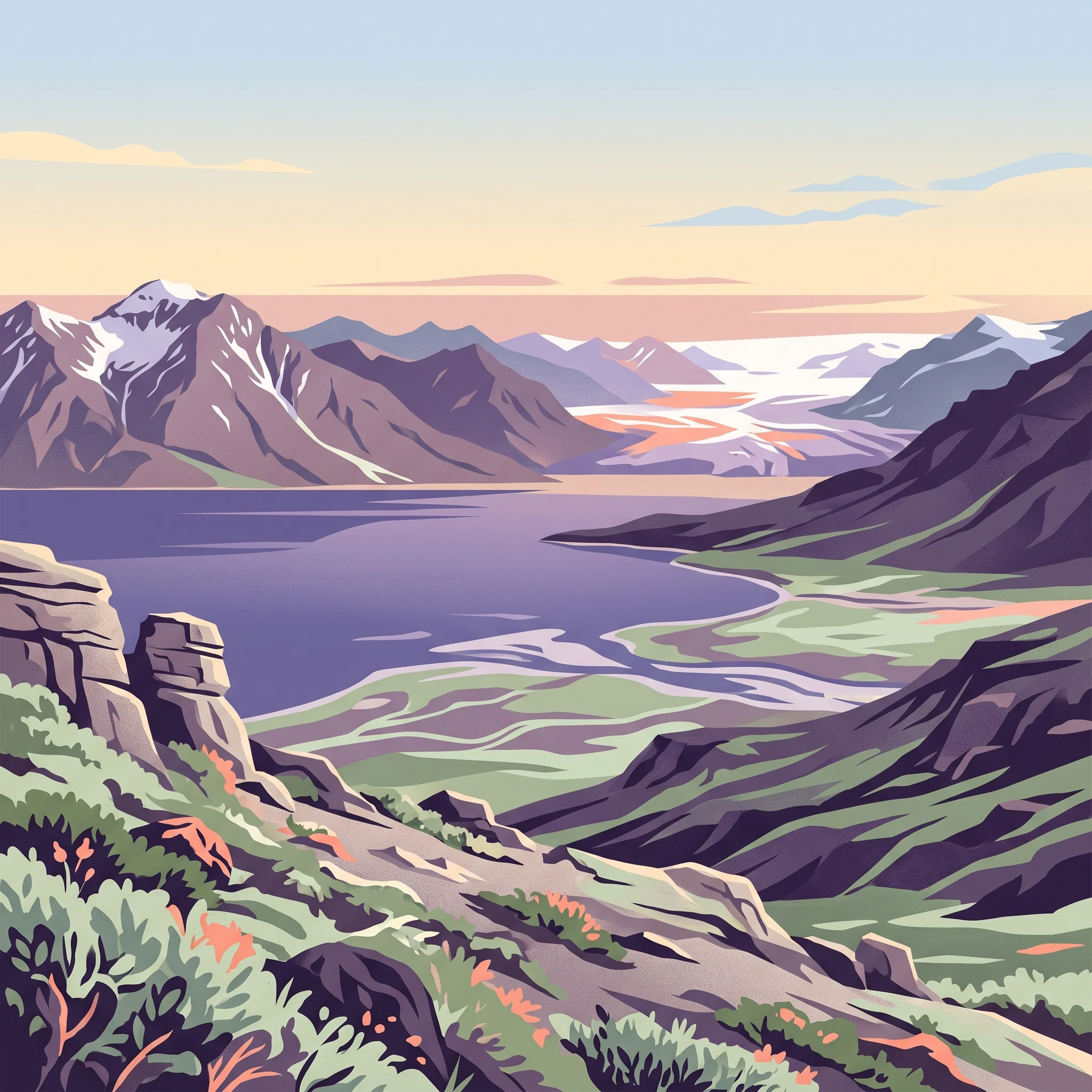
The landscape of Quttinirpaaq National Park is dominated by ice and rock, creating one of Earth's most dramatic polar environments. The highlands are covered by extensive ice caps that represent some of the oldest glacial ice in the Northern Hemisphere, dating back to at least the last Wisconsin glaciation. From these ice caps, glaciers descend into valleys and toward the coastline, sculpting the terrain into dramatic alpine scenery. The Arctic Cordillera runs through the park, with Barbeau Peak at 2,616 meters standing as the highest mountain in Nunavut. The park sits within the polar desert zone, receiving very little annual precipitation despite the abundance of ice. The terrain varies from ice-covered plateaus to exposed rock ridges, from glacial valleys to coastal areas along the Arctic Ocean. Lake Hazen, one of the park's notable features, occupies a basin surrounded by ice-capped mountains, creating a distinctive landscape element within this otherwise uniformly frozen terrain. The contrast between the white expanse of ice and the dark exposed rock creates a visually stark environment characteristic of the high Arctic.
Quttinirpaaq National Park ecosystems, habitats, and plant life
The ecological character of Quttinirpaaq reflects the extreme constraints of the high Arctic environment. The polar desert conditions, with minimal precipitation and extremely low temperatures, limit the potential for lush vegetation or diverse wildlife populations. Plant life is concentrated primarily in the Lake Hazen region, where the relatively milder microclimate supports more abundant growth. Dwarf willows, Arctic willow, and Arctic cotton represent the limited arborescent vegetation, with grasses and lichens occupying the more exposed terrain. The sparse vegetation supports only small populations of herbivores, which in turn sustain a modest predator community. The Arctic ecosystem here operates on fundamental simplicity, with food chains that are short and populations that fluctuate dramatically with seasonal conditions. The marine environment along the coast supports greater biological productivity, with seals, walruses, and polar bears maintaining connections to the rich Arctic Ocean food web. This is an ecosystem where life persists at the absolute margin of biological possibility.
Quttinirpaaq National Park wildlife and species highlights
Wildlife in Quttinirpaaq National Park is adapted to survive in one of Earth's harshest environments. Arctic hares and lemmings represent the primary small mammals, their populations fluctuating in response to vegetation availability and predator pressure. Muskoxen roam the terrain in small groups, their thick coats providing insulation against the extreme cold. Arctic wolves hunt these herbivores across the frozen landscape. A very small population of Peary caribou persists in the park, representing one of the most northerly caribou populations in Canada. The coastal areas support ringed seals and bearded seals, while walruses aggregate along the shore. Polar bears traverse the sea ice, hunting seals and occasionally venturing onto land. Narwhals appear in the surrounding waters during certain seasons. Birdlife during the summer months includes semipalmated plovers, red knots, gyrfalcons, and long-tailed jaegers that nest in the brief Arctic summer. The Lake Hazen region supports the greatest concentration of wildlife, its relatively warmer conditions allowing for more abundant food resources.
Quttinirpaaq National Park conservation status and protection priorities
Quttinirpaaq National Park serves as a critical protected area for Canada's Arctic wilderness and represents one of the most significant polar conservation areas in North America. The park preserves a complete high Arctic ecosystem including ice caps, glacial systems, polar desert, and the diverse habitats these create. Conservation of this landscape protects geological features of great scientific interest, including the ancient glacial ice that records past climate conditions. The wildlife populations, though small, include species of conservation concern such as the Peary caribou, whose extremely limited range makes it vulnerable to environmental changes. The park's inclusion on Canada's tentative World Heritage Site list in 2004 reflects international recognition of its outstanding universal value. The extreme isolation of the park has provided a degree of protection from human disturbance that is increasingly rare in the modern world. Climate change poses significant challenges to this polar ecosystem, with warming temperatures potentially disrupting the delicate ecological balance that characterizes this environment.
Quttinirpaaq National Park cultural meaning and human context
The human history of Quttinirpaaq spans thousands of years of Inuit presence in this extreme environment. The corridor from Tanquary Fiord through to Lake Hazen has been utilized by Arctic peoples for approximately 5,000 years, with archaeological evidence of Pre-Dorset, Dorset, and Thule cultures. These ancestors of modern Inuit left tangible evidence of their presence through tent rings and food caches, demonstrating seasonal utilization of this challenging landscape. The name Quttinirpaaq itself reflects the deep Inuit connection to this northernmost land. The eastern and northern coasts of Ellesmere Island hold significance in the history of polar exploration, serving as departure points for expeditions into the unknown Arctic. Fort Conger stands as a tangible link to this exploratory heritage, now preserved as a Federal Heritage Building. The park represents a place where indigenous knowledge and Arctic exploration history converge on a landscape that has shaped human resilience and adaptation.
Top sights and standout views in Quttinirpaaq National Park
Quttinirpaaq National Park offers unparalleled Arctic wilderness experience for the very few who venture to its remote location. The park encompasses Barbeau Peak, Nunavut's highest mountain at 2,616 meters, providing challenging mountaineering objectives within the Arctic Cordillera. The Lake Hazen region offers the most biologically productive area, with relatively warmer conditions supporting greater wildlife concentration. The dramatic light cycles of the midnight sun and polar night create entirely different park experiences depending on season. Backcountry routes, including the approximately 100-kilometer trail between Lake Hazen and Tanquary Fiord and loops around the Ad Astra and Viking ice caps, offer wilderness trekking opportunities among the most remote in North America. The park's status as one of Earth's northernmost protected areas makes it a destination for those seeking true polar wilderness solitude.
Best time to visit Quttinirpaaq National Park
The optimal visiting window for Quttinirpaaq National Park occurs during the summer months of May through August, when the midnight sun provides 24 hours of continuous daylight, allowing extended exploration of the landscape. Summer temperatures remain cool, often resembling winter conditions in more temperate regions, but this is the warmest period available. Visitors should be prepared for variable conditions and the possibility of snow at any time. The park is effectively inaccessible from November through February, when polar night brings complete darkness and temperatures drop to extreme lows. The transition seasons of March through April and September through October offer intermediate conditions but present greater logistical challenges. Those seeking to experience the full character of the high Arctic should plan for July or August visits when wildlife viewing opportunities are maximized and the landscape is most accessible.