
Why Steinbruch Holzmühle stands out
Steinbruch Holzmühle is best known for its geological exposure of Upper Jurassic limestone, particularly the Kimmeridgian strata and the fossil-rich Korallenoolith formation visible in the steep quarry wall. It is equally valued as one of a handful of small Lower Saxon reserves where a former industrial quarry has been intentionally rewilded to provide breeding pools and shelter for endangered amphibian species. The combination of accessible rock-face science and managed habitat restoration is what sets the reserve apart from purely forested or aquatic protected areas in the Region Hannover network.
Steinbruch Holzmühle history and protected-area timeline
The Steinbruch Holzmühle reserve has its origins in industrial activity rather than in conservation planning. For much of the nineteenth and twentieth centuries, the site operated as a small limestone quarry, exploiting the Jurassic carbonate rocks of the western Osterwald for local construction and agricultural needs.
As quarrying wound down, the exposed rock face and disturbed quarry floor transitioned from a working industrial site into a landscape of unexpected scientific and ecological interest. By the early 1980s, regional conservation planners recognized both the geo-scientific importance of the exposed Kimmeridgian strata and the opportunity the abandoned workings offered for amphibian habitat creation.
On 24 December 1985, the area was officially designated a Naturschutzgebiet under the identifier NSG HA 090, anchoring it within Germany's formal nature-protection framework. Since that designation, responsibility for the site has rested with the Region Hannover as the lower nature conservation authority, with technical oversight provided by the Lower Saxony State Office for Water Management, Coastal Defense and Nature Conservation (NLWKN).
Steinbruch Holzmühle landscape and geographic character
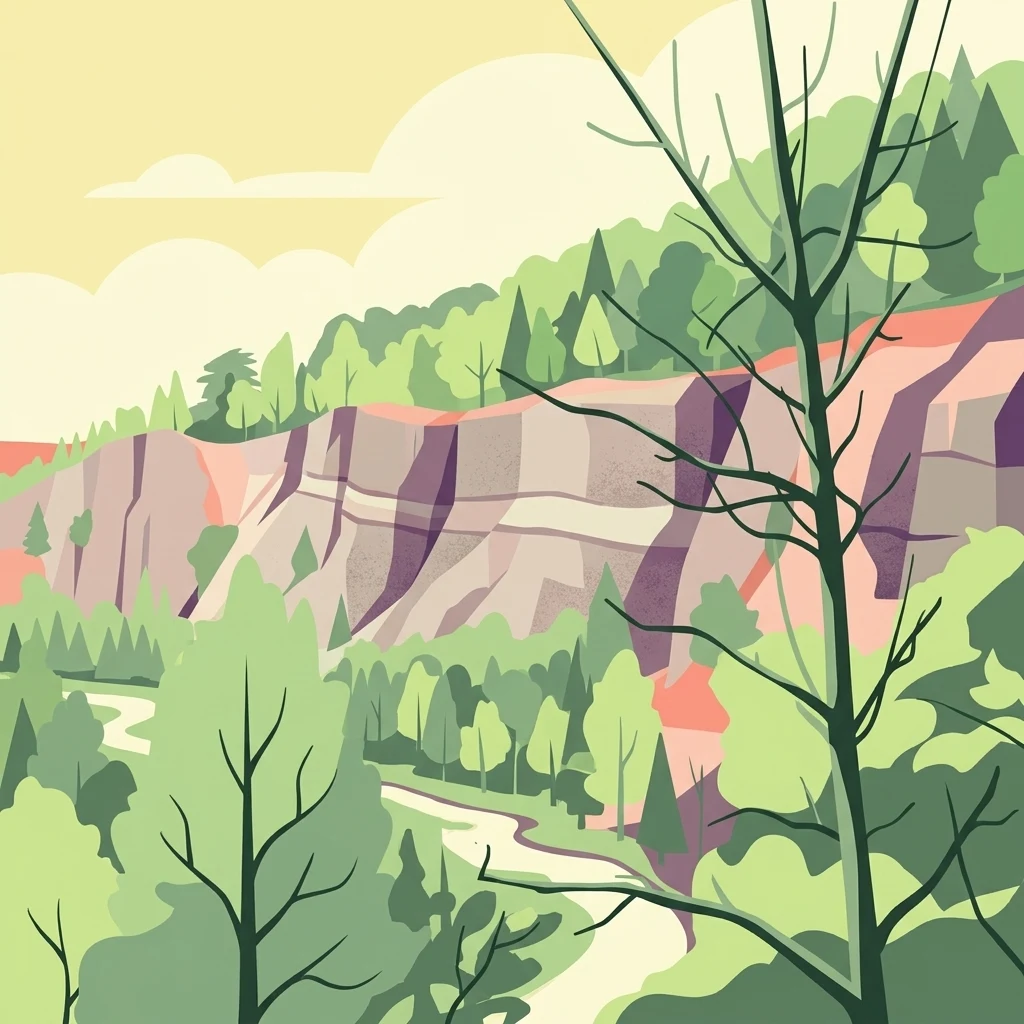
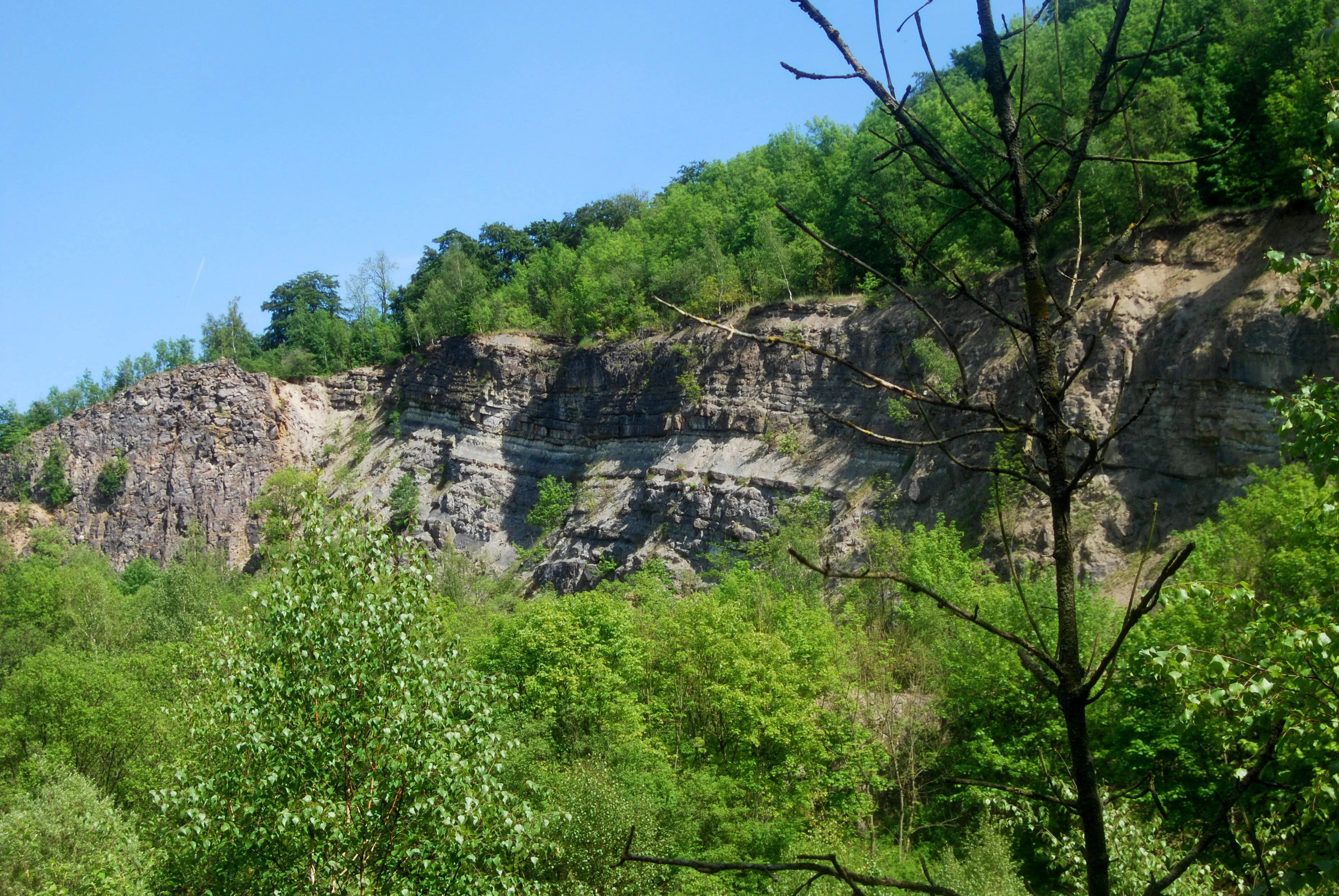
The landscape of Steinbruch Holzmühle is defined by contrast on a very compact scale. The southern boundary rises as a steep quarry cliff, cut directly into the Jurassic limestone bedrock and showing the visible layers of the Kimmeridgian and the Korallenoolith formation. This abrupt artificial cliff interrupts the otherwise gentle forested slopes of the western Osterwald and gives the reserve its characteristic terrain.
At the foot of the wall, the former quarry floor is a mosaic of loose rock, scree, and angular limestone blocks. These rough surfaces, together with the rubble banks added for habitat management, create a stony micro-relief that looks almost lunar against the surrounding deciduous forest. Artificial pools enclosed by low earth banks occupy depressions within this stony ground, forming small temporary water bodies that fill and evaporate with the seasons.
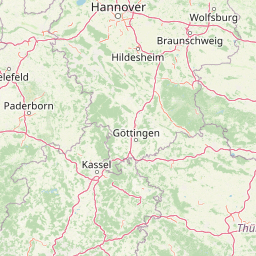
Just beyond the reserve's borders, the landscape settles back into the wooded ridges and valleys of the Osterwald, while the neighboring Saupark extends a much larger continuous forest park landscape to the east. The combination of sharp quarry topography and enclosing hill forest defines the visual character of the Steinbruch Holzmühle.
Steinbruch Holzmühle ecosystems, habitats, and plant life
Although only nine hectares in area, Steinbruch Holzmühle concentrates several distinct habitat types within a single footprint. The open rock face and scree create xeric, sun-exposed conditions very different from the shaded forest around it, favouring drought-tolerant plants, lichens, and invertebrates adapted to bare rock. The temporary pools, by contrast, host a dynamic annual cycle of flooding and drying that supports amphibians and aquatic invertebrates needing fish-free breeding waters.
Transitional zones along the quarry floor and the artificial earth banks blur the boundary between these extremes, producing a rich patchwork of bare mineral substrate, sparse vegetation, mossy rubble, and shallow water. The surrounding Osterwald forest further enriches the reserve by providing connective habitat and dispersal corridors for woodland species moving into and out of the protected area.
As a Category IV Habitat/Species Management Area, the reserve is managed less for wilderness and more for the persistence of these specific habitat mosaics, with active measures, including the maintenance of protective earth banks around the pools, designed to keep the site suitable for the species that defined its designation.
Steinbruch Holzmühle wildlife and species highlights
The wildlife profile of Steinbruch Holzmühle is dominated by amphibian species that depend on the reserve's unusual combination of safe temporary pools and sheltered rocky terrain. The artificial ponds, ringed by earth banks to keep out disturbance and predators, are actively maintained as breeding habitat. Beyond amphibians, the scree slopes and stone-rich margins host reptiles and a variety of invertebrates that thrive on warm, exposed mineral ground.
Because of the reserve's small size and tight adjacency to the Saupark, the area also benefits from the larger forest mammal and bird community moving through the Osterwald, though the quarry itself tends to be quieter, more open-country habitat than the dense woodland surrounding it. The deliberate management of the reserve keeps the balance tilted toward species that genuinely require disturbed, rocky, or temporary-water environments rather than generalist forest wildlife.
Steinbruch Holzmühle conservation status and protection priorities
Steinbruch Holzmühle's principal conservation significance lies in its dual role as a geological reference site and a managed biodiversity refuge. The exposed Kimmeridgian rock profile and the Korallenoolith formation give the reserve lasting value for stratigraphy, paleontology, and earth-science education, marking it as one of few places in the Region Hannover where Jurassic marine deposits are openly accessible for study.
At the same time, the protected area demonstrates the value of post-industrial land in conservation. By transforming a former quarry into a deliberately managed mosaic of scree, stone-block fields, and engineered amphibian pools, the reserve contributes to species protection in a region where natural rocky wetlands have largely disappeared.
Since 1985, the reserve's status as an IUCN Category IV Habitat/Species Management Area has given it formal standing within Lower Saxony's protected-area network, ensuring ongoing active management by the Region Hannover and the NLWKN rather than passive protection alone.
Top sights and standout views in Steinbruch Holzmühle
Among the most distinctive features of Steinbruch Holzmühle is its combination of an exposed Late Jurassic rock profile and active amphibian habitat management in a single compact site. Visitors and researchers value the visible Kimmeridgian and Korallenoolith strata along the southern quarry wall, while conservation managers emphasize the engineered earth banks and temporary pools that protect vulnerable amphibian populations.
The reserve's location, tucked into the western Osterwald immediately beside Saupark Springe, makes it a small but specialized component of a much larger forested protected landscape in the Region Hannover.
Best time to visit Steinbruch Holzmühle
Late spring and early summer are generally the most rewarding window for visiting Steinbruch Holzmühle in ecological terms, when the temporary pools are likely to hold water and amphibian activity peaks, and the quarry wall is most accessible for observing the exposed rock profile in clear, snow-free conditions. Late summer exposes the dry-weather character of the scree and stone-block habitats, while autumn brings the broader Osterwald forest around the reserve into color. Winters can be cold, with the quarry face occasionally holding snow and ice that highlights its geology, but should be approached with awareness of unstable ground after thaw.