
Why Altındere Valley National Park stands out
Altındere Valley National Park is best known for the Sümela Monastery, one of the most extraordinary religious monuments in Turkey and the entire Eastern Mediterranean. The monastery is perched on an almost vertical cliff face at such a height that it appears to rise above the clouds themselves. Built in 386 AD during the reign of Roman Emperor Theodosius I, it later flourished during the era of the Empire of Trebizond, reaching its architectural peak under Emperor Alexius III Komnenos in the 14th century, whose coronation ceremony was held at the site in 1349. The monastery complex encompasses multiple churches, chapels, a library, and residential quarters carved into and built upon the cliff face, creating a spiritual and architectural achievement of extraordinary distinction.
Altındere Valley National Park history and protected-area timeline
The history of Altındere Valley National Park is inseparable from the story of the Sümela Monastery, which forms the cultural heart of the protected area. The monastery was founded in 386 AD during the reign of Roman Emperor Theodosius I, when two Athenian monks, Barnabas and Sophronios, are said to have established a sacred site dedicated to the Virgin Mary in the cliff caves above the valley. The monastery flourished throughout the Byzantine period, gaining in importance and architectural complexity over the centuries. During the era of the Empire of Trebizond (1204-1461), the monastery reached its zenith of grandeur and influence. The most magnificent construction phase occurred during the reign of Emperor Alexius III Komnenos (1349-1390), who elevated the monastery's position and established it as a major spiritual center—this emperor's coronation ceremony was conducted at Sümela in 1349. The monastery continued to function through the Ottoman period and into modern times, though it experienced periods of decline and abandonment. Today, the surviving complex represents a composite of construction from different eras, with the dramatic cliff-side location and the surrounding valley earning the area national park protection in 1987 as a means of preserving both the cultural monument and its extraordinary setting.
Altındere Valley National Park landscape and geographic character
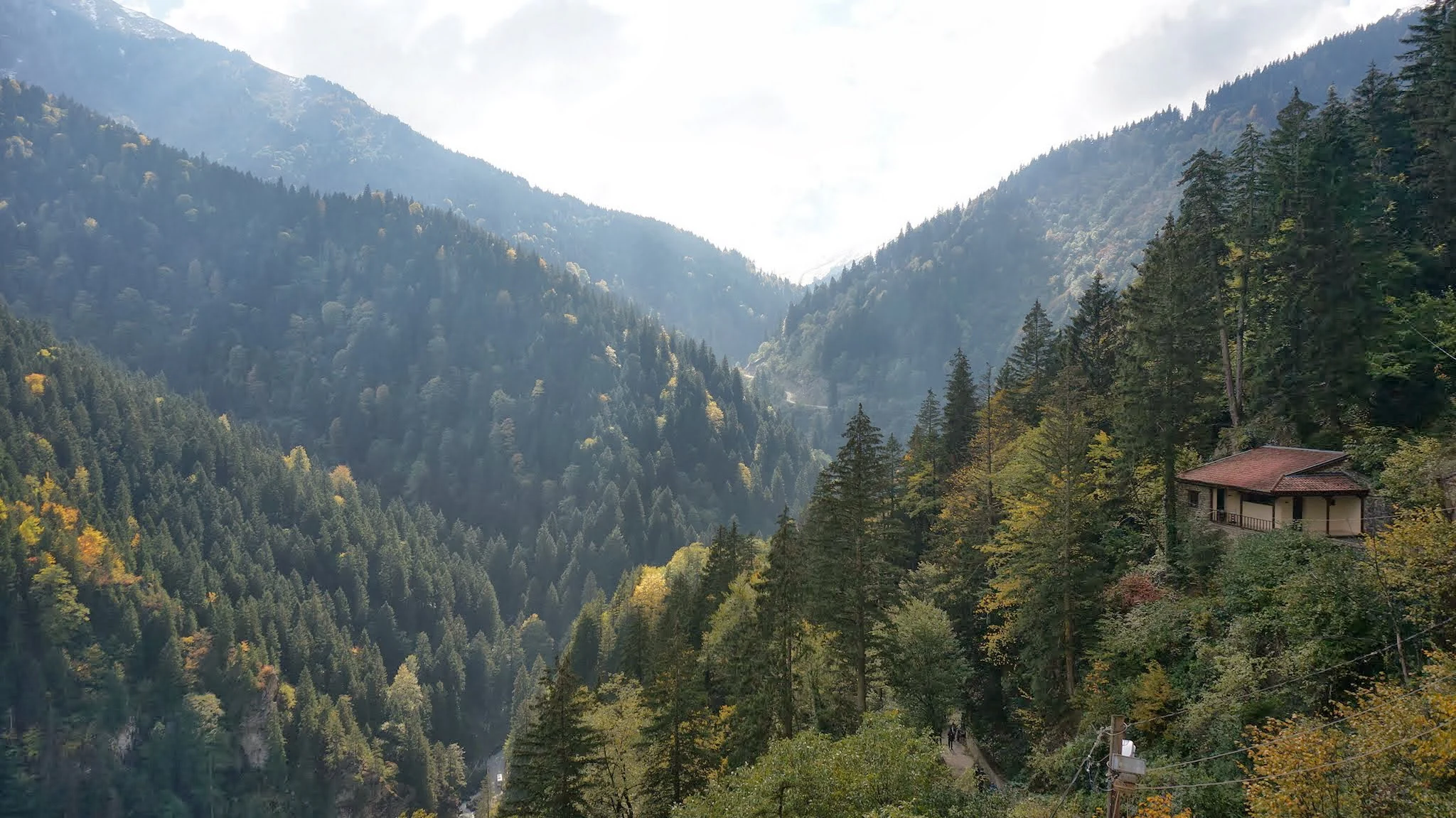
The landscape of Altındere Valley National Park is defined by the rugged topography of the Pontic Mountains rising from the Black Sea coast. The Altındere River has carved a deep, steep-sided valley through the mountain terrain, creating the dramatic gorge that forms the park's central geography. The valley walls rise sharply from the water's edge, with the Sümela Monastery clinging to a cliff face approximately 270 meters above the valley floor—an elevation that places the monastery above the valley's typical cloud layer, contributing to its ethereal appearance. The surrounding slopes are covered in dense montane vegetation typical of the Black Sea region's maritime climate, with forests covering much of the terrain. Rocky cliff faces, waterfalls, and narrow gorges characterize the valley's more dramatic sections, while broader areas of forest and meadow occur on more gentle terrain. The overall impression is one of dramatic verticality and natural beauty, where the monastery's construction on the cliff face appears to be an extension of the landscape itself rather than an imposition upon it.
Altındere Valley National Park ecosystems, habitats, and plant life
The natural environment of Altındere Valley National Park reflects the extraordinary ecological diversity of the Pontic Mountain range in northeastern Turkey. The Black Sea region's climate creates conditions of high humidity and significant precipitation, supporting lush forest growth across the mountain slopes. The park encompasses montane forest ecosystems that transition from lower broadleaf forests through mixed forest zones to higher elevation vegetation. These forests support significant biodiversity, including species characteristic of the region's unique flora and fauna. The steep terrain and varied elevations create multiple habitat types within the park boundaries, from river valley floor to cliff face and ridge top. The protection granted by national park status helps preserve these ecological communities and the watershed functions the area provides, ensuring the maintenance of both the natural systems and the spectacular landscape setting that makes the monastery location so distinctive.
Altındere Valley National Park wildlife and species highlights
The wildlife of Altındere Valley National Park is characteristic of the montane forest ecosystems of the Pontic Mountains in northeastern Turkey. The dense forests covering the valley slopes provide habitat for a variety of bird species and mammal species adapted to this mountainous environment. The region's position at the crossroads of different climatic and ecological zones contributes to species diversity, with both European and Asian species represented in the local fauna. While specific species documentation would require detailed wildlife surveys, the protected forest environments support populations of common forest-dwelling species including various songbirds, raptors, and small mammals. The rocky cliff faces and forest edges create diverse microhabitats that support additional species. The national park designation helps ensure these wildlife populations and their habitats are maintained within the broader conservation framework protecting this region's natural heritage.
Altındere Valley National Park conservation status and protection priorities
Altındere Valley National Park represents an important conservation designation that protects both cultural heritage and natural ecosystems within a single protected area. The national park status, established in 1987, provides legal protection for the Sümela Monastery complex and its dramatic setting, ensuring that development pressures and inappropriate uses do not degrade this significant cultural and visual landscape. Simultaneously, the protection encompasses the montane forest ecosystems of the Altındere valley, preserving the watershed, forest communities, and associated wildlife within a formal conservation framework. The park is managed by Turkey's Ministry of Forest and Water Management, which oversees protection, visitor management, and resource stewardship activities. This dual focus—on cultural monument preservation and natural ecosystem protection—makes the park an example of integrated conservation that recognizes both the built heritage and the natural environment as essential components of the area's outstanding universal value.
Altındere Valley National Park cultural meaning and human context
The cultural significance of Altındere Valley National Park extends far beyond the physical monument of the Sümela Monastery to encompass the broader historical relationship between the Black Sea region's peoples and its mountainous landscape. The monastery represents a continuity of religious use spanning over 1,600 years, from its founding in the late Roman period through the Byzantine Empire, the Empire of Trebizond, and into the modern era. The site's selection for the monastery's location—on a seemingly inaccessible cliff face—reflects the tradition of establishing sacred spaces in dramatic natural settings that emphasize spiritual transcendence. The complex includes not only the famous cliff-side churches and chapels but also supporting structures including a library, kitchen, and residential quarters, representing a complete monastic community. The 14th-century period under Emperor Alexius III represents the most significant phase of development, with the emperor's coronation at the site demonstrating its importance as a spiritual and political center. The monastery also holds significance as a pilgrimage destination, with the tradition of holy pilgrimage continuing among visitors to this day.
Top sights and standout views in Altındere Valley National Park
The Sümela Monastery is the overwhelming highlight of Altındere Valley National Park, with its position on a 270-meter cliff face creating one of the most dramatic religious sites in the world. The monastery complex encompasses multiple churches and chapels, including the main church and the dedicated Aya Varvara church accessible via mountain paths. The setting—appearing to float above the valley and often above the clouds—creates an unforgettable visual experience that has made the site one of Turkey's most photographed locations. The surrounding valley offers additional natural beauty, with the forested slopes, river gorge, and mountain backdrop providing context for the monumental structure. The combination of natural setting, historical depth spanning sixteen centuries, and architectural achievement makes this one of Turkey's most significant protected cultural landscapes.
Best time to visit Altındere Valley National Park
The best time to visit Altındere Valley National Park depends on what visitors hope to experience, though certain seasonal considerations apply. The Black Sea region's climate means the area receives significant precipitation, particularly during autumn and winter months, making spring and early summer generally more favorable for visitor access and enjoyment. Summer months offer the most stable weather conditions, though they also coincide with peak tourist season and larger crowds at the monastery. The dramatic mountain setting means that visibility and atmospheric conditions vary considerably—the monastery appears most dramatic when emerging above cloud layers, which occurs particularly in spring and autumn mornings. Winter visits offer fewer visitors and a different perspective on the landscape, though some facilities may have reduced accessibility. The monastery is a year-round site, but visitors should be prepared for variable mountain weather conditions regardless of season.