
Why Machakhela National Park stands out
Machakhela National Park is best known for its preservation of intact Colchic forests, one of the most species-rich and ecologically significant forest types in the Caucasus region. The park protects rare and relict tree species including the Colchic box tree, chestnut, Colchic hazel, Georgian walnut, and species of hornbeam, creating a living museum of Tertiary-era flora. The dramatic topography of the Machakhela gorge, with its steep rocky walls and forested slopes, provides both scenic beauty and habitat diversity. The park also contains the historical landscape of Machakheli, a medieval territorial unit known for its defensive fortresses, stone arch bridges, and traditional winepresses embedded in the forest.
Machakhela National Park history and protected-area timeline
Machakhela National Park was established in 2012 as part of Georgia's expanded program to protect its most significant natural ecosystems and biodiversity hotspots. The creation of the park responded to the need to conserve the remaining intact tracts of Colchic forest, which had faced pressure from logging, agricultural expansion, and development in the lowland and mid-mountain zones of Adjara. The establishment of protected area status provided formal legal protection to the Machakhela valley's forest ecosystems and cultural landscape, enabling coordinated management of both natural and historical resources. The park falls under the jurisdiction of the Agency of Protected Areas of Georgia, which manages the nation's network of national parks, reserves, and protected territories. The selection of this area for national park status reflected both its ecological significance—particularly the presence of rare and relict forest species—and its cultural heritage value, with the medieval fortress complexes of Machakheli representing important historical assets.
Machakhela National Park landscape and geographic character
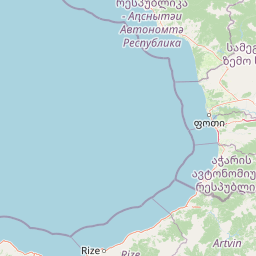
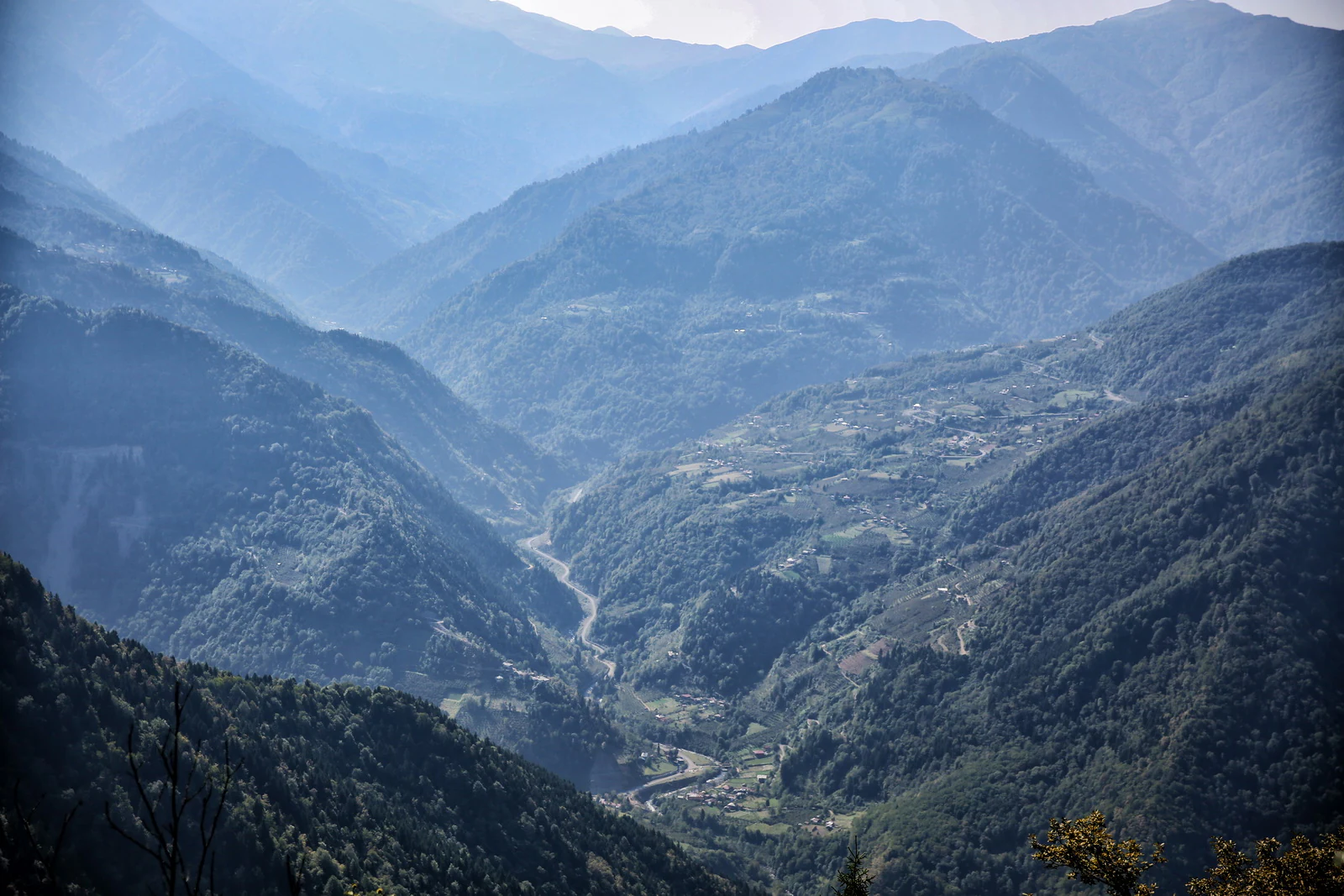
The physical landscape of Machakhela National Park is defined by the deep, steep-sided valley of the Machakhelistsqali River as it descends from the lower Caucasus slopes toward the Black Sea coastal plain. The terrain is dominated by mountainous relief with elevations ranging from roughly 200 meters in the valley bottoms to over 1,000 meters on the surrounding ridges. The slopes are often steep, with rocky outcrops and cliff faces interspersed with forested sections. The gorge itself creates dramatic visual compositions, with the river channel cutting through the terrain and the surrounding hillsides forming a natural corridor. The landscape receives substantial precipitation due to proximity to the Black Sea, contributing to the lush vegetation character and the year-round flow of the river system. From the slopes of Mtavarangelozi mountain, visitors can observe sweeping views extending across the Machakhela gorge toward the coastal city of Batumi and the sea beyond.
Machakhela National Park ecosystems, habitats, and plant life
The ecological character of Machakhela National Park is shaped by the Euxine-Colchic broadleaf forest ecosystem, one of the most distinctive and biodiverse forest types in the Palearctic region. These forests represent a relict community that persisted through glacial cycles in this humid refugium and retain many species with Tertiary-era origins. The forest cover dominates approximately 95% of the park's territory, composed of mixed broadleaf species forming a multilayered canopy. The Georgian page notes the presence of relic and rare species including Colchic box tree, chestnut, Colchic hazel, Georgian walnut, Unger's hornbeam, Smirnow's hornbeam, and elm, among others. This botanical assemblage creates a forest community of high conservation significance, with several species having restricted distributions and being of particular interest to biogeographers and conservation biologists. The humid climatic regime, influenced by proximity to the Black Sea, supports high productivity and structural complexity in the forest, with dense understory vegetation and rich ground flora.
Machakhela National Park wildlife and species highlights
While the provided sources focus primarily on the forest vegetation and cultural landscape, the Colchic forest ecosystem of Machakhela supports a diverse fauna community typical of Caucasus broadleaf forests. The dense forest structure provides habitat for numerous bird species, including both resident and migratory taxa that use the forest as breeding grounds or migration corridors. The presence of old-growth forest elements and the complex vertical structure create suitable conditions for cavity-nesting birds and species requiring mature forest habitat. The river corridor provides aquatic habitat and serves as a movement route for wildlife. The rocky outcrops and cliff faces offer potential habitat for mountain species. While specific species inventories are not detailed in the available sources, the broader Colchic forest zone is known to support populations of brown bear, lynx, wolf, and various smaller mammals, as well as a rich invertebrate fauna.
Machakhela National Park conservation status and protection priorities
Machakhela National Park represents an important conservation tool for the protection of Georgia's Colchic forest heritage. The park's establishment formalized protection for a forest ecosystem that had experienced historical pressure from logging and land conversion. The Colchic forests are recognized as a conservation priority at the regional and global levels due to their high species richness, endemism, and their status as a relict forest type. The national park designation provides a framework for long-term ecosystem protection while enabling compatible uses such as environmental tourism. The park's management approach integrates conservation of biological diversity with protection of the cultural landscape, recognizing that the historical features of the Machakheli region—including traditional land use patterns—contribute to the overall character and ecological value of the area.
Machakhela National Park cultural meaning and human context
The park occupies the historical region of Machakheli, a medieval territorial unit in southwestern Georgia that developed a distinctive cultural landscape over centuries of habitation. The name itself derives from this historical context, and the protected area contains physical evidence of long-term human relationship with the land. Medieval fortress ruins dot the landscape, representing the defensive architecture of the medieval period when this valley served as a strategic route through the Caucasus. Traditional stone arch bridges cross the river and its tributaries, infrastructure that once connected communities and facilitated movement through the mountainous terrain. Winepresses carved into the landscape reflect the viticultural tradition of the region, where terraced vineyards and associated processing facilities were integrated into the hillsides. These cultural features are not preserved in isolation but exist within the forest matrix, creating a landscape where natural and cultural heritage are intertwined.
Top sights and standout views in Machakhela National Park
The standout features of Machakhela National Park include its well-preserved Colchic forest ecosystems with numerous rare and relict species, the dramatic scenery of the Machakhela gorge with its steep cliffs and river valley, and the integration of historical cultural features within a protected natural landscape. The medieval fortress ruins of Machakheli, the traditional arch bridges, and the historic winepresses provide cultural context that distinguishes this park from more purely natural preserves. The panoramic views from Mtavarangelozi mountain extending toward Batumi and the Black Sea offer a dramatic vantage point. The park's two hiking trails allow visitors to explore these diverse features, with the active season from May through October providing favorable conditions for forest exploration in the subtropical climate of Adjara.
Best time to visit Machakhela National Park
The optimal period for visiting Machakhela National Park runs from May through October, which corresponds to the active tourist season in the region. During these months, the weather conditions are most favorable for hiking and outdoor exploration, with warmer temperatures and longer daylight hours. The spring months bring fresh green foliage and active wildlife activity as species become more visible following the winter period. Summer offers the fullest conditions for trail use but coincides with higher temperatures and increased precipitation in this humid climate zone. The autumn season provides colorful foliage displays and generally stable weather conditions. Winter visits would be more challenging due to reduced trail accessibility and colder temperatures in the mountainous terrain, though the forest retains its character year-round.