Why Gorkhi-Terelj National Park stands out
Gorkhi-Terelj National Park is best known for its dramatic rock formations, particularly Turtle Rock and the Praying Lama Rock, which stand as natural monuments recognizable throughout Mongolia. The park's accessibility from Ulaanbaatar has made it the country's most visited national park, offering visitors a compact yet diverse experience of Mongolian mountain landscapes without extensive travel. The presence of a functioning Buddhist monastery within the park provides a unique cultural dimension rarely found in other Mongolian protected areas. The combination of glacial lakes, natural hot springs, alpine forests, and the Tuul River corridor creates a ecological richness that supports significant wildlife populations including brown bears and exceptional bird diversity.
Gorkhi-Terelj National Park history and protected-area timeline
Gorkhi-Terelj National Park was established in 1993 as part of Mongolia's post-socialist expansion of its protected area network following democratic reforms. The park's designation reflected growing recognition of the need to preserve accessible natural landscapes near the capital while supporting emerging tourism sectors. Prior to formal protection, the area served as traditional grazing land for nomadic herders and contained spiritual sites associated with local Buddhist communities. The establishment of the park provided a framework for managing competing uses between conservation, traditional land use, and developing tourism. The park's management falls under the Ministry of Environment and Green Development of Mongolia, which oversees protection and visitor management. The development of tourism infrastructure, including the establishment of the Juulchin tourism corporation's operations, preceded the formal protected area designation and required integration into the park's management framework.
Gorkhi-Terelj National Park landscape and geographic character
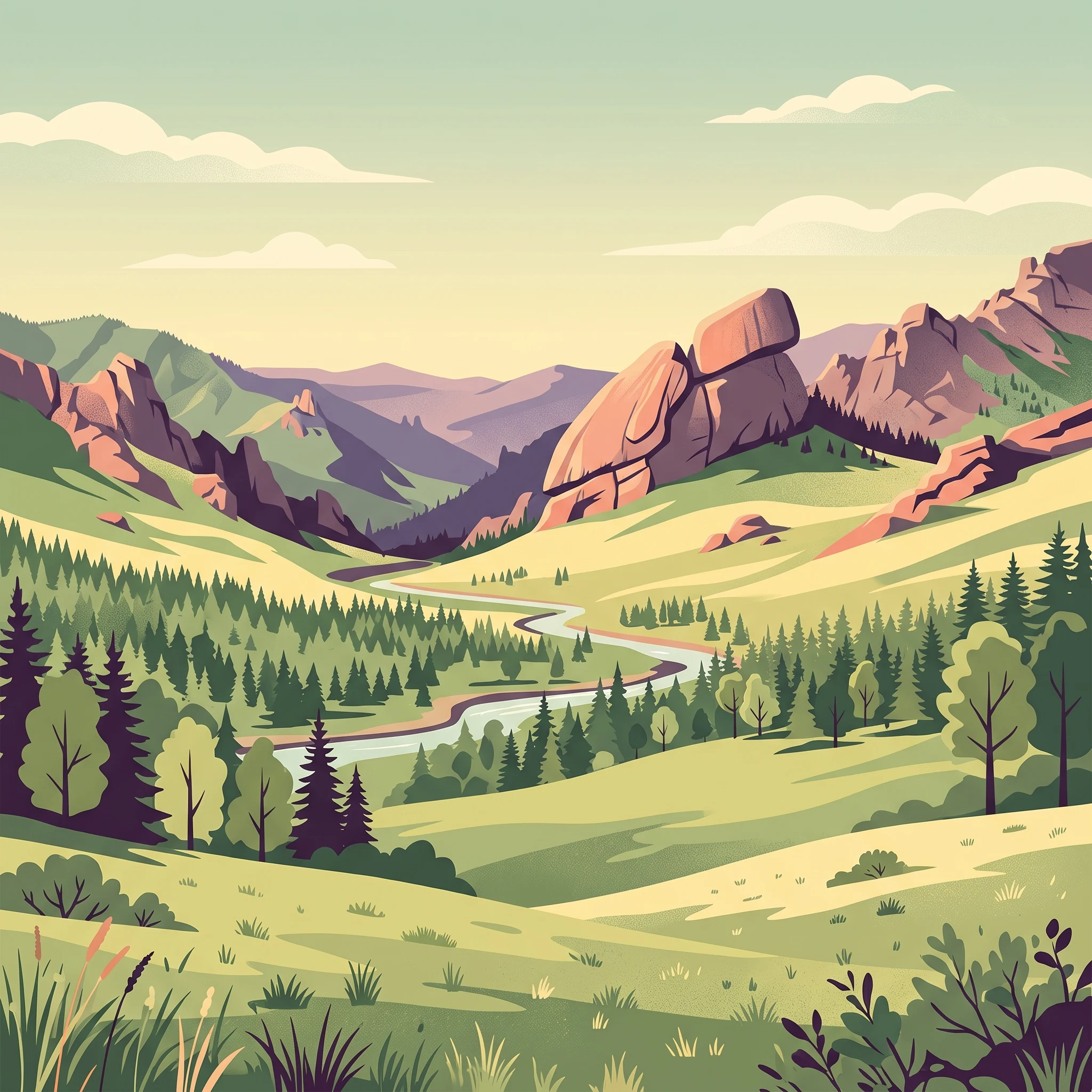
The landscape of Gorkhi-Terelj National Park is characterized by mountainous terrain of the northeastern Mongolian forest steppe zone. The Terelj River valley forms the park's central geographic feature, a broad valley floor flanked by rolling hills and steeper ridgelines. The terrain transitions from open grasslands on valley floors to mixed forests on lower slopes, with rocky outcrops and cliff bands appearing on more exposed terrain. The park's eastern sections contain higher elevations with more pronounced alpine character. Rock formations are a defining visual element, with granite boulders and cliff faces creating distinctive silhouettes against the sky. The Tuul River, one of Mongolia's major rivers, flows through the park providing hydrological connectivity and supporting riparian vegetation corridors. The landscape supports a mosaic of habitats including riverine forests, mountain meadows, rocky talus fields, and coniferous-deciduous forest stands.
Gorkhi-Terelj National Park ecosystems, habitats, and plant life
The ecological character of Gorkhi-Terelj National Park reflects the transition between Mongolia's forest steppe and mountain forest biomes. The park contains diverse habitat types including river corridor forests dominated by Siberian larch and birch, mixed coniferous forests on northern slopes, and open meadows in valley bottoms. This habitat diversity supports the park's notable bird species count exceeding 250, making it significant for avian conservation in the region. The forest and meadow ecosystems provide crucial habitat for brown bears, a species requiring extensive territory and secure habitat corridors. The Tuul River watershed function adds aquatic and riparian ecological dimensions to the park's conservation value. The park's elevation range creates temperature gradients that support both montane and subalpine species assemblages.
Gorkhi-Terelj National Park wildlife and species highlights
Gorkhi-Terelj National Park supports meaningful populations of large mammals including brown bears, which represent a conservation priority given their limited distribution in Mongolia. The park's diverse habitats support various ungulate species typical of the forest steppe zone. The exceptional bird diversity, with over 250 species recorded, positions the park as a significant area for avian fauna in Mongolia. This includes both resident species and migratory populations that utilize the park's habitats during seasonal movements. The river systems provide aquatic habitat supporting fish species and contributing to the broader food web that includes kingfisher species, osprey, and other fishing birds. The rock formations serve as nesting sites for raptors including eagles and falcons that inhabit the cliff bands.
Gorkhi-Terelj National Park conservation status and protection priorities
Gorkhi-Terelj National Park holds IUCN Category II designation, reflecting its primary purpose of protecting natural ecosystems while allowing sustainable tourism and environmental education. The park's conservation value is enhanced by its watershed protection function for the Tuul River, which provides water resources for the capital region and downstream agricultural areas. Protection of the brown bear population addresses species conservation needs in a country where suitable habitat is limited. The park's bird diversity exceeding 250 species indicates ecological health and habitat quality that supports broader biodiversity conservation objectives. Management balances visitor access in the developed tourist zone with protection of core wilderness areas that remain largely inaccessible to maintain ecological integrity.
Gorkhi-Terelj National Park cultural meaning and human context
The cultural landscape of Gorkhi-Terelj includes a functioning Buddhist monastery that remains active and open to visitors, representing spiritual continuity in a region with deep Buddhist heritage. The monastery adds cultural dimension to the park experience beyond natural landscape appreciation. Traditional Mongolian ger camps throughout the tourist zone maintain cultural authenticity through their design and operation, preserving nomadic hospitality traditions in a permanent setting. The park's proximity to Ulaanbaatar means cultural connections between urban and rural Mongolian communities are evident in visitor activities and local livelihoods. Rock formations have accumulated cultural significance, with Turtle Rock and the Praying Lama Rock named for their resemblance to recognizable forms that have entered local popular culture and tourism branding.
Top sights and standout views in Gorkhi-Terelj National Park
The most distinctive highlights of Gorkhi-Terelj National Park include the iconic rock formations, particularly Turtle Rock with its natural shape resembling a giant tortoise, and the Praying Lama Rock that appears to show a robed figure in contemplation. The accessible hot springs at Yestii provide visitors with natural thermal bathing opportunities in a backcountry setting. The Buddhist monastery offers cultural immersion and the chance to observe active religious practice. Khagiin Khar Lake, a deep glacial lake 80 kilometers from the tourist zone, rewards adventurous visitors with a pristine mountain lake experience. The combination of these features within a park easily reached from the capital makes Gorkhi-Terelj Mongolia's most complete protected area experience.
Best time to visit Gorkhi-Terelj National Park
The optimal visiting season for Gorkhi-Terelj National Park runs from late spring through early autumn, roughly May through September, when temperatures are mild and the landscape is green. Summer months offer the warmest conditions for hiking and outdoor activities, though this coincides with peak visitor numbers at the tourist camps. The shoulder seasons of May and September provide fewer crowds and still comfortable temperatures for most activities. Winter visits are possible but conditions become challenging with cold temperatures and limited services in the tourist zone. The park's elevation means weather can change rapidly, so visitors should prepare for variable conditions regardless of season. The park is accessible year-round via the main road from Ulaanbaatar, though winter conditions require appropriate vehicle preparation.