Why Great Otway National Park stands out
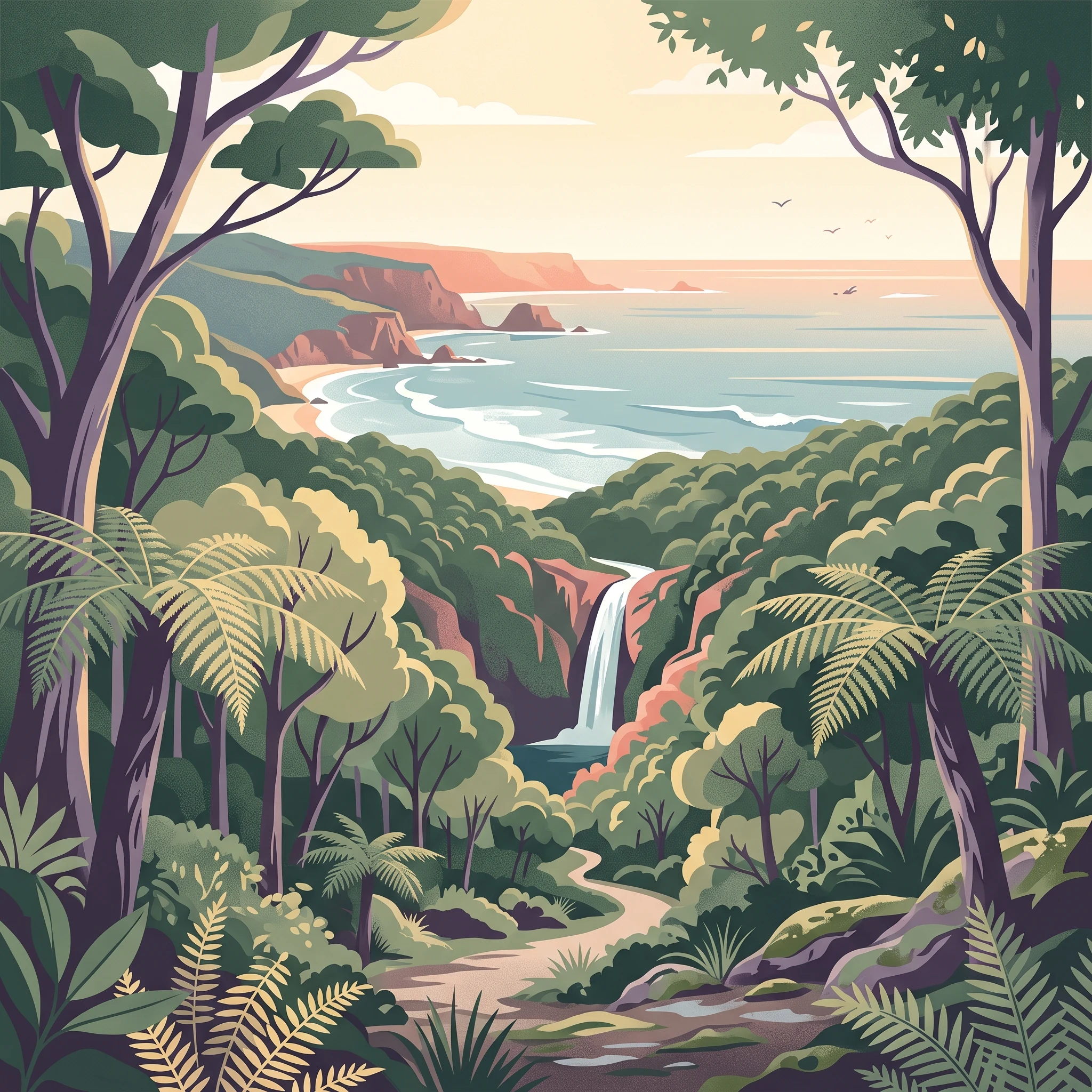
Great Otway National Park is best known for its dramatic contrast between coastline and forest, where towering waterfalls plunge into fern-filled valleys and the Otway Ranges support one of Australia's most significant cool temperate rainforest ecosystems. The park contains numerous waterfalls including Beauchamp Falls, Hopetoun Falls, and Stevenson Falls, all accessible via walking tracks that wind through myrtle beech and tree fern gullies. Its bioluminescent glow worm populations, particularly the species Arachnocampa otwayensis, create a distinctive night-time attraction along stream banks and in sheltered gullies. The park's coastal sections provide opportunities to observe migrating southern right whales and humpback whales, while the hinterland supports significant koala populations, particularly around the Aire River campground. The combination of old-growth forest remnants, diverse fungal communities, and the dramatic Otway coastline makes this park a distinctive protected area in the Australian national park system.
Great Otway National Park history and protected-area timeline
The history of Great Otway National Park is deeply intertwined with the broader story of European settlement and resource exploitation in Victoria's southwest. Commercial logging began in the Otway Ranges during the 1880s, accelerating dramatically as road and railway infrastructure improved throughout the region. The logging industry peaked in 1961, by which time the Otway Ranges had been almost entirely stripped of their old-growth forest, with significant land degradation resulting from the intensive extraction. The forest that stands today represents a relatively young second-growth ecosystem, highlighting the lengthy timeframes required to restore the towering trees and ecological complexity characteristic of the original old-growth forests. The region has also experienced several major bushfires that have shaped its ecology, including the devastating Ash Wednesday fires of 1983 that swept through southeastern Australia and burned through the park's predecessor reserves. The movement to create a unified national park in the Otway Ranges gained momentum through the efforts of the local community and the Otway Ranges Environment Network, who advocated for the combination of Otway National Park, Angahook-Lorne State Park, Carlisle State Park, Melba Gully State Park, areas of Otway State Forest, and various Crown Land reserves into a single protected area. This campaign succeeded in 2004, and the park was officially gazetted on 11 December 2005.
Great Otway National Park landscape and geographic character
The landscape of Great Otway National Park encompasses a remarkable variety of terrain within its 1,031 square kilometre expanse. The Otway Ranges form a low coastal mountain chain running parallel to Victoria's southern coastline, with Mount Cowley rising to 670 metres as the highest point within the park. The ranges are characterized by steep, V-shaped valleys carved by numerous streams and rivers that flow southward to the Southern Ocean. The park protects both the coastal margin and the interior mountain environment, creating a landscape of striking contrasts. Coastal sections feature dramatic sea cliffs, sandy beaches such as those at Johanna and Blanket Bay, and exposed headlands that bear the full force of Southern Ocean weather systems. Inland, the terrain becomes increasingly rugged, with deep gullies shadowed by dense vegetation and numerous waterfalls feeding streams that have carved through the soft sedimentary rock. The park includes Lake Elizabeth, a lake formed in 1952 when a landslide blocked the West Barwon River, creating a distinctive feature in the western section of the park. The underlying geology of the Otway Ranges consists primarily of Cretaceous sediments, with older granitic and metamorphic rocks appearing in some areas, all of which contribute to the nutrient-poor soils that characterize the region.
Great Otway National Park ecosystems, habitats, and plant life
The nature of Great Otway National Park is defined by its position in one of the wettest temperate regions of mainland Australia, supporting cool temperate rainforest, wet sclerophyll forest, and heathland communities that together form a complex and ecologically significant mosaic. The Otway Ranges experience a cool oceanic climate with extreme winter rainfall, recording over 1,900 millimetres of precipitation annually and the highest number of precipitation days in Australia, with 219.4 days of measurable rainfall per year. This moisture supports the development of cool temperate rainforest in the deepest valleys, where myrtle beech, Southern阻断山毛榉, and dense tree fern understory create a characteristically dark and atmospheric environment. The wet sclerophyll forests that blanket the slopes feature messmate, mountain ash, and brittle gum, with a diverse moss and lichen flora that thrives in the consistently humid conditions. The park's fungal diversity is exceptional, with 278 species documented in the Atlas of Living Australia, though this number represents only a fraction of the total fungal community. These fungi perform essential ecological roles as primary recyclers of organic matter and as mycorrhizal partners with the majority of plant species in the park. Notable species include the bioluminescent ghost fungus that glows pale green at night and the distinctive rosette fungus that appears in funnel-shaped formations at the base of trees.
Great Otway National Park wildlife and species highlights
Great Otway National Park supports a diverse array of wildlife, with particular significance attached to its koala populations, marine mammals, and birds. The park and specifically the Aire River campground are home to substantial koala populations, which thrive in the eucalyptus forests that dominate the park's more accessible areas. The coastal waters adjacent to the park provide habitat for migrating whales, with southern right whales and southern humpback whales commonly observed from the coastline during their seasonal migrations, along with resident populations of bottlenose dolphins. The park has been identified by BirdLife International as an Important Bird Area, recognizing its significance for populations of several endemic Australian bird species, including the rufous bristlebird, striated fieldwrens, and pink robins. The dense understory and ground layer of the forest provides habitat for a variety of smaller mammals, reptiles, and invertebrates, while the nocturnal fauna includes several species of possum and the enigmatic platypus in the park's streams. The glow worm displays, particularly visible at Angahook-Lorne State Park, Beauchamp Falls, Hopetoun Falls, Stevenson Falls, and Melba Gully, represent a distinctive wildlife spectacle that draws visitors to the park after dark.
Great Otway National Park conservation status and protection priorities
Great Otway National Park represents a significant conservation outcome in Victoria's protected area network, consolidating multiple former reserves and state forest into a single coherent protected landscape. The park protects one of the most important remaining blocks of coastal forest in southeastern Australia, including remnants of old-growth forest that survived the intensive logging period of the mid-twentieth century. The recognition of the park as an Important Bird Area by BirdLife International highlights its significance for forest-dependent bird species, particularly the populations of rufous bristlebirds, striated fieldwrens, and pink robins that breed and feed within its boundaries. The park's fungal communities, while poorly documented compared to plant and vertebrate diversity, play critical roles in ecosystem function through decomposition and mycorrhizal relationships. Local community groups, including the Southern Otways Landcare Network, have been actively involved in fungal survey work and education, contributing to the broader understanding of this often-overlooked component of biodiversity. The ongoing management challenge involves balancing visitor access with the need to protect sensitive ecosystems, particularly in areas with high conservation value such as the cool temperate rainforest gullies and the coastal habitats that support migrating whales.
Great Otway National Park cultural meaning and human context
The Great Otway National Park exists within a landscape that has been shaped by both natural processes and human activity over thousands of years. While the park itself does not feature prominently in documented indigenous heritage records, the broader Otway region was historically inhabited by Aboriginal peoples who utilized the coastal and forest resources of the area. The European history of the Otway Ranges is characterized by resource extraction, particularly the extensive logging operations that began in the 1880s and reached their peak in the early 1960s, fundamentally altering the character of the forest. The adjacent Cape Otway Lighthouse, established in 1846, stands as a significant cultural landmark in the region and remains an operating lighthouse that offers tours to visitors. The park's name derives from the Otway Ranges, which in turn is thought to derive from an early pastoral run in the area. The consolidation of the park from multiple former reserves reflects a broader shift in conservation philosophy toward landscape-scale protection that considers ecological connectivity rather than isolated reserves.
Top sights and standout views in Great Otway National Park
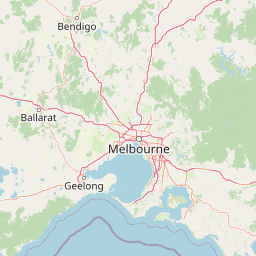
Great Otway National Park offers a distinctive combination of natural features that make it one of Victoria's most rewarding protected areas to explore. The waterfall walks to Beauchamp Falls, Hopetoun Falls, and Stevenson Falls showcase the park's ability to channel seasonal rainfall into dramatic cascades that drop through fern-filled gullies. The Otway Fly Treetop Walk provides an elevated perspective through the forest canopy, offering visitors a unique vantage point to appreciate the scale and complexity of the temperate rainforest. The park's bioluminescent glow worm displays, particularly at locations like Melba Gully, create a memorable night-time experience as the larvae of fungus gnats emit their characteristic blue-green glow along stream banks and sheltered tracks. The coastal sections provide opportunities for beach walks and whale watching during the migration season, while the camping areas at Johanna, Aire River, and Blanket Bay offer accessible base camps for exploring the park's interior. The combination of coastline, forest, waterfalls, and wildlife, all within a short drive of Melbourne, makes Great Otway National Park a accessible yet wild experience.
Best time to visit Great Otway National Park
The Great Otway National Park can be visited year-round, though each season offers distinctly different experiences and conditions. The wet winter months from June through August bring the waterfalls to their most impressive flow as the Otway Ranges receive the majority of their annual rainfall, creating spectacular displays at the park's numerous cascades. However, heavy rainfall can make some tracks muddy and difficult, and the short daylight hours limit time for exploration. Summer and early autumn, from December through March, typically offer more stable weather conditions with longer days ideal for walking and camping, though this is also the peak visitor season. The cooler temperatures of autumn provide comfortable conditions for extended walks through the forest, and the park's famous glow worms are visible throughout the year but are often most spectacular during the darker winter months when nights are longer. Visitors interested in whale watching should aim for the migration seasons, with southern right whales typically passing the coast from May to October, while humpback whales migrate through from May to November. Regardless of season, visitors should come prepared for changeable weather, as the Otway Ranges are known for their rapid shifts between sunshine and rain.