Mori Atlas logo
National parkBhitarkanika National Park

Explore the mapped boundaries and regional landscape context of this protected area.

Bhitarkanika National Park: A National Park in Kendrapara District, India

Bhitarkanika National Park stands as a significant protected area within the Kendrapara district of India. This national park offers a rich geographic identity, providing valuable insights into its mapped boundaries and surrounding natural landscapes. Users can delve into its regional context and understand its place within a broader atlas of protected lands, focusing on the park's specific landscape and geographic features for detailed exploration.

Mangrove ecosystemSaltwater crocodile habitatRamsar siteCoastal wetlandBirdwatching destinationDelta landscape

Bhitarkanika National Park

National park

Park overview

Structured park overview, official facts, and landscape profile for Bhitarkanika National Park

Bhitarkanika National Park park facts, protected area profile, and essential visitor context
Review the core facts for Bhitarkanika National Park, including designation, size, terrain, visitor scale, habitats, and operating context in one park-focused overview.

About Bhitarkanika National Park

Bhitarkanika National Park occupies a unique position in India's protected area network as a premier mangrove conservation site. The park sits within the estuarine region where the Brahmani and Baitarani rivers meet the Bay of Bengal, creating a constantly shifting landscape of tidal channels, mudflats, and dense mangrove forest. The ecosystem is defined by its extraordinary tidal dynamics, with twice-daily inundation creating selective pressures that have produced one of India's most specialized and biodiverse habitats. The surrounding Bhitarkanika Wildlife Sanctuary extends the protection across a much larger area, establishing a conservation matrix that preserves not just the core mangrove forest but also the hydrological processes and seasonal floodplains essential to the ecosystem's integrity. The park's landscape includes a mosaic of mangrove swamps, winding creeks, river channels, marshes, inland floodplains, forested beaches, and exposed mudflats, each supporting distinct ecological communities. Gahirmatha Beach and Marine Sanctuary lie immediately to the east, forming a continuous coastal conservation complex that separates the mangrove interior from the open sea.

Quick facts and research context for Bhitarkanika National Park

Bhitarkanika National Park covers 145 square kilometres in Odisha, India, established in 1998 as a Ramsar wetland site. The protected area comprises the second-largest mangrove ecosystem in India, formed at the estuary of the Brahmani and Baitarani rivers. It harbours the country's largest population of saltwater crocodiles, with approximately 1,671 individuals including some adults exceeding 6 metres in length. The park supports over 320 bird species and serves as critical habitat for migratory waterfowl, with around 200,000 birds visiting seasonally.

Park context

Deeper park guide and search-rich context for Bhitarkanika National Park

Bhitarkanika National Park history, landscape, wildlife, and travel context
Explore Bhitarkanika National Park through its history, landscape character, ecosystems, wildlife, conservation priorities, cultural context, and seasonal travel timing in a structured park guide built for atlas discovery and search intent.

Why Bhitarkanika National Park stands out

Bhitarkanika is internationally recognized for its remarkable saltwater crocodile population, representing one of the highest concentrations of this apex predator anywhere in the world. The park's mangrove ecosystem supports crocodiles of exceptional size, with approximately 10 percent of adults reaching lengths exceeding 6 metres, a proportion considered globally unique. Beyond crocodiles, the park protects the second-largest contiguous mangrove forest in India, a complex of tidal wetlands, creeks, and estuarine environments that serve as critical nursery grounds for fish and crustaceans. The area also supports significant populations of black ibis, darters, and serves as a vital nesting beach for olive ridley turtles.

Bhitarkanika National Park history and protected-area timeline

Bhitarkanika's conservation history reflects evolving Indian wildlife protection priorities. The Bhitarkanika Wildlife Sanctuary was first declared on 22 April 1975, covering an area of 672 square kilometres and establishing early protection for the region's mangrove forests. The core national park area of 145 square kilometres was formally notified in September 1998 under Notification No.19686/F by the Government of Odisha, elevating the protection status of the most ecologically sensitive zone. The area achieved international recognition as a Ramsar site on 19 August 2002, acknowledging its significance as a wetland of international importance under the Ramsar Convention. This designation highlighted the park's role as a critical habitat for waterfowl, its biodiversity value, and its function as a natural flood control system. The park is governed by the Ministry of Environment and Forests at the national level and the Government of Odisha at the state level, with ongoing management focused on crocodile conservation, mangrove restoration, and sustainable tourism development.

Bhitarkanika National Park landscape and geographic character

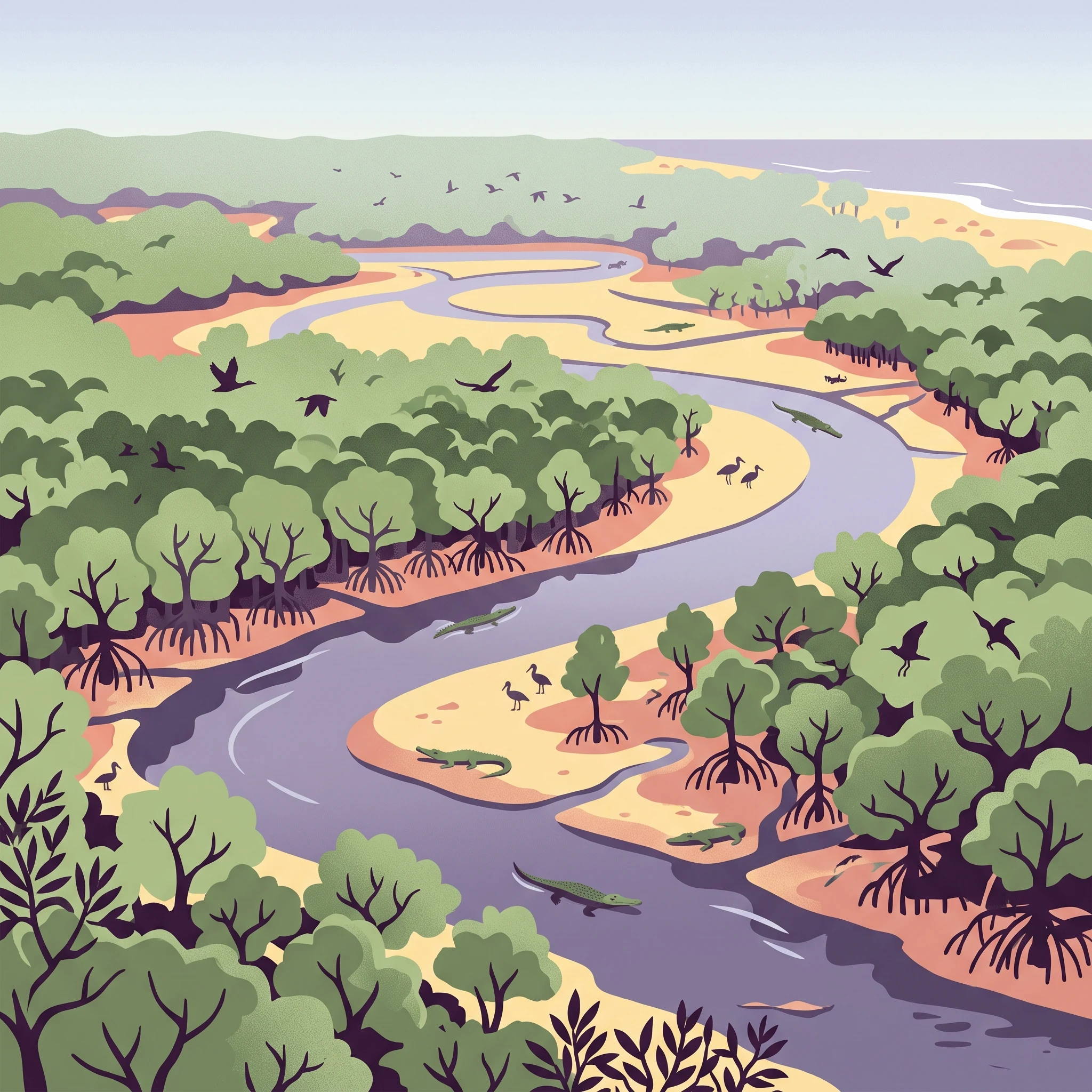
The physical landscape of Bhitarkanika is defined by its position at the convergence of major river systems and the sea. The Brahmani and Baitarani rivers deliver vast quantities of sediment to the coastal zone, building the deltaic environment that supports the mangrove ecosystem. A network of tidal creeks meanders through the forest, creating a constantly shifting water pattern that inundates different areas twice daily. The mangrove trees themselves form a distinctive landscape, with their complex root systems emerging from the water like stilts, creating a surreal environment where land and water intermingle. The park includes varying elevations from sea level to slightly higher ground along the river levees, with extensive mudflats exposed at low tide and submerged forests at high tide. The eastern boundary where the mangroves give way to the open beach at Gahirmatha represents a dramatic transition from dense forest to coastal dune and marine environments.

Bhitarkanika National Park ecosystems, habitats, and plant life

The ecological character of Bhitarkanika centers on its mangrove ecosystem, which represents a highly specialized intertidal forest adapted to varying salinity, tidal inundation, and soft substrate conditions. Mangrove species in Bhitarkanika have evolved specialized root systems that function like stilts, elevating the plants above the water while allowing photosynthesis without submersion during high tide. These root networks create complex underwater habitats that serve as critical nursery areas for fish, crustaceans, and juvenile marine species. The ecosystem supports remarkable biodiversity despite its relatively harsh conditions, with the constant tidal flux bringing nutrients and oxygen while flushing the system of accumulated salts. The park's mangroves are dominated by species suited to the estuarine environment, with casuarinas and reed grasses like indigo bush and Arundo donax also present in the transitioning zones between true mangrove and inland vegetation.

Bhitarkanika National Park wildlife and species highlights

Bhitarkanika supports an extraordinary concentration of wildlife, centered on its apex predator, the saltwater crocodile. The park contains one of the largest populations of endangered saltwater crocodiles in India, with approximately 1,671 individuals inhabiting its rivers and creeks. A notable feature is the presence of exceptionally large individuals, with 10 percent of adults exceeding 6 metres in length, a proportion considered globally unique. The 2016 survey recorded 308 adult crocodiles, including 16 individuals over 4.9 metres and several exceeding 6 metres. The park also supports significant populations of spotted deer, with 1,872 individuals recorded in the 2014 mammal survey, along with 1,213 wild boar, 1,522 monkeys, 305 jackals, and smaller populations of sambar deer, otters, jungle cats, fishing cats, and wolves. Avifauna is exceptionally rich with 320 species recorded, including eight kingfisher species, Asian open bills, cormorants, darters, black ibis, and egrets. The park receives approximately 200,000 birds annually, with 120,000 winter visitors from abroad and 80,000 resident birds arriving for nesting during monsoon season. Olive ridley turtles nest on nearby Gahirmatha Beach.

Bhitarkanika National Park conservation status and protection priorities

Bhitarkanika represents one of India's most significant conservation success stories, particularly regarding saltwater crocodile protection. The park's designation as a national park and Ramsar site reflects its international ecological importance and the commitment to preserving its unique mangrove ecosystem. The crocodile population has shown steady recovery over the years, from 203 adults in 2006 to 308 in subsequent surveys, demonstrating the effectiveness of protection measures. The mangroves provide critical ecosystem services including coastal protection, carbon sequestration, and water filtration, while serving as nurseries for commercially important fish species. The establishment of the surrounding wildlife sanctuary creates a buffer zone that protects the core area from external pressures and maintains the hydrological connections essential to ecosystem health. Conservation challenges include balancing tourism with protection, managing human-wildlife conflict at the park boundaries, and addressing the impacts of climate change on coastal ecosystems.

Bhitarkanika National Park cultural meaning and human context

Bhitarkanika exists within a landscape shaped by human settlement and use patterns in coastal Odisha. The region surrounding the park includes villages whose residents have historically interacted with the mangrove environment, utilizing its resources while respecting its dangers. The local communities in Kendrapara district have developed traditional relationships with the tidal landscape, with fishing and related activities forming part of the regional economic fabric. The park's name itself derives from local language, reflecting the area's established identity in regional culture. While the national park designation restricts certain activities within its core, the surrounding sanctuary area allows for more traditional uses that are compatible with conservation objectives. The relationship between the protected area and local communities remains an important aspect of long-term conservation planning.

Top sights and standout views in Bhitarkanika National Park

The defining highlights of Bhitarkanika include its globally significant saltwater crocodile population, with individuals of exceptional size making it a unique reptilian habitat. The second-largest mangrove ecosystem in India creates a spectacular landscape of tidal forests, winding creeks, and intertidal mudflats. The park's Ramsar designation confirms its international importance as a wetland habitat supporting extraordinary concentrations of waterfowl. The diverse wildlife includes over 320 bird species, significant populations of spotted deer and wild boar, and regular nesting by olive ridley turtles on nearby beaches. The network of tidal rivers and creeks creates opportunities for boat-based wildlife observation, allowing visitors to experience the mangrove ecosystem from its waterways.

Best time to visit Bhitarkanika National Park

The optimal season for visiting Bhitarkanika coincides with the dry winter months from November through February, when comfortable temperatures and minimal rainfall allow for comfortable exploration of the park's waterways and trails. This period also coincides with the peak arrival of migratory birds, with approximately 120,000 winter visitors arriving from abroad, creating exceptional birdwatching opportunities. The post-monsoon season from September to November offers the advantage of seeing the ecosystem at its most verdant following the seasonal rains, though some areas may remain inaccessible due to flooding. The monsoon season from June to August brings heavy rainfall and is generally less suitable for visits, though it corresponds with the resident bird nesting period. The crocodile breeding season, which peaks in the spring months, offers the best chances of observing these apex predators in their most active period.
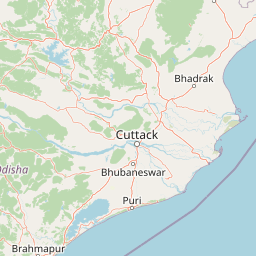
Park location guide

Geography guide, regional context, and park location map for Bhitarkanika National Park

Bhitarkanika National Park park geography, regions, and map view in India
Understand where Bhitarkanika National Park sits in India through a broader geographic reading of the surrounding landscape, nearby location context, and its mapped position within the national park landscape.

How Bhitarkanika National Park fits into India

India is a South Asian country bordered by the Indian Ocean, Arabian Sea, and Bay of Bengal. It shares land borders with Pakistan, China, Nepal, Bhutan, Bangladesh, and Myanmar. The country has a population of over 1.4 billion people and operates as a federal parliamentary republic with its capital in New Delhi.

Wider geography shaping Bhitarkanika National Park in India

India occupies the Indian subcontinent in South Asia, bordered by the Arabian Sea to the southwest, the Bay of Bengal to the southeast, and the Indian Ocean to the south. It shares land borders with Pakistan to the west, China, Nepal, and Bhutan to the north, and Bangladesh and Myanmar to the east. The territory also includes the Andaman and Nicobar Islands in the Indian Ocean.

Map view of Bhitarkanika National Park

Use this park location map to pinpoint Bhitarkanika National Park in India, understand its exact geographic position, and read its mapped placement within the surrounding landscape more clearly.

Pigeon | © OpenStreetMap contributors

Location context for Bhitarkanika National Park

Kendrapara districtOdisha
Park atlas

Discover connected regional park geography, coastal wetlands, and delta landscapes surrounding Bhitarkanika National Park in Eastern India.

Explore Other National Parks and Protected Areas Near Bhitarkanika National Park
After exploring Bhitarkanika National Park, browse other protected areas, compare nearby national parks, and trace coastal wetland ecosystems across Eastern India. Continue atlas-style discovery by mapping similar delta landscapes and comparing conservation efforts in surrounding regions, enriching geographic context.
Watercolor illustration showing a landscape with trees, water, and mountains
National parkMayurbhanj district

Simlipal National Park: National Park Protected Area in Mayurbhanj District

Mapped boundaries and regional geography of Simlipal National Park.

Simlipal National Park stands as a prominent national park, offering a rich protected area landscape within Mayurbhanj district, India. This entry provides detailed atlas-style information, focusing on the park's geographic footprint and mapped terrain. Explore the structured data that defines Simlipal National Park's identity as a protected natural landscape, ideal for understanding its place within regional geography and conservation efforts.

Area
2,750 km²
Established
1980
IUCN
II
Relief
Mountain
Watercolor painting showing mangrove trees, water channels, and hills in the background
National parkWest Bengal

Sundarbans National Park: UNESCO World Heritage Mangrove National Park in West Bengal

Explore its tidal geography and mapped protected boundaries.

Sundarbans National Park is a vital protected area on the Ganges Delta, recognized globally as the world's largest mangrove forest and a UNESCO World Heritage Site. Located in West Bengal, this national park features a unique estuarine geography characterized by intricate tidal channels and distributaries that define its landscape. Its protected boundaries safeguard a complex ecosystem, offering rich opportunities for atlas-driven exploration of its distinctive natural terrain and coastal wetland significance.

Area
1,330.1 km²
Established
1984
IUCN
II
Relief
Lowland
National parkPatuakhali District

Kuakata National Park: Protected Landscape Identity and Geographic Atlas

Mapped boundaries and regional context within Patuakhali District.

Kuakata National Park is a significant protected area designated as a national park, offering valuable insights into the geography of Patuakhali District. This park detail page provides a structured exploration of its mapped boundaries and protected landscape characteristics, serving as a vital entry point for understanding its place within the larger atlas of global natural sites. Focus on its specific geographic setting and conservation status for detailed discovery.

Area
16.13 km²
Established
2010
IUCN
II
Relief
Lowland
National parkBangladesh

Nijhum Dweep National Park: A Protected Landscape in Bangladesh's Geographic Atlas

Explore the mapped boundaries and regional setting of this national park.

Nijhum Dweep National Park is a key protected area situated within the deltaic geography of Bangladesh. This detailed entry provides insight into its mapped landscape, natural terrain, and its significance as a national park. Understand its geographic context and explore its protected boundaries as part of a broader atlas of natural areas, offering a factual basis for understanding this unique South Asian landscape.

Area
163.52 km²
Established
2001
IUCN
IV
Relief
Lowland
National parkJharkhand

Betla National Park: National Park Protected Area Exploration and Geographic Context in Jharkhand

Mapped boundaries of a significant protected landscape.

Betla National Park, situated in Jharkhand, India, is a key national park offering significant value for geographic and protected-area discovery. This resource facilitates exploration of its mapped boundaries, providing a clear understanding of its protected landscape and its relationship to the surrounding regional geography. Delve into the structured data to comprehend the park's atlas context and its role as a conserved natural area within India.

Area
226.32 km²
Established
1986
IUCN
II
Access
Moderate access
National parkBangladesh

Bhawal National Park: Mapped Protected Landscape in Bangladesh

Explore its national park designation and regional geography.

Bhawal National Park represents a key protected landscape within Bangladesh. This entry provides detailed information on its identity as a national park, focusing on its mapped geography and protected area significance. Users can explore the park's specific context within the broader South Asian region, understanding its contribution to the nation's conserved natural areas and gaining insight into its landscape character through an atlas-driven perspective.

Area
50.22 km²
Established
1982
IUCN
IV
Relief
Lowland
National parkBhaluka Upazila

Kadigarh National Park National Park: Protected Landscape Atlas and Geographic Overview

Understand Kadigarh National Park's mapped boundaries and regional geography.

Kadigarh National Park is a distinct national park recognized for its protected status within Bhaluka Upazila, Bangladesh. This entry offers an atlas-centric perspective, detailing the park's geographic boundaries and its contribution to the regional landscape. Examine the mapped extent of this protected area and understand its role within the surrounding natural geography, providing a factual basis for exploring its protected landscape identity.

Area
3.441 km²
Established
2010
Climate
Tropical
Access
Easy access
National parkChittagong District

Baroiyadhala National Park: A Vital Wildlife Corridor and Protected Forest Landscape in Bangladesh

Discover its terrain, mapped boundaries, and regional significance.

Baroiyadhala National Park, situated in Bangladesh's Chittagong District, stands as a critical national park dedicated to preserving forest ecosystems and functioning as an essential wildlife corridor. The park's undulating terrain and dense vegetation are vital for supporting threatened species and maintaining habitat connectivity. This page offers an atlas-style exploration of Baroiyadhala National Park, detailing its protected area status, geographic context within the Chittagong region, and its significance for conservation in South Asia, providing a rich understanding of its natural landscape.

Area
29.34 km²
Established
2010
IUCN
II
Climate
Tropical

Common questions about visiting, size, designation, and location context for Bhitarkanika National Park

Bhitarkanika National Park FAQs for park facts, access, geography, and protected area context
Find quick answers about Bhitarkanika National Park, including protected-area facts, park geography, trail and visitor context, and how the park fits into its surrounding country and regional landscape.
MoriAtlas Explorer

Continue Your Protected Areas Search Across the Global Atlas

Deepen your exploration by continuing the structured search for national parks and protected areas worldwide. Utilize the comprehensive filtering capabilities to compare different conservation landscapes and refine your understanding of global park geography. Discover more about the distribution and characteristics of protected natural areas.

Global natural geography