Why Shorsky National Park stands out
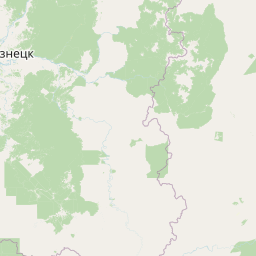
Shorsky National Park is best known for its vast expanse of dark coniferous mountain taiga, dominated by Siberian stone pine (Siberian cedar) and Siberian fir, set within the rugged ridges of Gornaya Shoria. The park protects one of the most representative examples of southern Siberian taiga, where old-growth forests, deep river valleys, and isolated mountain peaks combine to create a near-wilderness landscape. The area is equally recognized for the richness of its boreal wildlife, including brown bear, moose, Siberian musk deer, sable, lynx, and a wide spectrum of taiga birds, as well as for rare plant species such as Siberian candytuft and large-flowered lady's slipper orchid. Together, these qualities make Shorsky a defining example of an Altai-Sayan mountain taiga protected landscape.
Shorsky National Park history and protected-area timeline
Shorsky National Park was established in 1989, the same year as several other major Soviet-era national parks, following a resolution of the Council of Ministers of the RSFSR dated 27 December 1989 that authorized the creation of the Shorsky State Natural National Park in Kemerovo Oblast. The park was conceived as a means to protect the mountain taiga of Gornaya Shoria from growing pressures linked to forestry, mining, and expanding Soviet-era industry in southern Siberia, while also safeguarding the cultural landscape of the indigenous Shor people.
Since its creation, the park has been organized into five forest districts and administered from the town of Tashtagol, the main settlement of the region. It joined the association of reserves and national parks of the Altai-Sayan ecological region, linking it into a wider trans-boundary network of protected areas across the mountains of southern Siberia and northern Central Asia. In a more recent development, on 20 October 2022, the park was officially named after Sergei Dmitrievich Tivyakov, a figure associated with its history. Over time, Shorsky National Park has become a key institution for conservation, scientific research, and regulated nature tourism in Kemerovo Oblast and the broader Altai-Sayan region.
Shorsky National Park landscape and geographic character
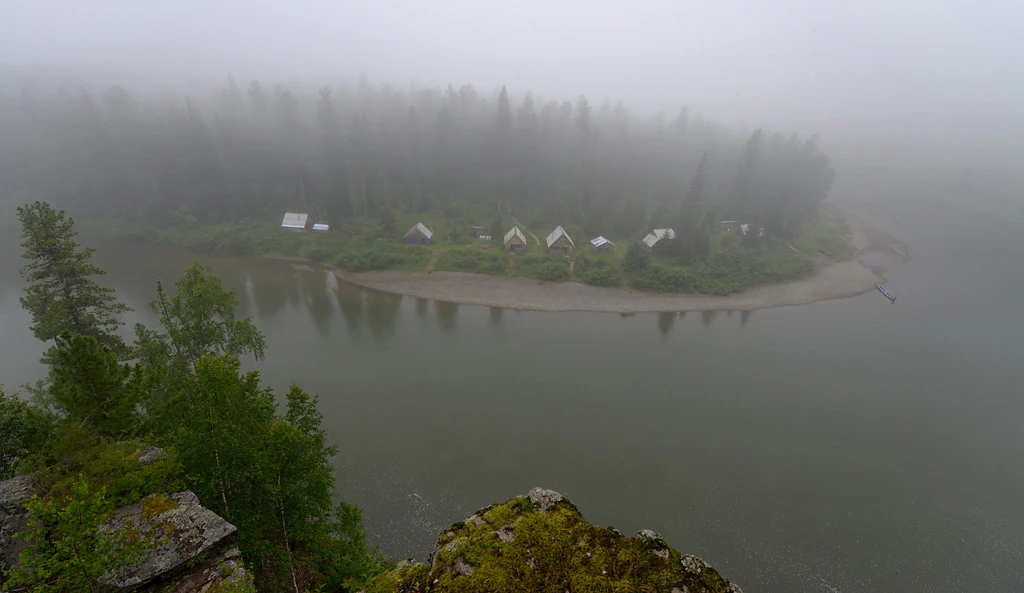
The landscape of Shorsky National Park is defined by mountain taiga shaped by deep river erosion. The relief consists of a complex mountain system strongly dissected by river valleys, with average elevations between 500 and 800 meters and individual summits reaching roughly 1,600 to 1,800 meters. Notable peaks include Mount Lysukha at 1,648 meters and Mount Kubez at 1,555 meters. These ridges create a varied topography of steep slopes, narrow valleys, and broader mid-mountain basins.
Hydrologically, the park's defining feature is the Mras-Su river, which crosses the main massif from north to south and splits the territory into approximately two equal halves. Its tributaries form a dense network of rivers and streams that carve the mountains and govern the distribution of soils and vegetation. Rivers are fed mainly by atmospheric precipitation and groundwater, with a regime typical of mountain streams.
The climate strongly shapes the visible landscape: sharply continental and severe, with mean January temperatures around minus 20 to minus 22 degrees Celsius, mean July temperatures of plus 17 to plus 18 degrees, and snow cover lasting from October through April. Annual precipitation averages around 900 millimeters, but windward mountain slopes can receive 1,500 to 1,800 millimeters per year, producing deep snow accumulation, especially in middle-mountain hollows where snow depths can exceed four meters.
Shorsky National Park ecosystems, habitats, and plant life
The vegetation of Shorsky National Park is dominated by dark coniferous mountain taiga, often called chernnevaya taiga, one of the signature forest formations of southern Siberia. The principal tree species are Siberian stone pine (Pinus sibirica) and Siberian fir (Abies sibirica); spruce, common pine, downy birch, and aspen are present as secondary species. The age structure of the forests shows a large share of middle-aged and maturing stands, while mature and old-growth forest accounts for roughly one fifth of the forested area.
Most forest communities are large-herb and broad-herb types, with rich shrub and tall herb understories that include ferns such as lady fern and bracken, alongside tall forbs like northern aconite, tall larkspur, and sweet cicely. Moss and shrub-herb forest types with bird cherry and rowan in the understory are less common but still ecologically important. In the middle-mountain forests of Shoria, the park preserves a unique and species-rich flora of the Southern Siberian mountains, including botanical rarities such as Siberian candytuft, large-flowered lady's slipper, true lady's slipper, and golden root.
Soils reinforce this forest identity. Sod-podzolic soils dominate the lower part of the taiga belt, while typical podzolic soils prevail in its upper part. Both soil types are favorable for tree growth, and together with the humid climate they sustain the park's extensive and continuous forest cover, creating one of the largest expanses of intact mountain taiga in the region.
Shorsky National Park wildlife and species highlights
The fauna of Shorsky National Park reflects the richness of southern Siberian taiga and includes both game species and rare or ecologically notable animals. The mammalian fauna is particularly diverse for a protected taiga landscape; common game and furbearer species include the mountain hare, red squirrel, sable, American mink, Siberian weasel, otter, wolverine, red fox, gray wolf, Eurasian lynx, and European moose. Smaller mammals are also well represented, with species such as the Siberian mole, Siberian chipmunk, water vole, muskrat, common hamster, stoat, least weasel, steppe polecat, Asian badger, and various shrews inhabiting the park.
Larger mammals extend the ecological profile of the park. European brown bear is present throughout the forested terrain, while ungulates include the European moose, Siberian roe deer, the Altai wapiti (a regional subspecies of red deer), and notably Siberian musk deer, a taiga specialist associated with old-growth coniferous forests. Reindeer also occur in the area. In the rivers, cold-water fish species such as Siberian grayling, lenok, and common taimen maintain populations that depend on the park's clean mountain waters.
Birdlife in Shorsky is rich; the park has recorded a substantial number of bird species, including many that are traditional objects of hunting in the region. Waterfowl such as mallard, shoveler, pintail, gadwall, garganey, Eurasian teal, and common pochard occur alongside game birds like capercaillie, hazel grouse, black grouse, common quail, corncrake, Eurasian woodcock, common snipe, great snipe, and jack snipe. Rarer and more ecologically sensitive species documented in the park include the black stork, golden eagle, peregrine falcon, and osprey, all of which add to the conservation significance of the bird community. Reptile and amphibian presence is more modest but still contributes to the natural diversity of the area.
Shorsky National Park conservation status and protection priorities
Shorsky National Park plays a key conservation role within the Altai-Sayan ecological region, one of the last large contiguous mountain wildernesses of southern Siberia. By protecting roughly 4,140 square kilometers of dark coniferous taiga, river valleys, and alpine terrain, the park safeguards forest ecosystems that have been heavily altered elsewhere in southern Siberia by industrial logging, mining, and associated infrastructure. The presence of extensive stands of Siberian stone pine and Siberian fir, along with substantial populations of species such as brown bear, Siberian musk deer, sable, and lynx, makes the park an important stronghold for taiga biodiversity at a regional scale.
The park also preserves populations of ecologically sensitive and legally protected species in Russia, including the black stork, golden eagle, peregrine falcon, and osprey, alongside rare plants such as large-flowered and true lady's slipper orchids and golden root. The combination of altitudinal variation, heavy snowfall, and deep forest cover creates refuge habitats that are resilient to many forms of human pressure but sensitive to disturbance, which is the core reason for the park's protected status. Inclusion in the association of reserves and national parks of the Altai-Sayan ecological region further strengthens its role in trans-regional conservation planning.
Shorsky National Park cultural meaning and human context
The territory of Shorsky National Park corresponds closely with the homeland of the Shor people, a small indigenous Turkic-speaking group traditionally associated with hunting, reindeer herding, and taiga forest culture in the mountains of southwestern Siberia. The name Shorsky itself reflects this association, and the park's borders encompass many Shor villages and historical settlements, including the communities reflected in the names of its forest districts.
Cultural and natural heritage sites are recognized across the park. The territory includes 25 officially designated natural monuments, six of which are most accessible and visited. These include the Saga waterfall, a hydrological monument, and several geological landmarks such as the Kizassky caves, the Nadezhda cave, the Soldier monument, the Drinking Elephant rock, and the Kabuksky vaucluse spring. The open-air ethnographic museum at Tazgol, located nearby, alongside traditional Shor settlements along the Mras-Su valley, anchors the park within the living cultural landscape of Mountain Shoria, where indigenous identity, taiga livelihoods, and natural heritage remain closely interwoven.
Top sights and standout views in Shorsky National Park
Among Shorsky's standout features is the expanse of dark coniferous mountain taiga dominated by Siberian stone pine and Siberian fir, which forms one of the largest intact taiga landscapes remaining in the Altai-Sayan region. The river network of the Mras-Su and its tributaries shapes the park's geography and supports cold-water fish populations such as Siberian grayling, lenok, and common taimen.
The park also stands out for the combined presence of large mammals such as brown bear, Eurasian lynx, moose, Siberian musk deer, and the Altai wapiti, alongside rare breeding birds including black stork, golden eagle, peregrine falcon, and osprey. Botanical rarities such as Siberian candytuft, large-flowered lady's slipper, true lady's slipper, and golden root add a distinctive floristic profile. Together with its cultural ties to the Shor people and natural monuments like the Saga waterfall and the Kizassky caves, these qualities make Shorsky a uniquely comprehensive mountain taiga protected area.
Best time to visit Shorsky National Park
Summer is the most accessible and ecologically expressive season in Shorsky National Park, when the deep snow has receded and the mountain rivers become workable for rafting and other water-based travel. This is when the dark coniferous forests are fully active, the tall herbaceous understory is at its most lush, and conditions for hiking, horseback riding, ascents to peaks such as Mount Lysukha, and caving in the park's geological monuments are favorable. Warm daytime temperatures around plus 17 to plus 18 degrees Celsius, combined with long daylight hours, make mid-mountain routes feasible without specialized winter equipment.
Winter, in contrast, is long, severe, and snow-dominated, with temperatures around minus 20 to minus 22 degrees Celsius in January and snow lasting more than half the year, often accumulating to depths of two meters or more in middle-mountain hollows. While the park's snow cover, frozen rivers, and frost-laden taiga create a strongly Siberian winter landscape, travel in this season demands significantly more preparation and is a more specialized experience.