Mori Atlas logo
National parkSochi National Park

Tracing the vertical transition from Black Sea coastlines to high alpine mountain ridges.

Sochi National Park: Mapping the Protected Landscapes and Caucasus Mountain Geography

(Sochi National Park (Национальный парк «Сочинский»))

Sochi National Park encompasses a sprawling protected area across Krasnodar Krai, defined by the sharp compression of subtropical coastal zones and the rugged peaks of the Greater Caucasus. This atlas record provides context on the park's diverse terrain, including dense river networks, deep karst cave systems, and relict Colchic forest ecosystems. Explore the geographic boundaries of a territory that extends from the Black Sea shoreline to the highest mountain ridges.

subtropical forestcolchic floracaucasus mountainsblack sea coastkarst caveswaterfalls

Sochi National Park

National park

Park overview

Structured park overview, official facts, and landscape profile for Sochi National Park

Sochi National Park park facts, protected area profile, and essential visitor context

Review the core facts for Sochi National Park, including designation, size, terrain, visitor scale, habitats, and operating context in one park-focused overview.

About Sochi National Park

Sochi National Park protects an exceptionally compressed cross-section of landscapes along Russia's Black Sea coast. Within its borders, the territory rises from seaside pebble beaches and coastal wetlands at the Black Sea up through river-cut foothills, deep forested valleys, and eventually to the high ridges and peaks of the western Greater Caucasus. Much of the park is mountainous, with only a narrow coastal foothill strip between the sea and the steep interior ranges.

The park is the workhorse of conservation in this part of Russia. It was created in 1983 to safeguard the natural complexes of the Caucasian Black Sea coast from uncontrolled development, logging, and habitat loss, and to balance protection with scientific, recreational, and educational use. Over time its responsibilities have grown, and today the park is a cornerstone of efforts to protect Caucasian biodiversity, with active programs for several endangered species and subspecies.

What makes the park unusual in a Russian context is its climate. Warm, humid subtropical conditions prevail in the lower elevations, allowing Mediterranean and Colchic vegetation to coexist with coniferous and broadleaf forests higher up. The result is a layered mosaic of habitats: coastal freshwater marshes, mixed broadleaf forests, Colchic relict woodlands, beech and hornbeam stands, montane coniferous forests, subalpine meadows, and rocky alpine zones. Rivers and streams of the Black Sea basin dissect these landscapes, producing canyons, waterfalls, and karst formations that have become signature features of the park.

Beyond its ecological value, Sochi National Park hosts significant cultural and archaeological heritage. Middle Paleolithic cave sites, Bronze and Iron Age dolmens, medieval fortresses, and later Russian imperial fortifications are scattered across the territory. The park is also a major recreational resource, with hiking trails, excursion routes, ecological education centers, and curated natural landmarks such as the Sochi Arboretum and the Yew-Boxwood Grove. It is regularly described as one of the most visited national parks in Russia, drawing millions of visitors each year.

Quick facts and research context for Sochi National Park

Sochi National Park is a Russian federal national park located in the Krasnodar Krai, covering essentially the whole municipal area of Greater Sochi. It runs from the borders with the Tuapse district in the northwest to the border with Abkhazia in the southeast, stretching inland from the Black Sea coast to the Main Caucasian Ridge watershed.

The park was created in 1983 by decision of the Council of Ministers of the RSFSR, making it among the earliest national parks in Russia. Its area was substantially expanded in 2013, and the park is now one of the largest and most visited national parks in the country.

Its climate is humid subtropical, unusual for Russia, and this setting supports an unusually rich combination of coastal, foothill, and high-mountain ecosystems. The park is administered as a federal state institution and includes forestry districts, ecological education centers, cave systems, archaeological sites, and a network of recreational and excursion routes.

Protection and recognition

Terrestrial conservation framework and official designation timeline for Sochi National Park.

Sochi National Park Protection Status and Mapped Designation History

Documented protection records outline the terrestrial scope and establishment history of Sochi National Park since its designated year in 2013. Structured recognition facts clarify the governing conservation framework and international designation context for this protected natural landscape.

Protection details

Protection scope
Terrestrial
Designated year
2013
Transboundary protection
No
Park context

Deeper park guide and search-rich context for Sochi National Park

Sochi National Park history, landscape, wildlife, and travel context

Explore Sochi National Park through its history, landscape character, ecosystems, wildlife, conservation priorities, cultural context, and seasonal travel timing in a structured park guide built for atlas discovery and search intent.

Why Sochi National Park stands out

Sochi National Park is best known for its compressed geography where subtropical Black Sea coastline meets the western foothills and peaks of the Greater Caucasus. Within a relatively short distance one can move from sea level up through Colchic broadleaf forests to alpine meadows and rocky summits. The park is also recognized for its Colchic and relict plant communities, including boxwood (Buxus colchica) and yew groves, and for hosting one of Russia's most important programs for the reintroduction of the Persian leopard. Karst caves, deep canyons, and more than forty named waterfalls, including the 33 Waterfalls cascade, contribute to its reputation as a landscape-rich destination on the Black Sea coast.
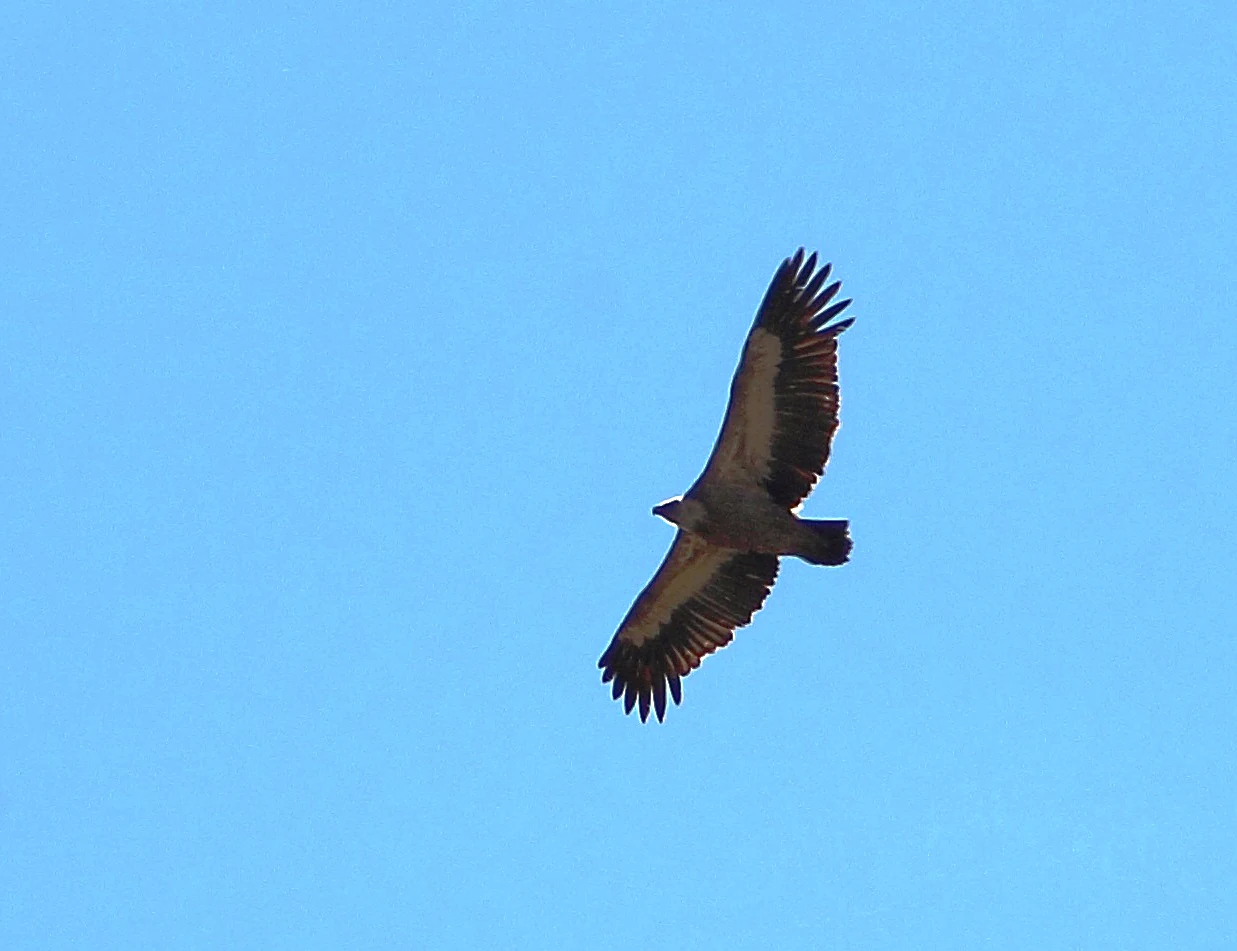
Griffon vulture in Sochi
A griffon vulture in Sochi National Park, near Krasnaya Polyana on the southern slope of the Greater Caucasus in Krasnodar Krai.

Sochi National Park history and protected-area timeline

Sochi National Park was established on 5 May 1983 by resolution No. 214 of the Council of Ministers of the Russian SFSR, with the explicit purpose of preserving the unique natural complexes of the Caucasian Black Sea coast and supporting environmental, recreational, educational, and scientific uses. Its creation marked it as one of the first national parks in the Russian Federation and an important early instrument of federal nature protection in the Caucasus region.

From its inception the park was structured around forestry districts, which were renamed and reorganized over the years to manage conservation, recreation, and education across the full Sochi coast. By the early 2000s it had established a network of ecological education centers within several of these districts and had opened dozens of excursion routes and recreational sites.

A major expansion occurred in 2013, when a Russian government resolution enlarged the park by incorporating forest-fund lands from the Tuapse Forestry District and a portion of the Sochi inter-republican state nature sanctuary, roughly nine thousand hectares. This brought the park to its current large footprint and consolidated protection along a longer stretch of coastline and adjacent mountains. From 2009, the park has also been the host site for the Caucasian Leopard Recovery Center (named after U.A. Semenov), one of the focal points of the program to restore the Persian leopard, also known as the Caucasian leopard, in the wild.

Sochi National Park landscape and geographic character

The defining image of Sochi National Park is the abrupt meeting of sea and mountains. The shoreline of the Black Sea lies only a short distance from the Main Caucasian Ridge, and the park extends vertically from coastal pebble beaches all the way up to high-mountain ridges and peaks. A narrow foothill strip lies along the coast, while the great majority of the territory is mountainous, broken into separate massifs by river valleys.

The terrain is shaped by roughly forty rivers and streams of the Black Sea basin, which over time have produced a dense network of canyons, gorges, and waterfalls. Notable peaks and ridges within the park include Aibga, Achishkho, Pseashkho, Aunts, Akhun, Akhtsu, Pshekho, and the iconic Fisht massif on the western edge of the park, with kar massifs and pointed summits punctuating the skyline. Cliffs and rocky scarps such as the Eagle Rocks near Sochi add to the scenic variety.

Karst processes have shaped much of the interior, producing cave systems, sinkholes, and limestone formations. The result is a landscape of great vertical and visual diversity: gentle coastal terraces, footslope forests, abrupt valley walls, alpine meadows, and bare mountain crests, all within the boundaries of a single protected area.
Dzykhra Mountain
View of Dzykhra Mountain

Sochi National Park ecosystems, habitats, and plant life

Sochi National Park sits at the intersection of several major biotic influences. Its lower elevations carry a humid subtropical character unique within Russia, while its mid and upper elevations belong to the temperate mountain forests of the Greater Caucasus. This combination creates a layered vegetation pattern that is among the richest in the country.

A defining feature of the park's flora is the presence of Colchic and relict species that survived the Pleistocene glaciations in the sheltered valleys of the western Caucasus. Hornbeam, beech, oak, and chestnut forests give way higher up to mixed and coniferous stands. Colonies of Colchic boxwood (Buxus colchica) and yew (Taxus baccata) form distinctive relict woodlands, with the Yew-Boxwood Grove being one of the most famous natural landmarks in the region. Subalpine and alpine zones above the tree line are characterized by tall-herb meadows and rocky habitats.

The park is also a center of orchid and bulb plant diversity, harboring many Caucasus-endemic and Red Data Book species. Notable among them are Voronov's snowdrop, Caucasian cyclamen, Caucasian kandik lily, Kesselring's lily, Colchic colchicum, Caucasian bellflower species, and numerous wild orchids. The flora also includes relict species such as Caucasian Dioscorea, Caucasian peony, and the Caucasian-endemic Sredinskya grandis, giving the park exceptional botanical interest well beyond its faunal profile.
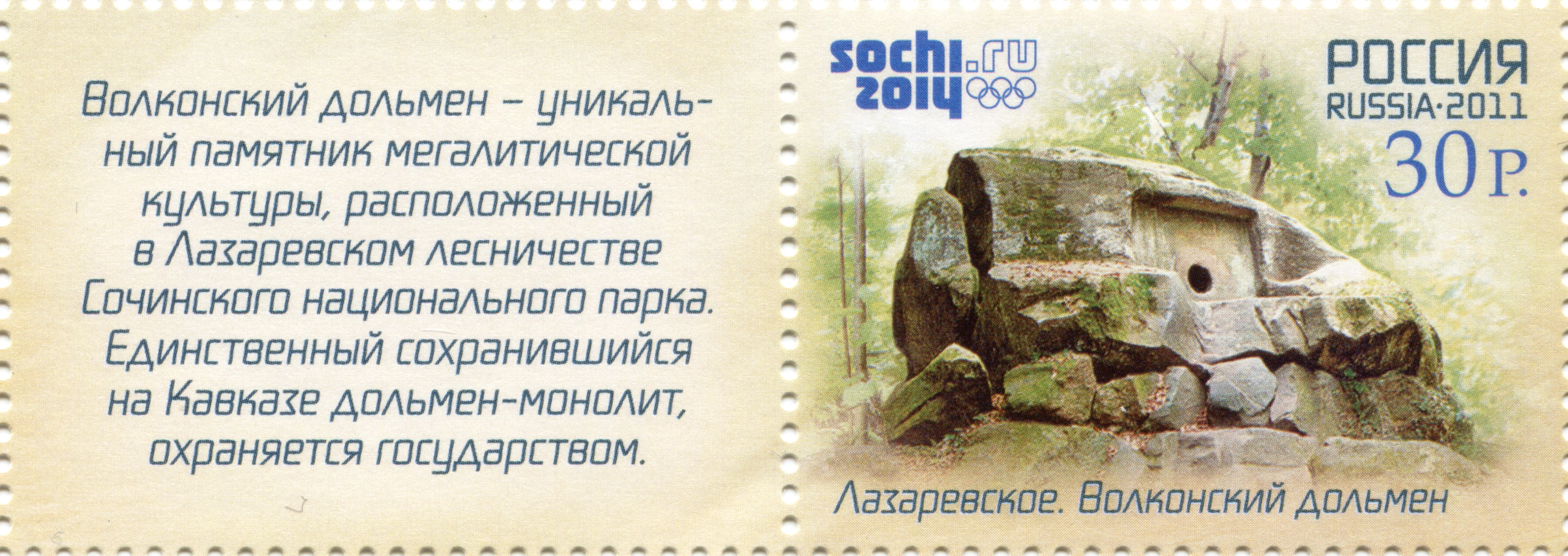
Volkonsky dolmen postage stamp
A 2011 Russian postage stamp depicting the Volkonsky dolmen, a megalithic monument located in the Lazarevskoye forestry of Sochi National Park, issued as part of a series for the 2014 Winter Olympics.

Sochi National Park wildlife and species highlights

Sochi National Park supports one of the most diverse vertebrate faunas of any Russian protected area, reflecting the unusual climatic and altitudinal range of its territory. The park's official Red Data Book lists numerous invertebrates, fish, amphibians, reptiles, birds, and mammals, including endemics and narrowly distributed Caucasian subspecies.

In the coniferous and mixed forests, mammals such as the Caucasian forest cat and the Caucasian otter occur alongside the European bison in reintroduction contexts. The park is also a critical site for bat conservation, hosting several cave-dwelling species including the greater horseshoe bat, the lesser horseshoe bat, Mehely's horseshoe bat, the giant noctule, and Schreiber's bent-winged bat, which depend on its extensive karst cave systems. Reptiles include Dinnik's viper, Kaznakov's viper, the Aesculapian snake, and the Greek tortoise, all Red Data Book species.

Raptors and large scavengers are particularly characteristic of the mountainous zones. Griffon vultures, cinereous vultures, golden eagles, bearded vultures, short-toed snake eagles, lesser spotted eagles, red kites, white-tailed eagles, peregrine falcons, and ospreys all occur within or above the forests, joined by the Caucasian black grouse as an endemic Caucasus inhabitant. Black storks nest in the forested river valleys. Streams support native fish such as the Azov-Black Sea shemaya and brown trout, and amphibians include the Caucasian toad, Caucasian parsley frog, and several Triton newts.

From 2009 the park has been home to the Caucasian Leopard Recovery Center, an active reintroduction site for the Persian leopard subspecies (Panthera pardus ciscaucasica), formerly extirpated from the region. This makes Sochi National Park one of the most important sites in Russia for the future recovery of a large apex carnivore in the Caucasus.
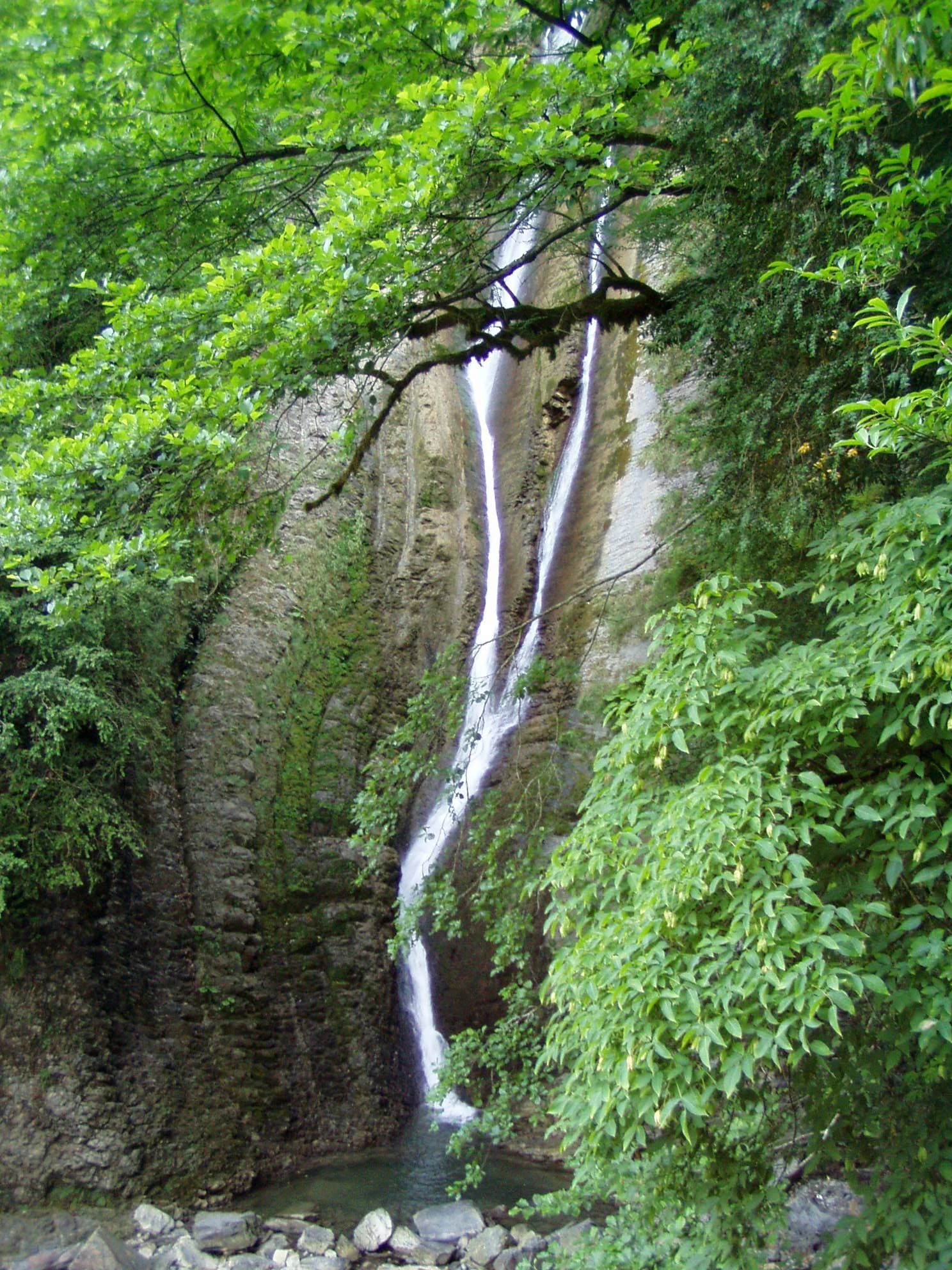
Orekhovsky waterfall in Sochi
The Orekhovsky waterfall located in Sochi

Sochi National Park conservation status and protection priorities

Sochi National Park is a cornerstone of biodiversity conservation on the Russian Black Sea coast. Its protected status, its large continuous area, and the unusually wide range of habitats it encompasses give it both regional and national importance.

The park serves as a refuge for many species that are endangered elsewhere in Russia or in the Caucasus, including relict Colchic and Mediterranean plants, several endemic amphibians and reptiles, numerous cave-dwelling bats, and a wide suite of large raptors. Karst caves within the park are among the most important bat hibernation and roosting sites in the region.

Beyond in-situ protection, the park is a center for active restoration work. The Caucasian Leopard Recovery Center, named after U.A. Semenov, has been operating within the park since 2009 as part of the broader program to restore the Persian leopard (Caucasian leopard) in the wild. Earlier the park also participated in European bison reintroduction efforts. Ecological education centers established within several of the park's forestry districts further strengthen its conservation role by connecting local communities and visitors with the protected area.

Sochi National Park cultural meaning and human context

Sochi National Park contains a remarkable density of cultural and archaeological heritage. Its mountain valleys and coastal lowlands have been inhabited for tens of thousands of years, and traces of this long human presence are preserved within the park itself.

Middle Paleolithic cave occupations, including the well-known Akhshtyrskaya cave and Vorontsovskaya cave sites, give the area a deep antiquity in the story of human settlement in the Caucasus. Later periods are represented by numerous dolmen groups of the Bronze Age, often clustered in the coastal and foothill districts and including the famous Volkonsky dolmen, the only surviving dolmen-monolith in the Caucasus. Iron and medieval periods are reflected in cliff fortresses and fortifications, from coastal strongholds such as the Hostinskaya fortress to inland fortifications like Godlik and Akhipse.

In the late nineteenth and early twentieth centuries the region saw the construction of Russian imperial-era military works such as the Navaginsky fort, alongside the development of tea cultivation, visible today in the surviving tea houses that are part of the region's identity. Together, these layers of human history, prehistoric, ancient, medieval, and modern, give the park an unusually rich cultural dimension alongside its natural values.
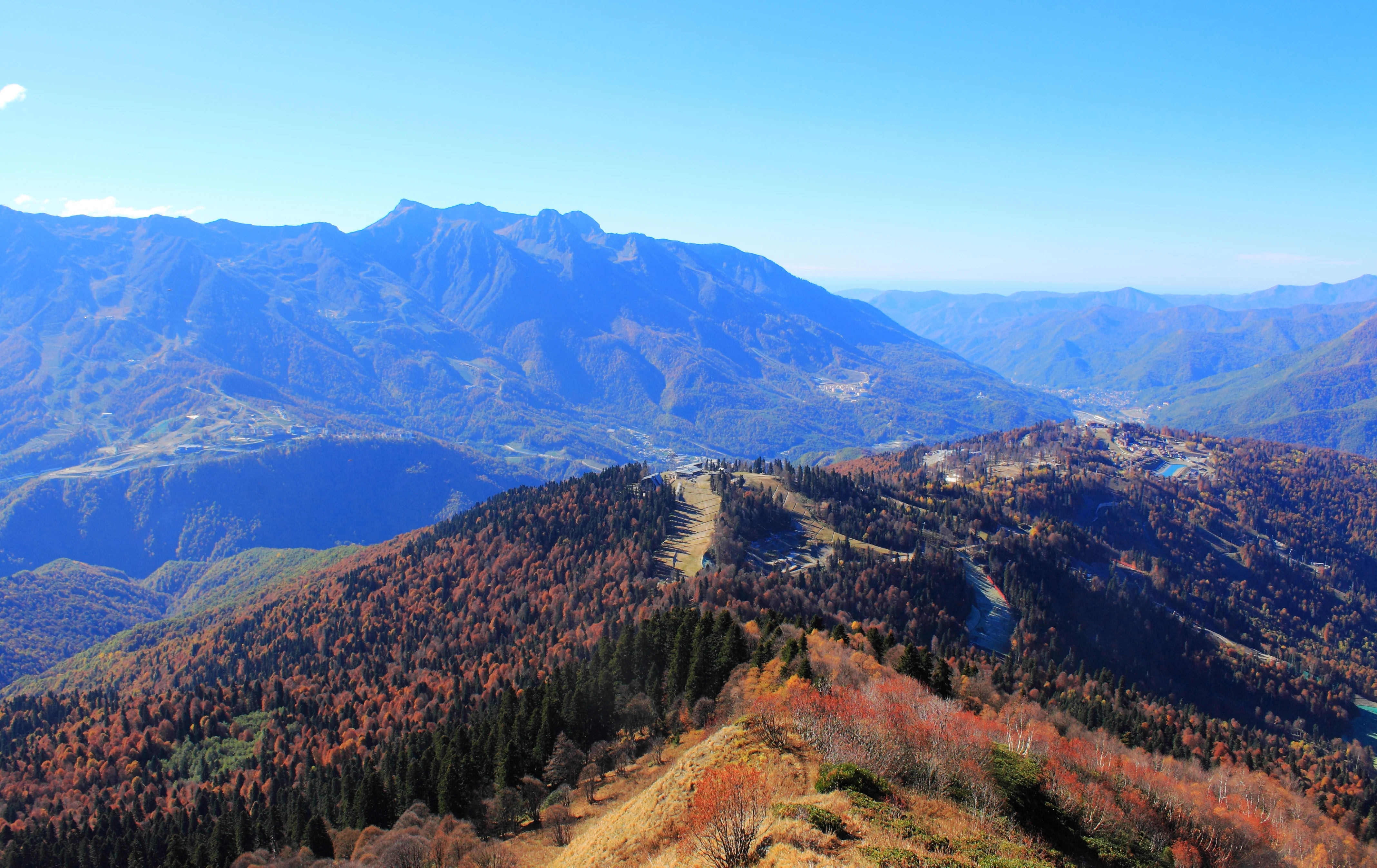
Autumn in Sochi National Park near Krasnaya Polyana
View of the Psekho Ridge and the Mzymta River valley near Krasnaya Polyana, located within Sochi National Park on the southern slopes of the Greater Caucasus in Krasnodar Krai.

Top sights and standout views in Sochi National Park

Sochi National Park stands out for the sheer compression of its landscapes within a single boundary: Black Sea coastline, relict Colchic forests, deep canyons, alpine ridges, and karst caves coexist across its territory. Iconic natural landmarks within the park include the Fisht massif, the Aibga ridge, the Eagle Rocks near Sochi, the 33 Waterfalls cascade, the Orekhovsky waterfall, the Yew-Boxwood Grove, the Vorontsovskaya cave system, and the Sochi Arboretum.

Ecologically, the park is distinguished by its humid subtropical climate, the survival of Colchic relict flora, a long list of Red Data Book species, and an unusually diverse bat fauna tied to its karst caves. The park also stands out for being among the first national parks in Russia and for hosting the Caucasian Leopard Recovery Center, marking it as a flagship site for large-carnivore restoration in the Caucasus.

Culturally, the park preserves a layered record of human presence: Middle Paleolithic cave sites, Bronze Age dolmen groups, medieval cliff fortresses, nineteenth-century Russian military forts, and traditional tea houses, all amid the same forested mountains and coastlines.

Best time to visit Sochi National Park

Sochi National Park spans a wide range of elevations and climates, so the character of a visit depends strongly on season and altitude. Spring, from late March through May, is a standout period for the park's flora, when relict colchicum, Caucasian snowdrops, cyclamen, kandik lilies and abundant wild orchids flower in the lower and middle elevations.

Summer, from June through early September, brings warm and humid conditions in the coastal and foothill zones, with cooler temperatures at higher elevations. This is the main season for hiking the upper mountains and alpine meadows, visiting waterfalls in full flow, and reaching the higher peaks. Autumn is generally a quieter period with colorful broadleaf and mixed forests, especially around Krasnaya Polyana.

Winter brings snow to the higher elevations, including ski areas above Krasnaya Polyana, while the coastal lowlands remain comparatively mild. Visitors focused on waterfalls, caves, and viewpoints can visit year-round, but those seeking the full alpine experience should plan around the snow-free season.
Monthly climate preview

Track monthly temperature ranges and precipitation patterns across representative protected coordinates

Sochi National Park Climate Normals, Long-Term Temperature and Precipitation Rhythm

Sochi National Park exhibits measured long-term temperature swings alongside steady monthly precipitation values across its representative coordinate point. Reviewing the complete twelve-month climatology dataset clarifies detailed seasonal temperature variations and precipitation distribution.
Annual mean13 °C
3 °C23 °C
Jan
Feb
Mar
Apr10°
May15°
Jun20°
Jul23°
Aug23°
Sep19°
Oct15°
Nov
Dec
Warmest month
August

23.2 °C

Coolest month
January

2.7 °C

Wettest month
October

4.5 mm/day

Driest month
August

2.4 mm/day

Park location guide

Geography guide, regional context, and park location map for Sochi National Park

Sochi National Park park geography, regions, and map view in Russia

Understand where Sochi National Park sits in Russia through a broader geographic reading of the surrounding landscape, nearby location context, and its mapped position within the national park landscape.

How Sochi National Park fits into Russia

Russia is a transcontinental nation spanning eleven time zones, bordered by fourteen countries. It is the world's largest country by area, covering 17,098,246 km². Moscow is the capital and largest city, while Saint Petersburg is the second-largest and a major cultural centre.

Wider geography shaping Sochi National Park in Russia

Russia spans Eastern Europe and North Asia, covering 17,098,246 km². It shares land borders with fourteen countries, more than any other nation, and spans eleven time zones. The landscape includes vast plains, mountain ranges such as the Urals and Caucasus, and extensive coastlines along the Arctic Ocean, Pacific Ocean, Baltic Sea, Black Sea, and Caspian Sea.

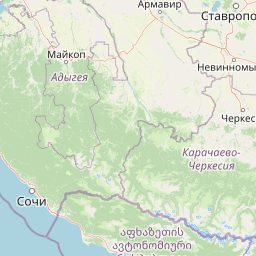
Map view of Sochi National Park

Use this park location map to pinpoint Sochi National Park in Russia, understand its exact geographic position, and read its mapped placement within the surrounding landscape more clearly.

Pigeon | © OpenStreetMap contributors

Location context for Sochi National Park

Krasnodar Krai
Natural feature types

View the Full Collection of Natural Features in Sochi National Park

Discover the complex landscape of Sochi National Park by navigating its mapped natural features. This MoriAtlas collection connects karst systems, river basins, and mountain peaks to provide a deeper understanding of the regional geography and terrain within this protected area.
Recorded earthquake history

Explore Historical Earthquake Records for Sochi National Park

Examine the recorded seismic history of this protected region through an indexed catalogue of historical earthquake events. MoriAtlas presents these documented occurrences by epicenter location, providing a clear perspective on the recorded seismic activity within the vicinity of Sochi National Park.

Sochi National Park Earthquake History

Catalogued events

39 events

Strongest magnitude

Magnitude 5.5

Most recent event

May 26, 2026

This history includes earthquakes recorded inside the park or within 50 km of its borders

Visual exploration of Black Sea coastlines, Colchic forests, and Caucasus mountain terrain

Sochi National Park Photos and Landscape Scenery

Photographic collections reveal the dramatic vertical gradient where subtropical shorelines rise directly into snowcapped peaks and dense relict woodlands. Visual research helps observers trace canyon networks, limestone cave systems, and protected habitats across the western Caucasus.

Griffon vulture in Sochi

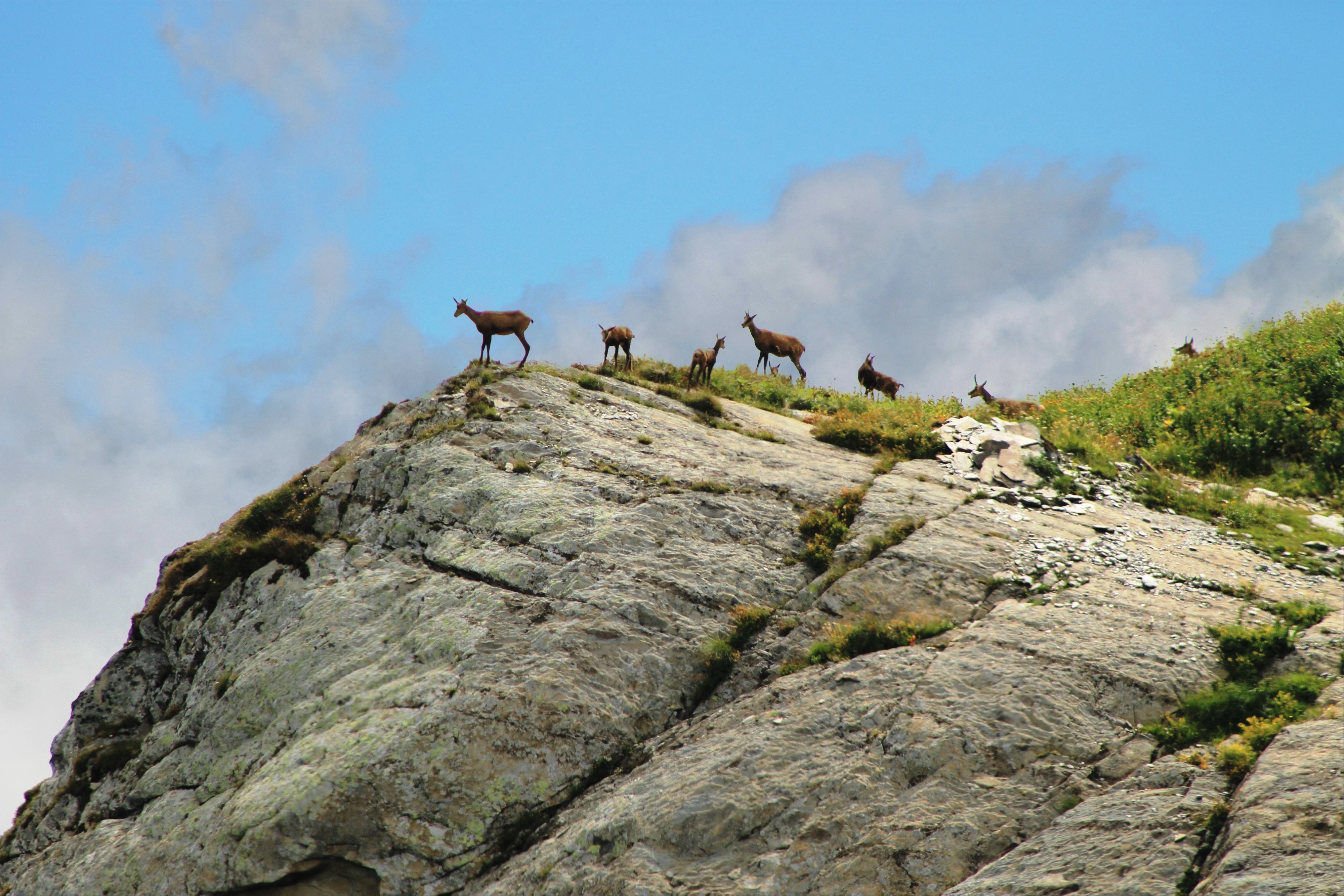
Wild chamois on Aibga Ridge

Dzykhra Mountain

Volkonsky dolmen postage stamp

Orekhovsky waterfall in Sochi

Erythronium caucasicum in Sochi National Park

Autumn in Sochi National Park near Krasnaya Polyana

Park atlas

Compare adjacent mountain reserves and coastal conservation landscapes

Parks Near Sochi National Park and Related Protected Areas in the Region

Browsing parks near Sochi National Park reveals connected ecosystems stretching from the Black Sea coast into the Greater Caucasus Mountains. Regional protected areas offer valuable context for comparing subtropical terrain, river gorges, and high-altitude wildlife habitats.
Watercolor artwork depicting a waterfall cascading between forested hills with a lake in the foreground and distant mountains
National parkKrasnodar Krai
Park boundaries overlap#1 closest

Northeast

Sochi National Park: Mapped Geography and Protected Mountain Landscapes

A cornerstone of the Western Caucasus mountain range

Sochi National Park represents a significant protected area within Krasnodar Krai, defined by its steep elevation changes and varied mountain ecosystems. The park preserves crucial river corridors and forest terrain, stretching from the Black Sea coast to the high-altitude meadows of the Greater Caucasus. This atlas overview highlights the natural boundaries and geographic character of one of Russia's most significant conservation landscapes.

Area
1,937.37 km²
Established
1983
IUCN
II
Relief
Mountain
Watercolor painting depicting mountains, a winding river, and green forests in a mountainous landscape
Nature reserveKarachay-Cherkess Republic
About 104 km away#2 closest

East

Teberda Nature Reserve: Protected Area Mapping and Geographic Context

Explore the mapped boundaries and regional geography of this protected landscape.

Teberda Nature Reserve is a significant protected area located in the Karachay-Cherkess Republic, offering rich opportunities for geographic exploration. This page provides detailed atlas-style information, focusing on the reserve's mapped landscape and its protected-area identity. Understand the unique geographic context and contours of Teberda Nature Reserve, contributing to a structured understanding of Russia's natural protected lands.

Area
849.96 km²
Established
1936
IUCN
Ia
Visitors
200K annual
Watercolor landscape with mountains, river, forests, and wetlands
National parkGeorgia
157 km away#3 closest

Southeast

Kolkheti National Park: Mapped Wetland Landscape & Protected Area in Georgia

Explore the peat bogs, coastal ecosystems, and bird migration routes.

Discover Kolkheti National Park, a key protected national park located in Georgia's western coastal region. This atlas entry focuses on the park's extensive wetland environments, including its significant peat bogs and Lake Paliastomi, highlighting its role as a critical migratory bird corridor and a unique natural landscape within the Black Sea region. Understand its geographic context and protected area boundaries.

Area
807.99 km²
Established
1998
IUCN
II
Visitors
13.7K annual
Watercolor painting of mountains, lake, and forest landscape with greenery and distant peaks
National parkKabardino-Balkaria
158 km away#4 closest

East

Prielbrusye National Park: Mapped Protected Landscape within Kabardino-Balkaria's Geography

Explore regional park boundaries and natural terrain context.

Prielbrusye National Park is a significant protected area featured in the MoriAtlas geographic discovery platform. This page details its identity as a national park, emphasizing its mapped boundaries and its position within the broader landscape of Kabardino-Balkaria. Users can explore the park's unique geographic context, understand its protected status, and integrate its information into a larger atlas-based understanding of regional natural territories.

Area
10,102 km²
Established
1986
IUCN
II
Relief
Mountain
National parkStavropol Krai
About 186 km away#5 closest

East

Kislovodsk National Park and the Mountain Landscapes of Stavropol Krai, Russia

Protected mountain terrain and urban resort geography

Tracing the vertical gradient of Kislovodsk National Park, this entry covers the park's transition from cultivated rose valleys to forested mountain ridges. Featuring sandstone formations and extensive walking trail networks, the geography showcases the intersection of Caucasus foothill ecosystems and managed resort heritage within the Stavropol Krai region.

Area
9.658 km²
Established
2016
IUCN
II
Visitors
5.1M annual
Watercolor painting of a mountainous landscape with rocky outcrops, forests, and distant hills
National parkRussia
About 186 km away#6 closest

East

Kislovodsk National Park: Geographic and Protected Area Atlas of the Caucasus Foothills

Mapped mountain terrain and urban forest boundaries in Russia.

Trace the extensive boundaries of Kislovodsk National Park, located within the North Caucasus foothills of Russia. This overview details the park's unique structure, shifting from city-adjacent gardens to the rugged elevation of the Dzhinal Ridge, providing a clear geographic context for one of Europe's most distinctive urban protected landscapes.

Area
10 km²
Established
2016
IUCN
II
Relief
Upland
Watercolor illustration of a landscape with green hills, trees, and a body of water
National parkAdjara
233 km away#7 closest

Southeast

Mtirala National Park: Protected Colchic Rainforest Landscape & Geographic Atlas

Explore Adjara's unique terrain and mapped protected boundaries.

Mtirala National Park, located in Georgia's Adjara region, is a protected national park renowned for its exceptionally high rainfall and ancient Colchic relict forests. This atlas-focused profile details the park's unique topography, its watershed between the Chakvistskali and Khoristskali rivers, and its significance as a vital ecosystem. Understand the geographic context of this protected landscape and its role in the broader Caucasus geography.

Area
281.26 km²
Established
2006
IUCN
II
Relief
Mixed relief
Watercolor illustration of a landscape with rolling hills, forests, and a winding river.
National parkAdjara
About 246 km away#8 closest

Southeast

Kintrishi National Park: Protected Colchic Forest Canyon Landscape in Adjara

Explore the mapped geographic boundaries of this unique Georgian national park.

Kintrishi National Park, located in Georgia's Adjara region, is a protected landscape renowned for its exceptionally intact Colchic deciduous forests within a steep river gorge. This area showcases dense woodland, dramatic terrain, and the unique Colchican willow species, offering rich geographic context. As a key protected area, Kintrishi National Park provides a valuable focus for atlas-based exploration of southwestern Georgia's natural heritage.

Area
186.84 km²
Established
2007
IUCN
II
Scope
Terrestrial

Common questions about visiting, size, designation, and location context for Sochi National Park

Sochi National Park FAQs for park facts, access, geography, and protected area context

Find quick answers about Sochi National Park, including protected-area facts, park geography, trail and visitor context, and how the park fits into its surrounding country and regional landscape.
MoriAtlas Explorer

Continue Your Protected Areas Search Across the Global Atlas

Deepen your exploration by continuing the structured search for national parks and protected areas worldwide. Utilize the comprehensive filtering capabilities to compare different conservation landscapes and refine your understanding of global park geography. Discover more about the distribution and characteristics of protected natural areas.

Global natural geography