
Why Kazbegi National Park stands out
Kazbegi National Park is best known for its spectacular alpine scenery featuring the iconic Mount Kazbegi and the dramatic Gergeti Trinity Church perched on a hillside above the town. The park protects one of the Caucasus region's most significant high-altitude ecosystems, characterized by steep glacial valleys, alpine meadows, and rugged mountain terrain. It is renowned for supporting populations of East Caucasian tur and chamois, as well as being a stronghold for endemic Caucasian plant species. The combination of outstanding natural beauty with cultural landmarks like the Gergeti Church makes Kazbegi one of Georgia's most recognizable protected areas.
Kazbegi National Park history and protected-area timeline
Kazbegi National Park was originally established in 1976 as a state nature reserve, reflecting Georgia's commitment to conserving its mountainous landscapes even during the Soviet period. The protected area was created to preserve the unique ecosystems of the Greater Caucasus region and the outstanding natural landscapes of the Khevi historic region.
Following the restoration of Georgia's independence in 1991, the country's protected area framework underwent significant reorganization. Under Georgia's Protected Areas Law, Kazbegi was redesignated as a national park, granting it formal protection under the national park category. This transition reflected a broader shift toward establishing parks that could balance conservation with sustainable tourism and public access.
The modern protected area complex includes multiple designated zones: the core national park area of approximately 8,686 hectares, along with several recognized nature monuments covering additional territory. These include Sakhiatsali Rock, a notable geological feature; Abano Mineral Lake, a small but ecologically distinct water body; and the Truso Travertines, representing unique mineral deposition formations. The park is administered by the Agency of Protected Areas of Georgia, the national body responsible for managing the country's protected area network.
Kazbegi National Park landscape and geographic character
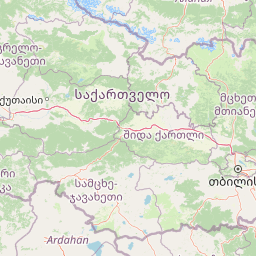
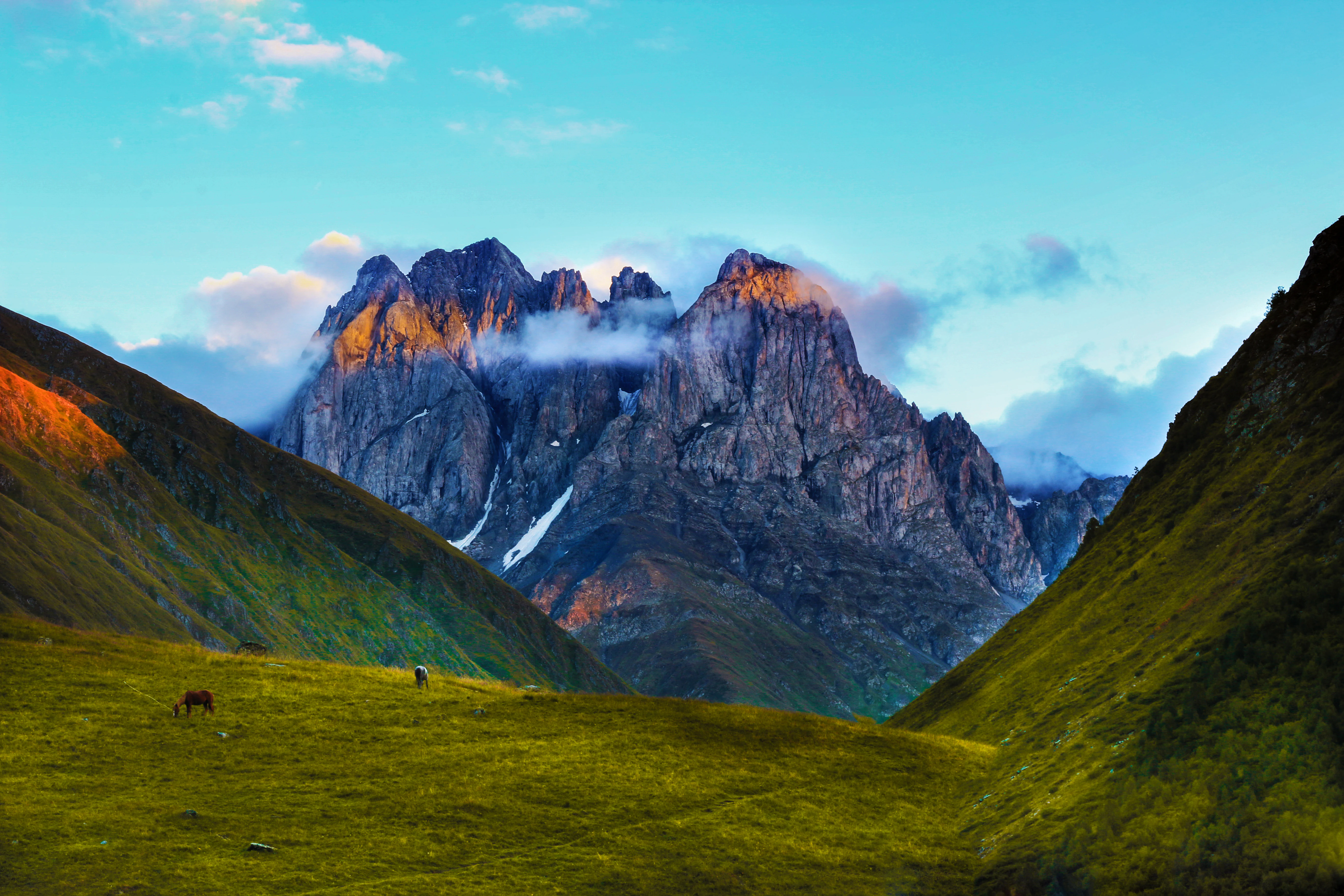
The landscape of Kazbegi National Park is defined by its position along the southern slopes of the Greater Caucasus main ridge, where towering mountain peaks give way to deep valleys and alpine terrain. The terrain is characteristically rugged, with steep-sided valleys carved by glacial activity and river erosion over millennia. The region's elevation range spans from approximately 1,400 meters at the valley floors to well over 3,000 meters at the highest peaks, creating diverse habitats across this vertical gradient.
Prominent features include dramatic rock faces and cliffs that define the dramatic scenery for which the region is famous. The landscape encompasses alpine meadows that bloom with wildflowers during the summer months, rocky terrain unsuitable for vegetation, and permanent snow fields on the highest summits. The Truso River valley and other watercourses have carved distinctive paths through the mountains, creating the characteristic valleys that define the Kazbegi area. The geological character of the region contributes to its visual drama, with the steep inclines and exposed rock creating the iconic Caucasus mountain scenery that attracts visitors from around the world.
Kazbegi National Park ecosystems, habitats, and plant life
Kazbegi National Park supports an ecologically significant mountain ecosystem characterized by remarkable plant diversity and distinctive habitat types. Approximately one-third of the park's territory is covered in forest, with the remaining areas comprising alpine meadows, snow-covered peaks, and inaccessible rocky terrain. The park documents approximately 1,347 plant species within its boundaries, representing one of the richest floral assemblages in the Caucasus region.
The forest communities are dominated by species adapted to the high-altitude environment, including Litvinov's birch, Caucasian pine, multiple juniper species, and sea buckthorn. These woodlands transition into alpine zones characterized by meadows and eventually into rocky terrain and permanent snow. Of particular conservation significance is the high degree of endemism, with over 26% of the plant species found in the park being endemic to the Caucasus region, meaning they occur nowhere else on Earth. This endemic character makes Kazbegi one of the most important centers of plant diversity in the entire Caucasus.
The park sits at the intersection of multiple ecological zones, creating a mosaic of habitats that supports diverse wildlife communities. The altitudinal range from subalpine forests through alpine meadows to nival zones creates distinct ecological bands, each supporting characteristic species assemblages.
Kazbegi National Park wildlife and species highlights
The fauna of Kazbegi National Park includes several species emblematic of the Caucasus mountain ecosystem. Among the most notable mammals is the East Caucasian tur, a wild goat species endemic to the eastern Caucasus that inhabits the rocky cliffs and steep terrain of the park. The chamois, another mountain goat-antelope, also occurs in the park's high-altitude zones. The brown bear remains present in the region, representing one of the larger predators within the park's ecosystem. Wolves maintain populations in the area, functioning as apex predators in the mountain ecosystem.
The birdlife of Kazbegi includes several species of conservation significance. The Caucasian snowcock inhabits the rocky alpine zones, while populations of griffon vulture and the bearded vulture, also known as lammergeier, are found in the park. The golden eagle, Georgia's national symbol, occurs as a breeding species in the high mountains. These raptor species are protected under Georgia's Red Book and represent the park's significance for avian conservation. Many of these wildlife species are listed in Georgia's Red Book of Endangered Species, reflecting their conservation importance and the critical role that Kazbegi plays in protecting them.
Kazbegi National Park conservation status and protection priorities
Kazbegi National Park serves as a critical conservation unit within Georgia's protected area network, preserving both outstanding natural landscapes and significant biodiversity. The park's designation as an IUCN Category II protected area reflects its primary objective of protecting natural ecosystems while allowing for sustainable public use. The high degree of plant endemism within the park's boundaries—exceeding 26% of documented species—makes it globally significant for biodiversity conservation.
The protected area provides essential habitat for species of conservation concern, including multiple species listed in Georgia's Red Book. The East Caucasian tur, chamois, wolf, brown bear, golden eagle, griffon vulture, and bearded vulture all receive protection within the park's boundaries. The presence of these species, particularly the large mammals and apex predators, indicates the ecological integrity of the park's ecosystems. The multiple nature monuments included within the protected area complex—Sakhiatsali Rock, Abano Mineral Lake, and the Truso Travertines—provide additional protection for specific geological and ecological features.
The park's management under the Agency of Protected Areas ensures that conservation objectives are integrated with sustainable tourism and visitor access, though challenges remain in developing appropriate infrastructure while maintaining ecological integrity.
Kazbegi National Park cultural meaning and human context
The Kazbegi region holds deep historical and cultural significance, situated in the historic Khevi region of Georgia. The landscape is marked by numerous religious monuments that reflect the area's role as a center of Georgian Christianity dating back centuries. The Gergeti Trinity Church, dating to the 14th century, stands as the most iconic landmark, perched on a hillside and framed by the dramatic Caucasus peaks. Additional historic structures include the Sioni basilica, Akhaltsikhe basilica, and the 17th-century Sno Castle.
The region also preserves evidence of pre-Christian traditions, with the area known for a blending of Christian and older pagan customs. This cultural layering reflects the historical position of Kazbegi as a frontier region where different traditions and influences intersected. The area's strategic importance along mountain routes passing through the Caucasus is evidenced by the numerous defensive structures and churches that mark the landscape. Local communities have maintained traditional land use practices in the surrounding areas, including pastoral activities that have shaped the cultural landscape over generations.
Top sights and standout views in Kazbegi National Park
Kazbegi National Park combines outstanding natural values with remarkable cultural heritage in one of the Caucasus region's most dramatic mountain settings. The park protects critical habitat for endemic species including over 26% of its plant species found nowhere else on Earth, while supporting populations of East Caucasian tur, chamois, and impressive raptor species. The iconic pairing of the Gergeti Trinity Church with the backdrop of Mount Kazbegi creates one of Georgia's most recognizable images. The high-altitude ecosystem, ranging from approximately 1,400 meters to over 3,000 meters, supports distinct ecological zones from subalpine forests through alpine meadows to rocky peaks. The park includes several nature monuments—Sakhiatsali Rock, Abano Mineral Lake, and Truso Travertines—adding geological and hydrological diversity to its conservation mandate.
Best time to visit Kazbegi National Park
Kazbegi National Park can be visited throughout the year, though the summer months from June through September typically offer the most accessible conditions for hiking and exploration. During this period, the alpine meadows are accessible, temperatures are moderate in the valleys, and the high mountain routes are snow-free. Autumn brings changing foliage colors to the forest areas and typically clear weather, though conditions begin to cool as the season progresses.
Winter transforms the landscape dramatically, with heavy snow cover creating conditions for winter sports and photography but making many trails inaccessible. The stark beauty of the snow-covered peaks is a significant attraction for winter visitors, though infrastructure limitations mean that access to the park requires appropriate preparation. Spring arrives later at these altitudes, with snow clearing from the lower trails in May and the first flowers appearing in the meadows. The shoulder seasons of late spring and autumn offer the advantages of fewer visitors while still providing access to the park's main attractions.