
Why Kozara National Park stands out
Kozara is best known for its dense deciduous and mixed forests covering the majority of the park area, creating a distinctive green landscape visible from the surrounding lowland plains. The park is renowned for its significant biodiversity, with 865 documented plant species including 19 rare and endangered varieties such as yew, lily-of-the-valley, wild cyclamen, and various orchids. The memorial complex at Mrakovica represents the park's historical importance, commemorating the organized partisan resistance during World War II and the approximately 35,000 victims from the wider region. The annual Kozara Marathon and Kozara Ultra Trail race, along with the UCI-listed Kozara Grand Prix mountain bike competition, have become notable sporting events drawing participants to the park's trail network.
Kozara National Park history and protected-area timeline
Kozara National Park was established on April 6, 1967, when the area was proclaimed a protected national forest under Yugoslav authority. The mountain had already gained historical significance during World War II, when the forested terrain provided shelter and strategic advantage to partisan resistance fighters opposing occupying forces. The establishment of the park was closely connected to preserving this historical memory, and in 1972 a major monument was erected at Mrakovica to honor approximately 35,000 victims from the wider region killed during the war. A museum was added in 1974, and a memorial wall listing 9,864 names of partisan fighters who died defending the area was completed. Unlike other Yugoslav memorial sites of the period, Kozara was primarily presented as a space of local suffering, liberation, and connection to the partisan movement rather than as a site of all-Yugoslav significance. Following the Bosnian War from 1992 to 1995, the memorial complex experienced a period of abandonment, though the main monument remained undamaged. In 1993, a cross was placed at the memorial entrance dedicated to WWII victims. Since 2012, the park has been governed by specific legislation enacted by Republika Srpska, and commemorative events continue annually on July 4th to mark the battle's anniversary.
Kozara National Park landscape and geographic character
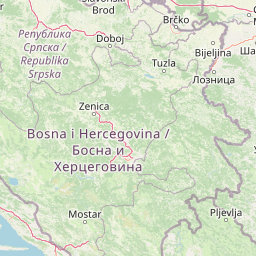
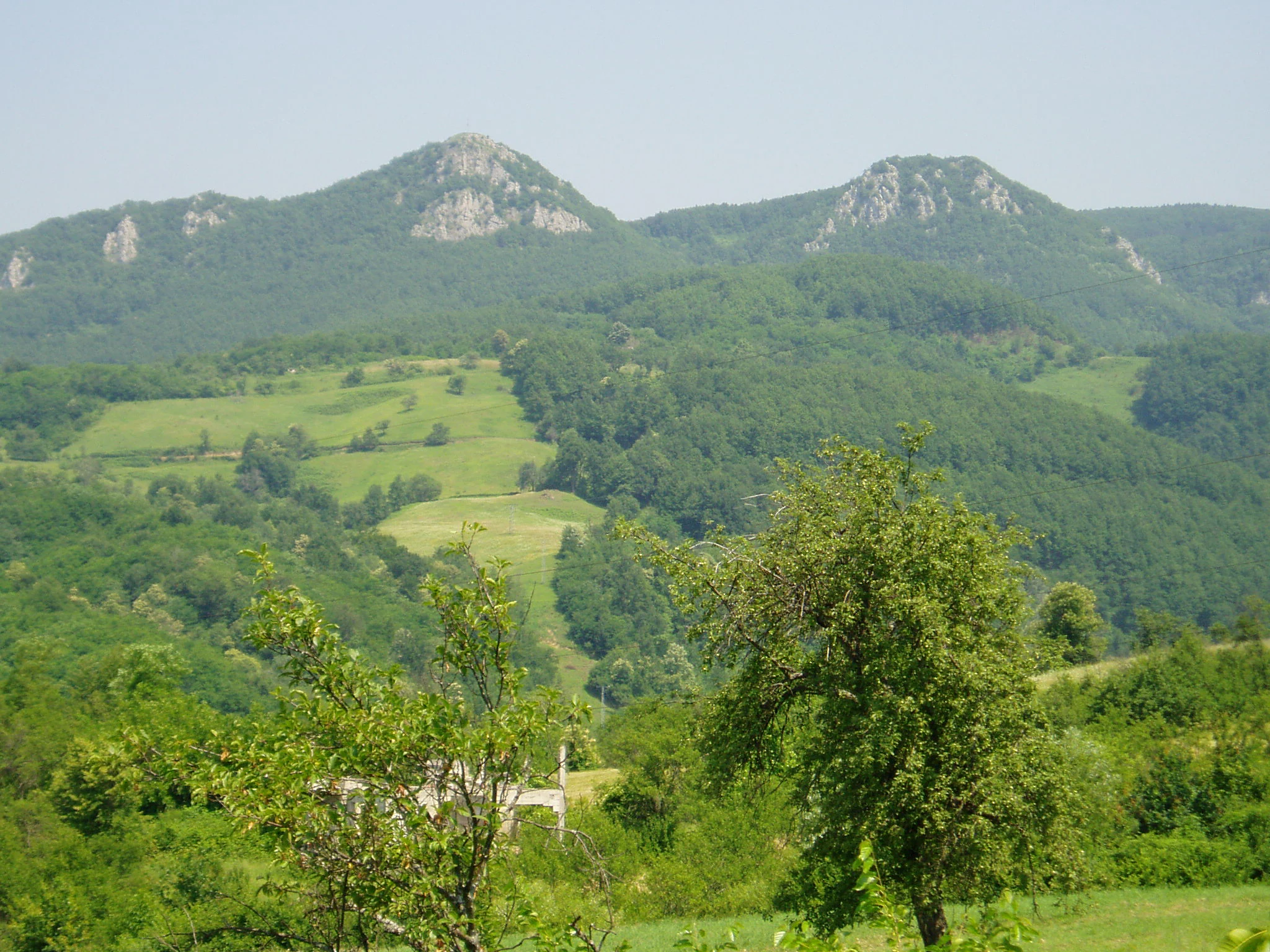
The Kozara landscape is characterized by a series of rounded, forested ridges and peaks rising from the surrounding lowland plains of the Pannonian basin. The highest point within the park reaches 876 meters at Gola planina, with other significant peaks including Rudine at 750 meters, Jarčevica at 740 meters, Glavuša at 793 meters, and Bešića-poljana at 784 meters. The central Mrakovica area contains several flat or gently sloping plateaus at elevations between 700 and 800 meters, which serve as the primary locations for visitor facilities and the memorial complex. The terrain is cut by numerous small streams and brooks, including Mlječanica, Moštanica, and the Starenice (Kozaračke rijeke), which radiate from the mountain's central watershed. The park's forests alternate with clearings, glades, and meadows, creating a mosaic landscape that varies in character from dense woodland to more open pastoral areas. The surrounding rivers—Una, Sava, Sana, and Vrbas—form a natural boundary to the park and contribute to the visual separation of this forested highland from the agricultural lowlands.
Kozara National Park ecosystems, habitats, and plant life
The ecological diversity of Kozara National Park is remarkable given its relatively modest area of nearly 3,900 hectares. Botanical surveys have documented 865 plant species across the park, including 657 vascular plants, 117 fungi, 11 lichens, and 80 mosses. The forest cover dominates the landscape, with beech and fir forests prevailing in the northern portions, while the southern areas feature lower-growing oak coppices and plantations of conifers including black pine, white pine, and Norway spruce. The park supports 19 documented rare and endangered plant species, including the English yew, lily-of-the-valley, wild cyclamen, Martagon lily, Daphne, hepatica, and several orchid species including the endangered Cephalanthera longifolia. The moderate continental climate supports this diverse flora, with the park functioning as an important hydrological node for the Kozara mountain, collecting and releasing water from numerous springs and streams that feed the surrounding river systems. Approximately 41 percent of the park has been assessed as suitable or very suitable for recreational use, with the most favorable conditions located in the central, northern, and eastern sections.
Kozara National Park wildlife and species highlights
The mammalian fauna of Kozara National Park includes several species typical of Dinaric forest ecosystems. Wild boar represents a significant species in the park's ecosystem, along with roe deer, wild hare, and red fox. European pine marten and stone marten are present among the mustelid species, alongside badger and squirrel. Wild cat, though less commonly observed, inhabits the more remote forest areas. The bird population is notably diverse, with birds of prey including various hawk and kite species and owls represented in the forest and open woodland habitats. Non-raptorial bird species include partridge, wood pigeon, turtle dove, thrushes, warblers, magpie, nightingale, various tit species, and sparrows. The ecological structure of the park—with its mix of forest, clearings, water sources, and the surrounding agricultural landscape—supports this avian diversity and provides habitats for both forest-dwelling and more open-country species.
Kozara National Park conservation status and protection priorities
Kozara National Park holds IUCN Category II designation as a national park, reflecting its primary purpose of protecting natural ecosystems while allowing for sustainable recreational use. The park has also achieved certification from the EUROPARC Federation as an IUCN Category V protected area, recognizing its value for both conservation and recreation. The designation acknowledges the park's successful integration of natural preservation with cultural-historical protection, as the memorial complex represents an important human heritage dimension within the protected landscape. The high percentage of forest cover—88 percent of the park area—represents a significant conservation achievement, maintaining what is essentially the last major forest remnant in the broader Pannonian region of northwestern Bosnia. The documentation and protection of 19 rare and endangered plant species demonstrates active conservation management, while the continued ecological monitoring of the 865 documented species provides a scientific foundation for ongoing protection efforts.
Kozara National Park cultural meaning and human context
The cultural significance of Kozara National Park is deeply intertwined with the events of World War II and the partisan resistance movement in occupied Yugoslavia. The mountain provided strategic terrain for organized resistance against occupying forces, and the Battle of Kozara became a pivotal chapter in the region's wartime history. The memorial complex at Mrakovica serves as the primary expression of this heritage, centered on a monument erected in 1972 followed by the establishment of a museum in 1974 and a memorial wall bearing the names of 9,864 fallen partisan fighters. Unlike many Yugoslav-era memorial sites that emphasized pan-Yugoslav narratives, Kozara was presented primarily as a space of local suffering and resistance, creating a distinct regional identity around the mountain and its defenders. The famous poem "Stojanka majka Knežopoljka," written by Skender Kulenović in 1942, became a cultural testament to the region's wartime experience. Since the 1990s, while commemorative events continue annually on July 4th, the park administration has worked to balance this historical heritage with a broader emphasis on natural recreation and tourism.
Top sights and standout views in Kozara National Park
Kozara National Park offers a distinctive combination of forested mountain landscapes, ecological diversity, and historical significance within a relatively compact protected area. The 300-kilometer trail network provides extensive opportunities for hiking, cycling, and nature exploration across varied terrain from dense forest to open glades. The annual Kozara Marathon and Kozara Ultra Trail attract runners seeking a challenging mountain race, while the UCI-calendar Kozara Grand Prix brings competitive mountain biking to the park's singletrack. The Mrakovica memorial complex provides contemplative heritage tourism focused on WWII history, while the surrounding forest and meadow landscapes support nature observation and photography. The park's proximity to Banja Luka and Prijedor makes it accessible for day trips while also supporting longer stays through camping and cabin accommodations. The spring period, particularly around May 1st, sees the park at its busiest with spontaneous visitor gatherings reaching up to 10,000 people at peak times.
Best time to visit Kozara National Park
Kozara National Park can be enjoyed throughout the year, though each season offers distinct experiences. The spring months of April and May bring forest floors alive with wildflowers and new foliage, creating particularly attractive conditions for hiking and nature observation. May 1st has become a traditional peak visitation day, with large spontaneous gatherings at Mrakovica representing a local cultural practice. Summer offers warm conditions ideal for trail-based activities, though the forest canopy provides welcome shade. The autumn season showcases the park's deciduous forests in rich seasonal colors, making it a particularly scenic time for photography and walking. Winter transforms the landscape, with opportunities for alpine skiing at developed facilities within the park and a quieter, more contemplative atmosphere for those seeking to explore the memorial sites and forest trails without the summer crowds. The moderate continental climate means all seasons present viable options for different types of park experiences.