Mori Atlas logo
National parkNizhegorodskoe Povolzhie National Park

Discover the complex ecological network of taiga, karst formations, and Volga river habitats.

Nizhegorodskoe Povolzhie National Park: A Comprehensive Atlas of Protected Russian Landscapes

(Nizhegorodskoe Povolzhie National Park named after V.A. Lebedev)

Nizhegorodskoe Povolzhie National Park serves as a federal protected area within Nizhny Novgorod Oblast, characterized by a unique mosaic of five distinct geographic clusters. These areas encompass some of the largest remaining old-growth southern taiga forests in Europe, intact peat bog systems, and dramatic limestone karst terrain. By consolidating diverse ecosystems including sandy Volga terraces and meadow-steppe fragments, the park provides essential habitat for rare raptors and bat populations across its diverse regional network.

national parkEuropean RussiaNizhny Novgorod Oblastold-growth taigapeat bogswetlands

Nizhegorodskoe Povolzhie National Park

National park

Park overview

Structured park overview, official facts, and landscape profile for Nizhegorodskoe Povolzhie National Park

Nizhegorodskoe Povolzhie National Park park facts, protected area profile, and essential visitor context

Review the core facts for Nizhegorodskoe Povolzhie National Park, including designation, size, terrain, visitor scale, habitats, and operating context in one park-focused overview.

About Nizhegorodskoe Povolzhie National Park

Nizhegorodskoe Povolzhie National Park is a federal protected area in the central part of European Russia, created in 2024 as part of the national Ecology project. It is the first national park to be established within Nizhny Novgorod Oblast, an industrial and densely populated region that historically lacked large federal-level nature reserves. The park was deliberately designed not as a single contiguous mass but as a set of five separated clusters, each capturing a different natural complex that is underrepresented or threatened in the surrounding region.

The largest cluster is Kilemarskaya Taiga in the northeast of the oblast, which extends from the Voskresensky and Sharanga districts. This cluster protects one of the largest remaining in Europe of undisturbed old-growth southern taiga, dominated by dark coniferous forests of Siberian fir, Norway spruce, aspen, and birch, with oak elements reaching the northern limit of their range along the Yuronga River. The adjacent Lake Yurongskoye is the only known habitat in the region for the floating water-lily species nimfeynik schitolistny. This cluster is also home to boreal faunal elements such as Siberian newt, Eurasian nutcracker, Eurasian pygmy owl, and the secretive dusky cuckoo.

The second major cluster, Kamsko-Bakaldinskie Bogs, covers roughly 20,000 hectares in the Voskresensky, Lyskovsky, and Vorotynsky districts. It is the largest and only still-intact peat bog system in the Volga basin and forms the core of an internationally recognized wetland of importance for migratory and breeding birds. The bog landscape mixes raised, transitional, and lowland peatlands with pine forests on drier ground and over twenty bog complexes and six lakes, several of which are protected as natural monuments. Peat deposits reach depths of as much as fourteen meters in places. The area serves as breeding territory for rare raptors including greater spotted eagle, short-toed snake eagle, peregrine falcon, and golden eagle.

The Pustynskie Lakes cluster in the northwest of the Arzamas district and the southeast of the Sosnovskoye district contains century-old forest stands, lowland and transitional bogs, and karst lakes, situated at the ecological transition between sub-boreal forests, oak woodlands, and meadow steppe. The Povolzhie coastal cluster spans the Kstovo, Lyskovsky, and Bor districts and includes the only remaining stretch of the Volga with a natural, unmodified hydrological regime. It combines high sandy dunes supporting tree-form junipers, pine forests on river terraces, oak-dominated slopes, and one of the last fragments of meadow steppe in the region. Finally, the tiny Ichalkovsky Bor cluster in the Perevoz urban district preserves a forested patch on a high limestone river-cliff above the Pyana River, notable for its karst sinkholes, caves, and grottoes, and for harboring the only breeding pair of imperial eagle in the region, along with one of the largest bat hibernation sites in the oblast.

Taken together, these five clusters create a network that connects taiga, peat bogs, river-cliff forest, karst woodland, and steppe fragments, conserving biodiversity that no single habitat could support on its own.

Quick facts and research context for Nizhegorodskoe Povolzhie National Park

Nizhegorodskoe Povolzhie is a federal national park in Nizhny Novgorod Oblast, Russia, created on 28 March 2024 by Russian government decree and named after Senator Vladimir Lebedev. Its total area is about 65,802 hectares.

The park is divided into five separate clusters located across nine administrative districts: Kilemarskaya Taiga, Kamsko-Bakaldinskie Bogs, Pustynskie Lakes, Povolzhsky Coast, and Ichalkovsky Bor. Several of these areas had previously been protected as wildlife sanctuaries or natural monuments.

Its territory lies along the middle Volga river system and includes old-growth southern taiga, raised and transitional peat bogs, karst lakes, steppe fragments on sandy river terraces, and one of the few remaining stretches of the Volga with a natural hydrological regime. The park is part of the Nizhny Novgorod Zavolzhye UNESCO biosphere reserve and a Ramsar-recognized wetland of international value.

Protection and recognition

Documented terrestrial protection scope and conservation recognition metrics

Nizhegorodskoe Povolzhie National Park Protection Status and Designation Records

Nizhegorodskoe Povolzhie National Park maintains a documented terrestrial protection scope across its regional landscape. Structured records outline baseline conservation status and official designation metrics for this protected area.

Protection details

Protection scope
Terrestrial
Transboundary protection
No
Park context

Deeper park guide and search-rich context for Nizhegorodskoe Povolzhie National Park

Nizhegorodskoe Povolzhie National Park history, landscape, wildlife, and travel context

Explore Nizhegorodskoe Povolzhie National Park through its history, landscape character, ecosystems, wildlife, conservation priorities, cultural context, and seasonal travel timing in a structured park guide built for atlas discovery and search intent.

Why Nizhegorodskoe Povolzhie National Park stands out

Nizhegorodskoe Povolzhie stands out for the exceptional ecological breadth packed into a single protected designation. Its five clusters protect, within one park, very different ecosystems: some of the largest surviving old-growth southern taiga dark coniferous forests in Europe; the largest and most intact peat bog system remaining in the Volga basin; a rare fragment of unreconstructed Volga shoreline with sandy dunes and steppe; and an isolated karst pine forest with limestone sinkholes and caves. The park also contains a remarkable concentration of rare species. Its wetlands serve as breeding and refuge habitat for globally significant raptors such as greater spotted eagle, short-toed snake eagle, peregrine falcon, and golden eagle. The karst forests host one of regional Russia's most important bat hibernation sites, while the taiga provides refuge for cold-adapted species whose main distribution lies far to the east or north. This combination of landscape diversity and rare-species richness gives the park a distinctive profile among recently established Russian protected areas.
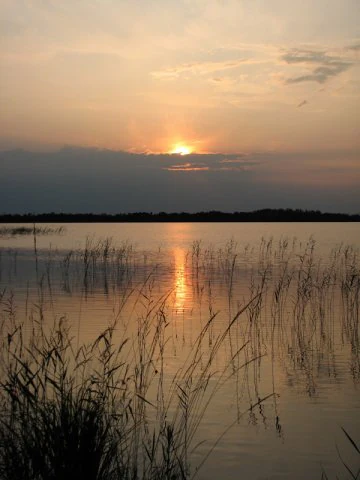
A peaceful lake at sunset with reeds emerging from the water in the foreground and a distant, flat shoreline under a hazy, warm sky.
Sunset over Bolshoe Plotovo lake and the surrounding boglands in the Nizhegorodskoe Povolzhie region.

Nizhegorodskoe Povolzhie National Park history and protected-area timeline

The idea for what became Nizhegorodskoe Povolzhie emerged in 2019, when the first national-park planning process for Nizhny Novgorod Oblast was launched under the federal project on Conservation of Biological Diversity and Development of Ecological Tourism, part of the national Ecology program. The work was carried out by the All-Russian Research Institute Ecology. Landscape studies identified five promising zones for the future park: Kilemarsky, Kamsko-Bakaldinsky, Zavolzhsky, Pustynsky, and Ichalkovsky, covering more than 440,000 hectares in total.

Through subsequent negotiations, the area considered for designation shrank considerably. The earlier 76,000-hectare proposal was reduced to about 65,000 hectares before final approval, largely due to difficulties in reaching agreement with existing land users in the proposed zones. The park was formally established by decree of the Russian government on 28 March 2024, under decree number 389. It was named in honor of Vladimir Albertovich Lebedev, a senator from Nizhny Novgorod Oblast who had played an active role in biodiversity conservation and had personally taken part in the park's design phase.

Although the park is officially new, many of its core areas already had a long history of legal protection. Kilemarsky, Pustynsky, and Ichalkovsky wildlife sanctuaries, the Kamsko-Bakaldinskaya group of bogs recognized as a wetland of international importance, and individual natural monuments such as the Pustynskie Lakes and Lake Bolshoe Plotovo were absorbed into the new national park, giving the protected complex a longer de facto protection record than its official founding date suggests.

Nizhegorodskoe Povolzhie National Park landscape and geographic character

The park's landscape mosaic is unusually rich for a single designation in European Russia, combining elements that normally belong to separate geographic regions. The Kilemarsky cluster in the northeast defines the park's northern landscape character, with continuous high-canopy southern taiga, dense dark coniferous stands on podzol soils, scattered broadleaf components, and the Yuronga River valley with occasional lakes such as Lake Yurongskoye. This is one of Europe's most extensive surviving examples of a relatively untouched coniferous landscape.

The Kamsko-Bakaldinskie Bogs cluster in the central lowlands introduces open mire landscapes. Here the ground flattens into vast peat plains, dotted with bog pools and lined by sparse pine forests on sandy ridges between the bogs. The Pustynskie Lakes cluster adds karst features: shallow lakes in karst depressions, surrounded by mature mixed forests and lowland bogs, marking the transition between sub-taiga forest and meadow steppe.

The Povolzhsky cluster carries the Volga signature: a tall right-bank terrace with sandy dunes, dry pine forests, juniper stands, and small meadow-steppe patches that face the river. The Ichalkovsky Bor cluster is the most geologically dramatic. It is built on the steep right bank of the Pyana River, exposing limestone bedrock, with a striking array of karst sinkholes, shafts, and caves. The largest of these, Kuleva Yama, is about 200 meters long and 150 to 180 meters wide and reaches roughly 25 meters in depth, while many other sinkholes measure 50 to 60 meters across and approach 30 meters deep. The park's landscape is therefore a composite of taiga plain, peatland, floodplain terrace, and limestone karst.

Nizhegorodskoe Povolzhie National Park ecosystems, habitats, and plant life

The ecological character of Nizhegorodskoe Povolzhie is defined by five sharply different habitat systems. The Kilemarsky area supports an old-growth southern taiga forest on the boundary of zonal dark-coniferous and broadleaf vegetation, where fir, spruce, aspen, birch, and oak coexist in unusual combinations. The canopy is moss-rich, the understory includes rare orchids such as lady's slipper and red helleborine, and the lichen flora features old-forest indicator species such as Lobaria pulmonaria. Nearby Lake Yurongskoye supports a unique aquatic community including the floating water-lily nimfeynik schitolistny, otherwise unknown in the region.

The Kamsko-Bakaldinskie Bogs represent a different kind of habitat entirely. They combine raised Sphagnum mires, transitional bogs, and lowland sedge mires, with sundew, dwarf birch, small-fruited cranberry, bay willow, and blueberry willow among the characteristic bog plants, set against pine forests on dry ground. The peat column in places reaches fourteen meters. The Pustynskie Lakes zone adds broadleaf-rich forest, with individual oaks in floodplain oak woodlands estimated to be as much as 300 years old, growing beside karst lakes and bog margins.

The Povolzhsky cluster introduces sandy terrace habitats rather than typical taiga: high dunes, dry pine forests with juniper, and meadow steppe elements clustering against the upper river terrace. The Ichalkovsky Bor is a unique combination within the East European Plain, where steppe, oak woodland, taiga, and mountain-type vegetation come together on a single limestone site, producing unusually high species richness in a compact area. Together these habitats cover more than 65,000 hectares of representative natural landscape for central European Russia.

Nizhegorodskoe Povolzhie National Park wildlife and species highlights

Across all of its clusters, Nizhegorodskoe Povolzhie supports 157 animal species listed in the Red Book of Nizhny Novgorod Oblast, including 30 species listed in the Red Book of the Russian Federation. Among these, 88 bird species have some form of conservation status, with twenty bird species listed at federal level. The park therefore combines raptor, waterbird, owl, bat, and mammal conservation values in a single protected system.

The Kamsko-Bakaldinsonie bog area is one of the most important breeding grounds for large raptors in the central Volga region. Greater spotted eagle, short-toed snake eagle, peregrine falcon, and golden eagle have all been recorded nesting in or around the bog area, whose remoteness and waterlogged ground provide significant protection for reproduction. The Povolzhsky cluster along the Volga supports invertebrates such as the spring dung beetle, Briseis hermit, and steppe Tarpeia butterfly, along with spotted ant and Orion blue butterfly, the latter two having only two known modern refuges in the region. The Ichalkovsky Bor hosts the only known breeding pair of imperial eagle remaining in Nizhny Novgorod Oblast, as well as common buzzard, European honey buzzard, black kite, boreal owl, Eurasian eagle-owl, and long-eared owl, while its underground caves form the largest bat hibernation site in the region, sheltering nine of the twelve bat species recorded in the oblast.

The Pustynskie Lakes area is one of the few remaining habitats of the regionally endangered pallid harrier, the Russian desman (a species threatened with extinction), and the European mink, whose regional population is at critically low levels. Mammals of note across the park also include the great jerboa, the only member of its family in the region, the spotted ground squirrel, listed at the federal level as declining, and the Siberian newt, the rarest amphibian in the oblast with fewer than 1,000 known individuals. The Kilemarsky taiga adds a distinctive boreal faunal element, including species such as Eurasian nutcracker, brambling, dusky cuckoo, Eurasian pygmy owl, yellow-necked mouse, common blackbird, and European greenfinch, which represent either northeastern or western faunal influences rarely seen together at this latitude.

Nizhegorodskoe Povolzhie National Park conservation status and protection priorities

Nizhegorodskoe Povolzhie carries significant conservation weight both because of its habitat diversity and because of the formal protection it formalizes. The Kamsko-Bakaldinskie Bogs form part of the only internationally important wetland area in the Volga Federal District, lie within the Nizhny Novgorod Zavolzhye UNESCO biosphere reserve, and are registered as a key ornithological territory of global importance. By integrating these already-recognized lands into a single national park framework, the designation extends protection beyond earlier sanctuary-level measures and provides a coordinated regime for managing hydrology, peatlands, and breeding bird populations.

The park also absorbs and elevates several pre-existing natural monuments and wildlife sanctuaries. Kilemarsky, Pustynsky, and Ichalkovsky sanctuaries, together with the natural monuments of Lake Bolshoe Plotovo, Lake Svetloye, Lake Gorskoye, the Pustynskie Lakes, and the larger bog complexes, gain stronger federal-level protection as part of the national park. This is particularly important for the Kilemarsky area, which preserves one of Europe's largest forest tracts of undisturbed southern taiga with oak elements at the northernmost limit of oak's natural distribution.

From a conservation perspective, the park's individual clusters fill distinct ecological roles. The bog areas safeguard carbon-rich peatlands and critical raptor nesting habitat. The river-cliff and steppe fragments along the Volga protect one of the last unmodified stretches of the river, valuable for hydrological, geomorphological, and steppe-ecosystem reasons. The Ichalkovsky karst area provides irreplaceable habitat for cave-roosting bats and for several bird species with no other breeding site in the oblast. By unifying such varied sites under a single national park, the designation creates a coherent framework for conservation across an unusually wide range of ecological zones.

Top sights and standout views in Nizhegorodskoe Povolzhie National Park

The park's strongest distinguishing feature is the combination, in one federal-level designation, of five very different natural systems: old-growth southern taiga, peat bogs of international importance, sandy Volga terrace with steppe fragments, karst lakes, and a steep limestone river cliff. Within these areas, several standouts define the park's identity.

Kilemarsky Taiga is one of the largest remaining virtually undisturbed old-growth southern taiga forests in Europe. The Kamsko-Bakaldinskie Bogs are the largest fully preserved peat bog system in the entire Volga basin. The Povolzhsky cluster protects the last stretch of the Volga not altered by hydroelectric damming. The Ichalkovsky Bor contains a striking karst terrain of conical sinkholes and caves, including Kuleva Yama, and anchors the largest bat hibernation site of the oblast.

Best time to visit Nizhegorodskoe Povolzhie National Park

Because the park spans very different ecosystems, the best moment to visit depends on what a visitor wants to see. In late spring and early summer, the taiga cluster at Kilemarsky and the karst forest at Ichalkovsky Bor are most rewarding for wildflower enthusiasts, when lady's slipper orchids and other rare understory species come into bloom and the broadleaf layer is in fresh leaf.

Summer is the strongest season for wetland observation at the Kamsko-Bakaldinskie Bogs, when breeding raptors and large waterbirds are most active and access conditions are most favorable. Autumn brings intense color to the taiga and oak-rich clusters, especially around the Yuronga valley and the Pustynskie Lakes, with golden broadleaf canopies and mushroom-rich forests. Winter tends to be harsh in the northern taiga and bog areas, which is also when the bat hibernation sites in the Ichalkovsky caves are biologically most sensitive, so cold-season visits are generally less suitable for general nature exploration.
Monthly climate preview

Long term representative temperature and precipitation patterns across twelve monthly periods

Nizhegorodskoe Povolzhie National Park Climate Normals and Annual Temperature Rhythm

Nizhegorodskoe Povolzhie National Park records measured monthly temperature and precipitation variations across a representative coordinate point from long term climatology data. Examining the complete twelve month climate profile reveals detailed shifts in average temperature and precipitation norms.
Annual mean3 °C
-13 °C19 °C
Jan-13°
Feb-12°
Mar-5°
Apr
May12°
Jun17°
Jul19°
Aug17°
Sep11°
Oct
Nov-5°
Dec-11°
Warmest month
July

19.2 °C

Coolest month
January

-12.8 °C

Wettest month
June

2.6 mm/day

Driest month
March

1.4 mm/day

Park location guide

Geography guide, regional context, and park location map for Nizhegorodskoe Povolzhie National Park

Nizhegorodskoe Povolzhie National Park park geography, regions, and map view in Russia

Understand where Nizhegorodskoe Povolzhie National Park sits in Russia through a broader geographic reading of the surrounding landscape, nearby location context, and its mapped position within the national park landscape.

How Nizhegorodskoe Povolzhie National Park fits into Russia

Russia is a transcontinental nation spanning eleven time zones, bordered by fourteen countries. It is the world's largest country by area, covering 17,098,246 km². Moscow is the capital and largest city, while Saint Petersburg is the second-largest and a major cultural centre.

Wider geography shaping Nizhegorodskoe Povolzhie National Park in Russia

Russia spans Eastern Europe and North Asia, covering 17,098,246 km². It shares land borders with fourteen countries, more than any other nation, and spans eleven time zones. The landscape includes vast plains, mountain ranges such as the Urals and Caucasus, and extensive coastlines along the Arctic Ocean, Pacific Ocean, Baltic Sea, Black Sea, and Caspian Sea.

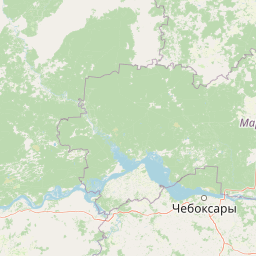
Map view of Nizhegorodskoe Povolzhie National Park

Use this park location map to pinpoint Nizhegorodskoe Povolzhie National Park in Russia, understand its exact geographic position, and read its mapped placement within the surrounding landscape more clearly.

Pigeon | © OpenStreetMap contributors

Location context for Nizhegorodskoe Povolzhie National Park

Nizhny Novgorod Oblast

Visualizing old growth taiga, peat bogs, and limestone karst formations

Nizhegorodskoe Povolzhie National Park Photos and Protected Landscapes

Examine field photography documenting the diverse ecosystems of Nizhegorodskoe Povolzhie National Park across five distinct regional clusters. Visual records reveal the complex terrain of dark coniferous forests, river floodplains, and unique geological sinkholes.

A peaceful lake at sunset with reeds emerging from the water in the foreground and a distant, flat shoreline under a hazy, warm sky.

Park atlas

Compare surrounding taiga reserves, wetland complexes, and connected regional ecosystems

Parks Near Nizhegorodskoe Povolzhie National Park and Regional Protected Areas

Browsing other protected areas near Nizhegorodskoe Povolzhie National Park reveals the broader ecological transition zones across European Russia. Extending your search helps connect isolated taiga forests, river basins, and wetland reserves into a wider geographic perspective.
Watercolor painting of a river winding through grassy wetlands with distant hills under a pastel sky
National parkRepublic of Mordovia
About 175 km away#1 closest

South

Smolny National Park: National Park Protected Area and Geographic Context in Republic of Mordovia

Explore the mapped landscape and regional geography of Smolny National Park.

Delve into the specifics of Smolny National Park, a designated national park in Russia's Republic of Mordovia. This detailed atlas view focuses on its protected area identity and geographic setting, providing essential context for understanding its landscape. Discover the mapped boundaries and regional placement that define this protected territory, crucial for any structured exploration of Russian natural areas.

Area
365 km²
Established
1995
IUCN
II
Relief
Lowland
A watercolor illustration showing a winding river flowing through a lush green landscape with rolling hills in the background.
National parkMari El
About 181 km away#2 closest

East

Mariy Chodra National Park: Regional Geography and Protected Forest Atlas

Mapped terrain, karst lake systems, and woodland corridors in Mari El

Deepen your understanding of Mariy Chodra National Park through its distinct geological and forest features. This overview examines the intersection of rolling upland blocks, sandy terrain, and the varied hydrology of the Ilet River drainage basin within the Volga region.

Area
366 km²
Established
1985
IUCN
II
Relief
Upland
Watercolor illustration showing a lake, forested hills, and mountains in the background
National parkRussia
About 186 km away#3 closest

East

Mariy Chodra National Park: Geographic and Protected Area Mapping for Russian Forests

Regional forest landscapes and protected Russian terrain

Mariy Chodra National Park is an essential protected natural area located in Russia, distinguished by its forest-dominated ecosystems. This entry provides detailed geographic context and boundary information for those studying the distribution of protected landscapes across the Russian Federation.

IUCN
II
Protected areaRussia
About 216 km away#4 closest

Southeast

Chuvash Forest Protected Area: Explore Russian Volga Region's Mixed Woodland Ecosystems

Discover mapped boundaries and regional landscape context.

Chuvash Forest stands as a protected area defined by its mixed woodland ecosystems within Russia's Volga region. This entry provides detailed geographic context, highlighting the park's mapped boundaries and its role as a distinct natural landscape. It serves as an essential point for understanding the environmental character and regional significance of protected lands in Eastern Europe, aiding structured atlas exploration of Russia's natural geography.

IUCN
II
Climate
Temperate
Access
Access unknown
Scope
Terrestrial
A horizontal watercolor painting depicting a gentle river flowing through a forested landscape with soft rolling hills in the background.
National parkVladimir Oblast
About 335 km away#5 closest

West

Мещёра National Park: A Study of Glacial Lowland Geography and Protected Forest Landscapes

A diverse protected mosaic in Vladimir Oblast, Russia.

Focusing on the flat, sandy expanses of the Meshchera Plain, this national park showcases a unique transition zone between taiga and nemoral forests. The area is characterized by its slow meandering rivers, numerous glacial lakes, and extensive peat bog systems that provide a benchmark for regional ecological preservation.

Area
2,239 km²
Established
1992
IUCN
II
Relief
Lowland
Watercolor painting of a lake surrounded by trees and distant hills
National parkVladimir Oblast
About 335 km away#6 closest

West

Meshchyora National Park: A Premier Wetland Protected Area in Vladimir Oblast

Explore its mapped boundaries and intricate floodplain geography.

Meshchyora National Park is a key protected landscape in central Russia, renowned for its expansive wetland ecosystems across the Meshchera Lowlands of Vladimir Oblast. Covering nearly 119,000 hectares, the park preserves a unique glacial terrain of peatlands, lakes, and meandering rivers, supporting remarkable biodiversity. Its role as a vital component of the Oka River basin and its conservation focus on restoring degraded peatlands make it a significant site for atlas-based geographic discovery and understanding protected area landscapes.

Area
1,189 km²
Established
1992
IUCN
II
Relief
Lowland
Watercolor painting of a meadow with wildflowers and rolling hills under a soft sky
National parkRussia
About 338 km away#7 closest

Southeast

Sengileevskie Mountains National Park: National Park Protected Area and Mapped Landscape Context

Explore protected boundaries and regional geography.

Uncover the geographic specifics of Sengileevskie Mountains National Park, a designated national park. This entry provides detailed insights into its protected area status, mapped landscape features, and regional context, serving as a foundational element for atlas-based exploration and understanding of Russia's conservation areas.

IUCN
II
National parkRyazan Oblast
About 359 km away#8 closest

West

Meshchyorsky National Park: Ryazan Oblast Protected Landscape Exploration

National park geography and mapped terrain.

Investigate Meshchyorsky National Park, a key protected area situated in Ryazan Oblast, Russia. This page provides detailed atlas-level context, focusing on the park's geographic identity, its mapped boundaries, and its role as a national park within the regional landscape. Explore the natural terrain and discover the protected land's place in Central Russia's geography through structured data and mapping.

Area
66 km²
Established
1992
IUCN
II
Relief
Lowland

Common questions about visiting, size, designation, and location context for Nizhegorodskoe Povolzhie National Park

Nizhegorodskoe Povolzhie National Park FAQs for park facts, access, geography, and protected area context

Find quick answers about Nizhegorodskoe Povolzhie National Park, including protected-area facts, park geography, trail and visitor context, and how the park fits into its surrounding country and regional landscape.
MoriAtlas Explorer

Continue Your Protected Areas Search Across the Global Atlas

Deepen your exploration by continuing the structured search for national parks and protected areas worldwide. Utilize the comprehensive filtering capabilities to compare different conservation landscapes and refine your understanding of global park geography. Discover more about the distribution and characteristics of protected natural areas.

Global natural geography