Mori Atlas logo
National parkPembrokeshire Coast National Park

Discover the mapped boundaries and diverse terrain of this unique national park on the Welsh coast.

Pembrokeshire Coast National Park: Iconic Coastal Protected Landscape & Regional Geography

(Parc Cenedlaethol Arfordir Penfro)

Pembrokeshire Coast National Park, situated in west Wales, stands as a distinctive protected landscape renowned for its spectacular and varied coastal scenery. This national park, established in 1952, is primarily defined by its dramatic limestone cliffs, pristine beaches, and the unique geological formations showcased along its rugged shoreline. Explore the park's mapped boundaries and understand its place within the regional geography of Pembrokeshire, revealing a rich tapestry of natural terrain from sea stacks to inland moorland.

Coastal landscapesNational TrailSeabird coloniesMarine protected areaLimestone cliffsIsland wildlife

Pembrokeshire Coast National Park

National park

Park overview

Structured park overview, official facts, and landscape profile for Pembrokeshire Coast National Park

Pembrokeshire Coast National Park park facts, protected area profile, and essential visitor context
Review the core facts for Pembrokeshire Coast National Park, including designation, size, terrain, visitor scale, habitats, and operating context in one park-focused overview.

About Pembrokeshire Coast National Park

Pembrokeshire Coast National Park represents one of Britain's most distinctive protected areas, established in 1952 to preserve the exceptional natural beauty and cultural heritage of Wales' southwestern coastline. The park stretches along virtually the entire coastline of Pembrokeshire, a peninsula jutting into the Atlantic Ocean, creating a landscape of extraordinary diversity within a relatively compact area. The park's coastal character sets it apart from all other UK national parks, as it is defined not by mountain ranges or rolling countryside but by the interplay between land and sea along a dramatic shoreline. The landscape ranges from the steep limestone cliffs of the Castlemartin peninsula in the south, through the forested valleys around Saundersfoot and Amroth, to the wild, exposed headlands of the north where the Preseli Hills meet the sea. Between the western and southern sections lies Milford Haven, one of the world's finest natural deep-water harbors, where the tranquil Daugleddau estuary opens into a sheltered waterway that has served as a maritime gateway for centuries. The park's geology is exceptionally well-exposed along its coastline, with rock formations spanning hundreds of millions of years visible in cliff sections, making it a living classroom for geological study.

Quick facts and research context for Pembrokeshire Coast National Park

Pembrokeshire Coast National Park covers 629 square kilometers along the western coastline of Pembrokeshire in Wales. Established in 1952, it is one of Wales' three national parks and the only UK national park defined primarily by its coastal landscapes. The park features four main geographic sections: the southern Pembrokeshire coast including Caldey Island, the Daugleddau estuary, the St Bride's Bay coast with its offshore islands, and the Preseli Hills moorland. The famous Pembrokeshire Coast Path, a 186-mile National Trail established in 1970, traverses the park's entire coastline. The park contains significant conservation designations including seven Special Areas of Conservation, a Marine Nature Reserve, six national nature reserves, and 75 Sites of Special Scientific Interest.

Park context

Deeper park guide and search-rich context for Pembrokeshire Coast National Park

Pembrokeshire Coast National Park history, landscape, wildlife, and travel context
Explore Pembrokeshire Coast National Park through its history, landscape character, ecosystems, wildlife, conservation priorities, cultural context, and seasonal travel timing in a structured park guide built for atlas discovery and search intent.

Why Pembrokeshire Coast National Park stands out

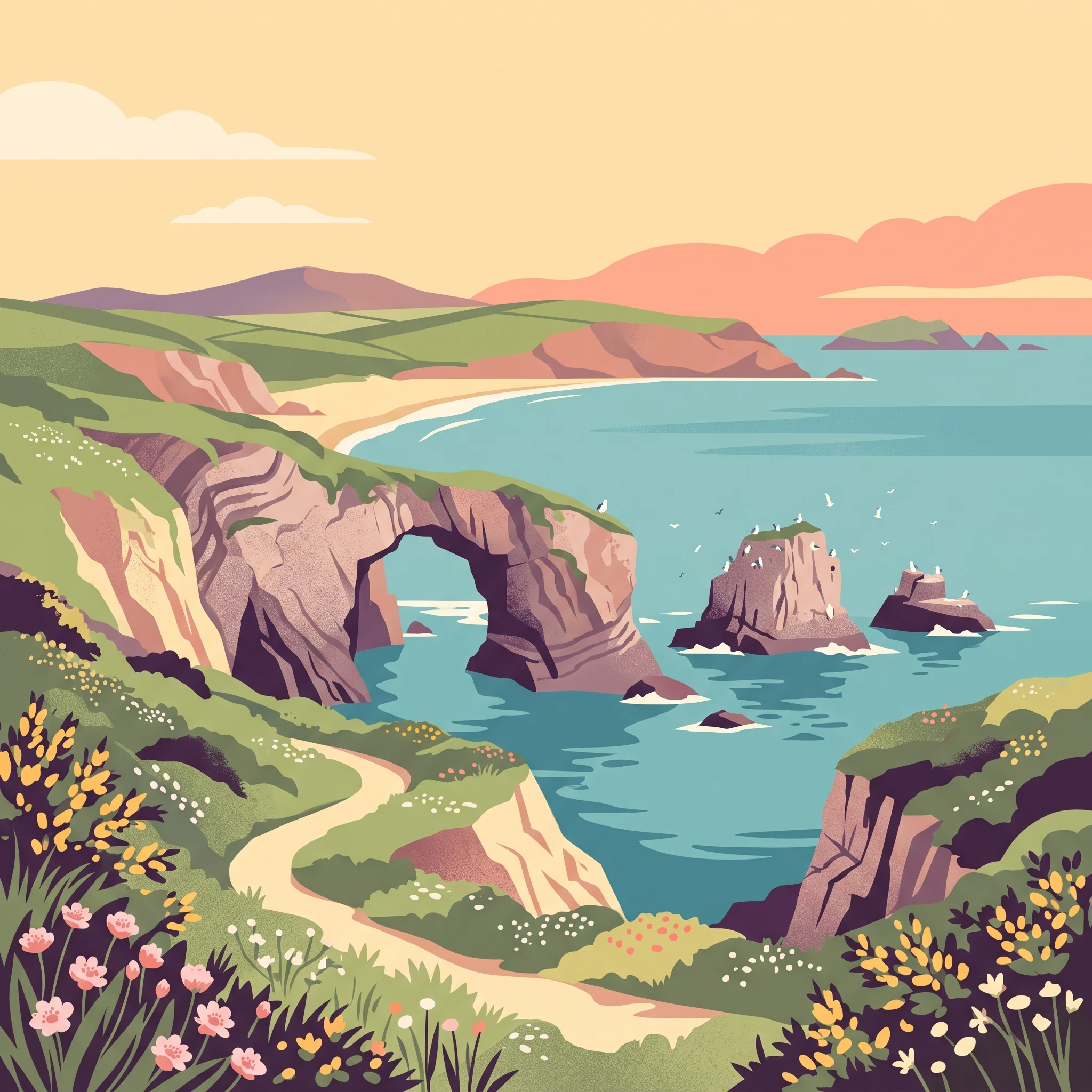
Pembrokeshire Coast National Park is best known for its spectacular and varied coastal scenery, which has earned it recognition as one of the world's premier coastal destinations. The park's defining features include the dramatic limestone cliffs and natural arches such as the Green Bridge of Wales, the iconic sea stacks known as Elegug Stacks that serve as crucial seabird nesting colonies, and the pristine sandy beaches that have garnered numerous Blue Flag and Green Coast Awards. The Pembrokeshire Coast Path, one of Britain's most celebrated long-distance walking trails, follows the entire park coastline at cliff-top level, offering walkers unparalleled views of rugged headlands, hidden coves, and offshore islands. The park is also renowned for its offshore islands including Skomer and Ramsey Island, which support important seabird colonies and marine wildlife, and for the Preseli Hills, the inland moorland that provides a contrasting wild landscape to the coastal scenery.

Pembrokeshire Coast National Park history and protected-area timeline

Pembrokeshire Coast National Park was established in 1952 as part of the post-war movement to protect Britain's most outstanding landscapes. It became the second Welsh national park, following Snowdonia which was designated in 1951, and the fifth national park in the United Kingdom overall. The creation of national parks in Britain reflected a growing recognition that certain landscapes possessed national importance that transcended local boundaries and required systematic preservation for future generations. The park's designation came at a time when post-war planning was reshaping how communities related to their natural surroundings, and the creation of a coastal-focused national park was somewhat innovative, as most British national parks featured mountainous or upland terrain. The Pembrokeshire Coast National Park Authority was established to manage the park, with purposes centered on conserving and enhancing the natural environment while encouraging public enjoyment and understanding of the landscape. In recent decades, the authority has worked to document environmental changes, launching projects such as the "Changing Coasts" initiative in 2016 to record how winter storms are reshaping the coastline. The park also manages the Pembrokeshire Coast Path, which was designated as a National Trail in 1970 and now forms part of the longer Wales Coast Path that circuits the entire Welsh coastline.

Pembrokeshire Coast National Park landscape and geographic character

The landscape of Pembrokeshire Coast National Park is defined by the dynamic relationship between land and sea along a deeply indented coastline. The park encompasses four principal geographic sections, each with distinct character. The southern coast features the limestone plateau and dramatic cliffs of the Castlemartin peninsula, where the famous Green Bridge of Wales arches above the waves, while the area around Tenby and Saundersfoot presents a contrast of steep-sided wooded valleys descending to sandy coves. The Daugleddau estuary, leading to the great natural harbor of Milford Haven, provides sheltered waters flanked by tidal woodlands, while the St Bride's Bay coast sweeps westward from the fishing village of St David's, dotted with offshore islands including Ramsey Island and Skomer. The Preseli Hills in the park's interior rise as wild moorland, cut through by the wooded valleys of the River Gwaun and Afon Nyfer, offering an exposed, mountainous feel quite different from the coastal landscapes. Throughout the park, the geology is spectacularly exposed, with examples of natural arches, sea stacks, rock folding, and sea caves visible along the shoreline. The Elegug Stacks near Stackpole are particularly notable, two massive limestone pillars that rise from the sea and provide nesting sites for razorbills and guillemots in spring.

Pembrokeshire Coast National Park ecosystems, habitats, and plant life

The ecological diversity of Pembrokeshire Coast National Park reflects its varied coastal and inland habitats, supporting a richness of species that has earned the area significant conservation recognition. The park contains seven Special Areas of Conservation, a Marine Nature Reserve, six national nature reserves, and 75 Sites of Special Scientific Interest, reflecting the national and international importance of its wildlife habitats. The coastal habitats range from exposed cliff tops and limestone grasslands to sheltered sandy beaches and tidal mudflats, each supporting distinct communities of plants and animals. The offshore islands of Skomer and Ramsey are particularly important for seabirds, hosting breeding colonies of puffins, guillemots, razorbills, and manx shearwaters that nest on the cliff faces during the summer months. The marine environment around the park supports diverse communities of seabed organisms, marine mammals, and fish species that benefit from the clean Atlantic waters. The inland Preseli Hills provide contrasting moorland habitats with their dwarf shrub heath, bog vegetation, and the distinctive rock outcrops that support specialized plant communities adapted to exposed conditions.

Pembrokeshire Coast National Park wildlife and species highlights

Pembrokeshire Coast National Park supports exceptional wildlife populations, particularly concentrated in its coastal and marine environments. The park's offshore islands rank among Britain's most important seabird colonies, with Skomer and Ramsey Islands hosting thousands of breeding seabirds including puffins, which nest in burrows on the grassy cliff tops during summer, along with razorbills and guillemots that nest on the narrow ledges of sea cliffs. The Elegug Stacks provide additional nesting habitat for these species in spring. The marine environment supports populations of grey seals and common seals that haul out on rocky shores and islands, while dolphins and porpoises are regularly sighted in the offshore waters. The park's varied habitats also support diverse breeding bird populations, with species such as choughs and peregrine falcons breeding on coastal cliffs, while the inland heathlands and woodlands support populations of songbirds and raptors. The grasslands and meadows of the park provide habitat for numerous invertebrate species, including rare butterflies and moths that depend on specific plant communities.

Pembrokeshire Coast National Park conservation status and protection priorities

Pembrokeshire Coast National Park holds significant conservation importance at both national and international levels, with designations that reflect the exceptional ecological value of its landscapes and habitats. The park's network of protected areas includes seven Special Areas of Conservation designated under the European Union's Habitats Directive, protecting habitats such as heathlands, grasslands, and marine environments that are considered to be of European importance. The establishment of a Marine Nature Reserve within the park's boundaries recognizes the significance of the surrounding seas and their wildlife, providing protected status to the underwater environments that support diverse communities of marine organisms. The presence of six national nature reserves and 75 Sites of Special Scientific Interest further demonstrates the concentration of important conservation land within the park. In 2011, National Geographic Traveler magazine recognized Pembrokeshire as the world's second best coastal destination for sustainable tourism, acknowledging both the quality of the natural environment and the park's approach to managing visitor impact. The Pembrokeshire Coast National Park Authority continues to balance conservation of the natural environment with sustainable tourism and the wellbeing of local communities.

Pembrokeshire Coast National Park cultural meaning and human context

Pembrokeshire Coast National Park contains a rich tapestry of human history woven into its landscape, with archaeological sites and historical features that reveal thousands of years of settlement and activity. The park includes numerous sites of historic and archaeological importance, among them Pentre Ifan, a Neolithic burial chamber that stands as a silent testament to the prehistoric communities that inhabited this coastline. St. Govan's Chapel, a tiny medieval chapel perched on a cliff near Bosherston, represents the religious traditions that shaped the lives of coastal communities, its location reflecting the spiritual relationship between people and this dramatic landscape. The coastline has long been associated with maritime activity, from the fishing communities that still operate from small harbors around the coast to the historic significance of Milford Haven as one of Britain's great natural harbors. The park's landscape has been shaped by centuries of human activity, with traditional farming practices maintaining the grasslands and woodlands that form part of the park's character, and coastal villages such as Tenby and St David's retaining historic cores that reflect their long history.

Top sights and standout views in Pembrokeshire Coast National Park

Pembrokeshire Coast National Park offers an extraordinary concentration of natural highlights within a relatively compact area. The iconic Green Bridge of Wales, a natural limestone arch standing dramatically on the south coast, represents one of the park's most photographed features. The Elegug Stacks near Stackpole provide a striking visual landmark and important wildlife habitat. The park's beaches are among Britain's finest, with Barafundle Bay regularly cited as one of the country's most beautiful, while the numerous Blue Flag awards recognize water quality and environmental management. Offshore, Ramsey and Skomer Islands offer access to some of Britain's best wildlife experiences, with boat trips allowing visitors to observe seabird colonies and marine wildlife. The Pembrokeshire Coast Path provides the means to explore the entire coastline on foot, with 186 miles of spectacular walking along cliff-top trails. The Preseli Hills offer a contrasting inland experience of wild moorland with ancient archaeological sites. The contrast between the sheltered tidal waters of Milford Haven and the wild Atlantic coast creates a remarkable diversity of maritime landscapes within a single protected area.

Best time to visit Pembrokeshire Coast National Park

Pembrokeshire Coast National Park offers rewarding experiences throughout the year, though the summer months of June through August bring the warmest conditions and longest days for walking and beach activities. The spring months of April and May are particularly special for wildlife enthusiasts, as seabirds return to nesting colonies on cliffs and islands, with puffins, razorbills, and guillemots establishing their breeding territories. Autumn can bring dramatic weather patterns and the chance to witness migratory birds moving along the coast, while winter, though quieter, offers a different character with storm waves crashing against the cliffs and fewer visitors on the trails. The park's coastal location means that weather can be changeable throughout the year, and the experienced visitor comes prepared for rapid conditions changes regardless of season. The Pembrokeshire Coast Path can be walked at any time of year, though the spring and autumn seasons often provide comfortable walking conditions with fewer crowds than summer.
Park location guide

Geography guide, regional context, and park location map for Pembrokeshire Coast National Park

Pembrokeshire Coast National Park park geography, regions, and map view in United Kingdom
Understand where Pembrokeshire Coast National Park sits in United Kingdom through a broader geographic reading of the surrounding landscape, nearby location context, and its mapped position within the national park landscape.

How Pembrokeshire Coast National Park fits into United Kingdom

The United Kingdom is a parliamentary constitutional monarchy located in northwestern Europe, consisting of four constituent countries: England, Scotland, Wales, and Northern Ireland. As a major global power with over 69 million residents, it maintains significant international influence in politics, economics, and culture.

Wider geography shaping Pembrokeshire Coast National Park in United Kingdom

The United Kingdom is an island nation located in northwestern Europe, surrounded by the Atlantic Ocean, North Sea, English Channel, Celtic Sea, and Irish Sea. It shares a land border with the Republic of Ireland to the west. The territory includes the island of Great Britain, the northeastern portion of Ireland, and most of the smaller British Isles islands.

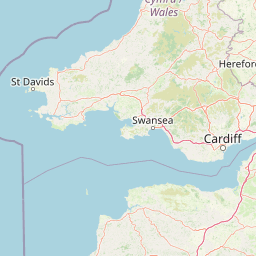
Map view of Pembrokeshire Coast National Park

Use this park location map to pinpoint Pembrokeshire Coast National Park in United Kingdom, understand its exact geographic position, and read its mapped placement within the surrounding landscape more clearly.

Pigeon | © OpenStreetMap contributors

Location context for Pembrokeshire Coast National Park

Pembrokeshire
Park atlas

Trace the regional context of protected areas, comparing diverse coastal and inland geographies near Pembrokeshire Coast.

Explore More National Parks and Protected Areas Around Pembrokeshire Coast National Park
Continue your protected-area discovery by exploring other national parks and significant landscapes located in the broader region surrounding Pembrokeshire Coast National Park. Compare diverse coastal terrain, inland hills, and marine protected zones to gain richer geographic context and understand connected conservation efforts.
National parkWales

Brecon Beacons National Park: Explore Wales' Iconic Protected Mountain Landscape

Discover mapped terrain, park boundaries, and regional geography.

Brecon Beacons National Park, officially Bannau Brycheiniog, stands as a premier protected area within Wales, covering over 1,344 square kilometers of striking mountainous terrain. This national park is defined by its dramatic Old Red Sandstone ranges, including Pen y Fan, South Wales' highest peak, and features diverse landscapes from heather moorland to extensive river valleys. Its mapped boundaries encompass unique geological features, significant historical sites, and provide context for regional geographic exploration, making it a key destination for understanding protected lands in the UK.

Area
1,344 km²
Established
1957
IUCN
V
Visitors
4.4M annual
National parkWales

Snowdonia National Park: Protected Landscape and Map Exploration in North Wales

Mountain terrain, glacial lakes, and regional geography.

Snowdonia National Park offers a profound exploration of mountainous protected landscapes in North Wales. This page details the park's mapped boundaries, revealing a terrain shaped by glaciation, featuring dramatic peaks like Snowdon, steep valleys, and pristine glacial lakes. Understand its geographic identity within the United Kingdom and how its protected status contributes to the regional landscape context, providing a unique focus for atlas-based discovery.

Area
2,142 km²
Established
1951
Relief
Mountain
Climate
Temperate
Watercolor illustration of a landscape with mountains, a lake, and trees
National parkCounty Wicklow

Wicklow Mountains National Park: Protected Landscape and Geographic Atlas Mapping

Explore County Wicklow's mapped natural terrain and park boundaries.

Understand the geographic scope and protected landscape identity of Wicklow Mountains National Park. This page offers detailed information on its mapped boundaries and its context within County Wicklow, providing a foundation for atlas-based discovery of Ireland's natural areas. Explore how this national park contributes to the region's mapped geography and conservation landscapes.

Area
205 km²
Established
1991
IUCN
II
Relief
Mountain
Watercolor illustration of Dartmoor moorland landscape with rolling hills, grassy vegetation, a stream, and distant mountains.
National parkDevon

Dartmoor National Park: Granite Tors and Prehistoric Landscape in Devon

Mapped protected area with significant Bronze Age remains.

Dartmoor National Park represents a distinctive granite upland in Devon, England, characterized by its dramatic tors and expansive moorland. This protected landscape is globally significant for its dense concentration of prehistoric archaeological sites, including stone circles, standing stones, and ancient settlements. Exploring Dartmoor offers a unique insight into Britain's regional geography, mapped terrain, and enduring connection to ancient human history.

Area
954 km²
Established
1951
IUCN
V
Visitors
11M annual
Watercolor painting showing a landscape with green and purple vegetation, a body of water, and distant hills.
National parkEngland

New Forest National Park: Historic Protected Landscape and Regional Geography in England

Mapped heathland, ancient woodlands, and pastoral traditions.

Explore New Forest National Park, a nationally significant protected area in England renowned for its unique blend of ancient royal forest history, traditional pastoral practices, and biologically rich lowland habitats. This page provides an atlas-focused view of its mapped boundaries, distinctive terrain, and geographic context within England, highlighting its value as a living landscape shaped by centuries of common grazing rights and supporting rare wildlife.

Area
566 km²
Established
2005
IUCN
V
National parkUnited Kingdom

Peak District National Park: Explore Protected Landscape and Regional Geography

Mapped boundaries and natural terrain context for this UK national park.

Investigate the Peak District National Park, a cornerstone of the United Kingdom's protected natural areas. This MoriAtlas entry provides essential details on its geographic scope, mapped boundaries, and landscape characteristics. Engage with structured data to understand how this national park fits into the atlas of the United Kingdom, supporting detailed geographic and protected-area discovery for researchers and explorers.

Area
1,440 km²
Established
1951
IUCN
V
National parkCounty Clare

Burren National Park: National Park in County Clare, Ireland

Explore protected landscape and mapped geography.

Burren National Park is a designated national park located in County Clare, Ireland. This MoriAtlas page provides detailed insights into its protected landscape character, its unique karst terrain, and its specific geographic boundaries. Understand how this protected area fits within the broader context of County Clare's Atlantic coast geography, enabling structured atlas-style exploration of its natural significance.

Area
15 km²
Established
1991
IUCN
II
Relief
Mountain
National park

Killarney National Park: A Protected Landscape for Geographic Exploration

Explore mapped boundaries and regional atlas context.

Killarney National Park is a significant protected area in Ireland, recognized as a national park for its unique natural attributes. MoriAtlas provides detailed mapping and geographic data to explore this protected landscape. Users can engage with the park's specific terrain, understand its mapped perimeters, and gain insights into its regional geographic significance, enhancing their overall atlas exploration experience.

Area
102.89 km²
Established
1932
IUCN
II
Relief
Mountain

Common questions about visiting, size, designation, and location context for Pembrokeshire Coast National Park

Pembrokeshire Coast National Park FAQs for park facts, access, geography, and protected area context
Find quick answers about Pembrokeshire Coast National Park, including protected-area facts, park geography, trail and visitor context, and how the park fits into its surrounding country and regional landscape.
MoriAtlas Explorer

Continue Your Protected Areas Search Across the Global Atlas

Deepen your exploration by continuing the structured search for national parks and protected areas worldwide. Utilize the comprehensive filtering capabilities to compare different conservation landscapes and refine your understanding of global park geography. Discover more about the distribution and characteristics of protected natural areas.

Global natural geography