
Why Tiveden National Park stands out
Tiveden National Park is best known for its pristine old-growth forest ecosystems and dramatic granite landscape of fracture valleys, caves, and boulder fields. The park contains the most significant remaining tract of older forest in the Tiveden region, with some forests containing trees up to 200 years old. The distinctive Trollkyrka rock formation exemplifies the park's rugged character, while the network of deep valleys and granite cliffs creates a terrain strikingly different from the more typical Swedish forest landscape. The park also serves as a biological boundary zone where northern and southern Scandinavian species overlap in their distributions, providing habitat for species at the edge of their range including the three-toed woodpecker near its southern limit.
Tiveden National Park history and protected-area timeline
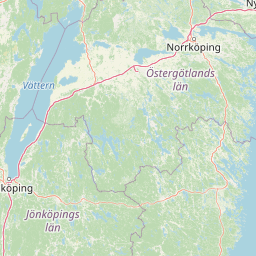
The history of human activity in the Tiveden region extends back to the Middle Ages when the dense forest served as a refuge for outlaws and those seeking to escape authority. The remote and difficult terrain made the forest an ideal place for those wishing to avoid detection, establishing a historical association with lawlessness and isolation that persists in local cultural memory. The establishment of Tiveden as a national park in 1983 reflected growing recognition of the region's ecological significance and the need to preserve its remaining old-growth forest characteristics. The initial protected area covered 1,350 hectares, but the park was significantly expanded in 2017 when approximately 50 percent additional land was incorporated, bringing the total area to roughly 2,030 hectares. The 2017 expansion added the area surrounding Lake Stora Trehörningen along with valuable forest land in the eastern portion of the park. This expansion was accompanied by infrastructure improvements including new trail markings with dedicated color-coded routes, a new circular trail around Stora Trehörningen, and two additional access points at Vitsand beach and Ösjönäs in the southwest. The park is administered jointly by Sweden's environmental protection agency Naturvårdsverket and Örebro County, with the cooperation of Västra Götaland County for the portion of the park extending into that administrative area.
Tiveden National Park landscape and geographic character
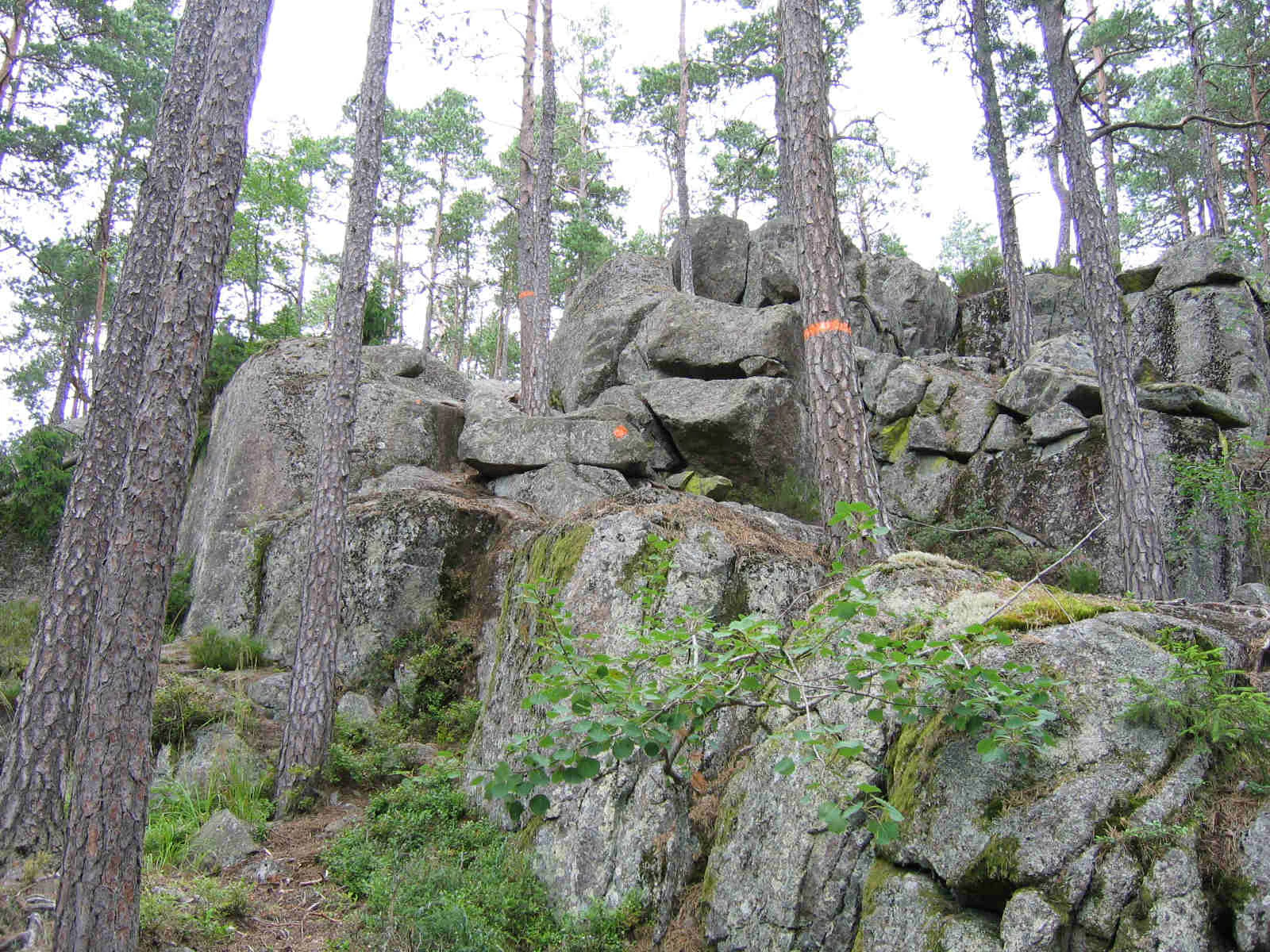
The landscape of Tiveden National Park is defined by its ancient granite bedrock and the distinctive geological features created by tectonic and glacial processes over hundreds of millions of years. The underlying granite dates to the Precambrian era when massive forces associated with the formation of the proto-North Atlantic and the creation of Lake Vättern fractured the continental crust in a rectangular pattern that remains clearly visible in the contemporary topography. The fracture zones, where the bedrock was crushed and broken, became the pathways for water flow and locations where lakes and marshes formed as the softer material eroded. Between these fracture valleys, blocks of intact granite remained as elevated plateaus and ridges, creating the characteristic alternating pattern of steep-sided valleys and rounded hilltops that dominates the park's scenery. Glacial processes during the final glaciation further modified this foundation, with the retreating inland ice approximately 11,000 years ago leaving behind massive boulder fields. Most boulders accumulated in the fracture valleys where they formed extensive block fields, while scattered erratics also rest on the exposed rock surfaces across the plateau areas. The resulting landscape features narrow valleys typically 25 to 50 meters deep, granite cliffs and rock formations including the notable Trollkyrka, caves such as Stenkällas grotta, and numerous small lakes and marsh areas scattered throughout the forest.
Tiveden National Park ecosystems, habitats, and plant life
The ecological character of Tiveden National Park reflects the challenging conditions created by nutrient-poor granite substrate and thin soils that limit plant growth and habitat complexity. The forest ecosystem consists primarily of pine and spruce, with pine dominating the exposed rock surfaces and shallower soils while spruce occupies areas with slightly greater soil accumulation. Deciduous trees remain uncommon throughout most of the park due to the limited nutrient availability. The park contains the largest remaining area of older forest in the Tiveden region, with some forest stands reaching 200 years of age. The vegetation on exposed rock surfaces consists largely of reindeer lichens and heather, while areas with minimal soil development support blueberry bushes as the primary ground cover. Species requiring richer soil conditions such as liverwort and hazel occur only rarely in isolated locations with local soil accumulation. The park's position in southern-central Sweden places it at a biogeographic crossroads where northern and southern species distributions meet, creating a transitional ecological character distinct from both the boreal north and the deciduous forest zone to the south.
Tiveden National Park wildlife and species highlights
The wildlife population in Tiveden National Park reflects the park's position as a transitional zone between northern and southern Scandinavian faunal provinces. Large mammals present include elk and roe deer, though population densities remain relatively low due to the limited productivity of the forest ecosystem. Smaller mammals include red fox, badger, marten, and squirrel, with beaver also present and occasionally creating management challenges by damming streams and drainage ditches adjacent to roads within the park. The old-growth forest characteristics support a diverse bird community associated with mature woodland, including capercaillie, pygmy owl, and several woodpecker species. The three-toed woodpecker reaches near its southern range limit in Tiveden, making the park significant for monitoring the southern edge of this species' distribution. The marshes and wetland areas support species typical of these habitats, including dwarf birch, a shrub species more common in the northern Norrland region that reaches its southern boundary in the Tiveden marshes.
Tiveden National Park conservation status and protection priorities
Tiveden National Park was established with the explicit purpose of preserving a contiguous forest, lake, and fracture valley landscape in essentially unmodified condition while allowing natural forest dynamics to proceed toward old-growth development. The management philosophy permits natural processes to operate with minimal human intervention, with the approach described as allowing land, water, plants, and animal life to develop essentially freely. This represents a significant departure from the intensive forest management that characterizes most of Sweden's productive forest land, where timber extraction has dramatically altered forest composition and structure. The park protects what remains of a once-extensive forest landscape that covered much of the Tiveden region, now reduced to this single significant protected area of older forest. The expansion in 2017 added valuable mature forest habitat and the lake ecosystem of Stora Trehörningen, strengthening the ecological coherence of the protected area. The park also provides public access for recreation along marked trails while protecting core natural values from damage.
Tiveden National Park cultural meaning and human context
The Tiveden forest holds a significant place in Swedish cultural history and folklore, with the landscape traditionally associated with supernatural beings including trolls, dwarves, and other figures from Scandinavian mythology. The dramatic granite formations, deep shadowed valleys, and isolated character of the forest contributed to these associations, and the park's name itself derives from this cultural heritage. Historical records indicate that during the Middle Ages the forest served as a refuge for outlaws and those escaping authority, its rugged and remote character providing natural concealment. The region formed part of the historical province of Västergötland, one of Sweden's traditional landskap, and the park now lies at the administrative intersection of two modern counties. The cultural connections to the landscape remain evident in place names and local traditions, providing a human context that enriches the purely ecological interpretation of the protected area.
Top sights and standout views in Tiveden National Park
Tiveden National Park offers distinctive experiences centered on its rugged old-growth forest landscape and unique geological formations. The Trollkyrka rock formation stands as the park's most recognizable landmark, a dramatic pile of granite blocks rising above the forest canopy. Visitors can explore a network of long hiking trails passing through diverse terrain including mature forest, deep valleys, rocky ridges, and lake shores. The 2017 expansion created new access points and a complete circuit around Lake Stora Trehörningen, providing opportunities to experience the lake landscape that was previously less accessible. The Stenkällas grotta cave offers another geological highlight, while the Vitsand beach area provides swimming access in the northwestern part of the park. The visitor center with its exhibition provides orientation and educational context for understanding the park's natural and cultural history. Portions of the longer Bergslagsleden trail pass through the park, connecting it to Sweden's broader network of long-distance hiking routes.
Best time to visit Tiveden National Park
The park can be visited throughout the year, with each season offering a distinct character. Summer months bring the most accessible trail conditions and opportunity to experience the full forest canopy, while the long Swedish winter transforms the landscape into a snowy wilderness with different appeal for those seeking solitude. The shoulder seasons of spring and autumn offer intermediate conditions and the opportunity to observe seasonal changes in the forest. Summer provides the warmest conditions for swimming at Vitsand beach and the longest days for extended hiking, though this is also the peak visitor season. Autumn brings the changing colors of the forest and may offer improved wildlife viewing opportunities as animals become more active during the cooler days. Winter access requires appropriate preparation for cold conditions and variable snow cover, but rewards visitors with a particularly peaceful experience of the forest in its quiet season.