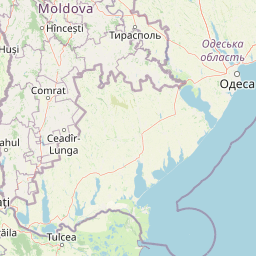

Why Măcin Mountains stands out
The Măcin Mountains are renowned for their exceptional biodiversity and geological significance. They represent the only national park in Romania protecting authentic steppe vegetation, a habitat that has largely disappeared from Europe. The mountains host 27 endemic plant species and over 72 threatened flora species, making them globally significant for conservation. The area is particularly important for birds of prey, serving as Romania's most significant breeding area for raptors and a crucial passage point for migratory species. The unique beech and hornbeam forest found here is the only such formation in Romania, while the Dobrogean bellflower exists nowhere else on Earth except within this park.
Măcin Mountains history and protected-area timeline
The geological history of the Măcin Mountains spans hundreds of millions of years, beginning with the Precambrian orogenetic cycles and continuing through the Caledonian, Hercynian, and early Alpine deformations. During the Triassic period, the granite formations existed as an island within the ancient Tethys Ocean. The current structural arrangement was finalized during the Eco-Cimmerian orogenetic phase in the Late Neocomian. The region has been inhabited since ancient times, with archaeological evidence pointing to Daco-Roman settlements along the Danube, including the fortified settlement of Aegyssus on what is now Tulcea. The historical town of Arrubium, located at modern-day Măcin, dates to the Celtic period. Throughout subsequent centuries, the Dobruja region experienced Byzantine, Ottoman, and Romanian rule, each leaving cultural imprints on the landscape.
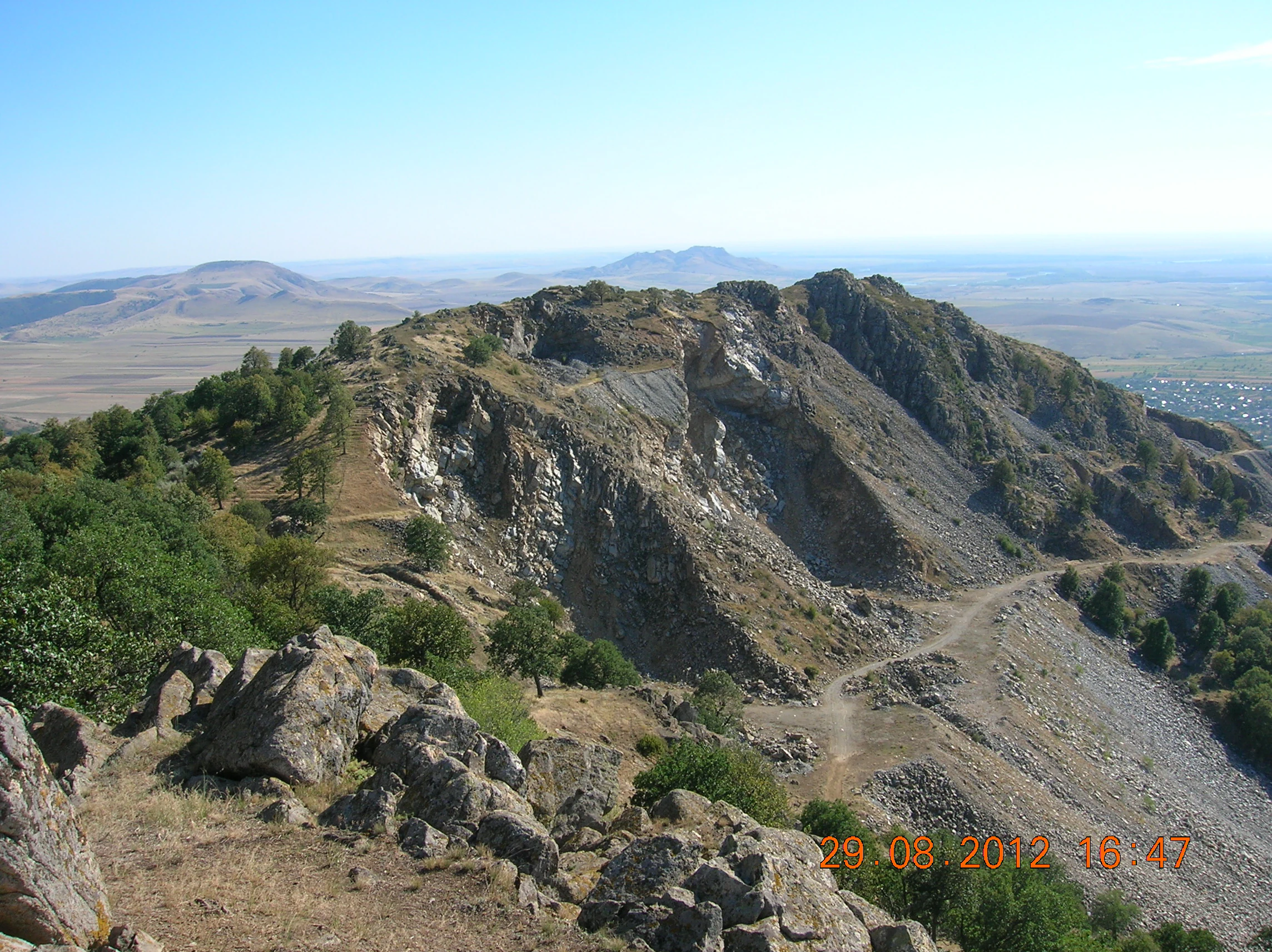
Măcin Mountains landscape and geographic character
The Măcin Mountains present a landscape of rounded summits and steep, erosion-sculpted slopes dominated by granite outcrops. The terrain is characterized by a series of parallel ridges and isolated mound-like massifs that rise from the surrounding loess-covered plain. The main ridge follows the Pintenul Bugeacului from the northwest before fragmenting into numerous spurs in the south-southwest direction. Key peaks include Țuțuiatu at 467 meters, Pietrosul Mare at 426 meters, Priopcea at 409 meters, and Victoria peak at 341 meters. The landscape features numerous depressions, including the Greci depression drained by the Dumbravei and Plopilor valleys. Steep-sided valleys, rock-covered slopes, and the ruin-like appearance of weathered granite formations create a distinctive visual character. The mountains are bordered by the Danube to the north and west, the Taița River and Niculițel Hills to the east, and the Casimcea Plateau to the south.
Măcin Mountains ecosystems, habitats, and plant life
The ecological character of the Măcin Mountains is defined by a remarkable convergence of biogeographical influences. The region sits at the crossroads of Central European, Mediterranean, Balkan, and Pontic ecological zones, creating a unique blend of habitats and species. The vegetation spans multiple zones: steppe grasslands in lower areas, xerophilic forests of pubescent oak and hornbeam at medium altitudes, and mesophilic beech and hornbeam forests at higher elevations. The forests cover approximately 8,600 hectares within the mountain range, representing the most extensive woodlands in Dobruja. The park protects Romania's only remaining significant steppe vegetation, an ecosystem that has vanished from most of Europe. Plant communities here include rare associations found nowhere else in Europe, with 27 endemic species and over 72 nationally and internationally protected plant taxa.
Măcin Mountains wildlife and species highlights
The wildlife population of the Măcin Mountains reflects the diversity of habitats present, from open steppe to dense forests. The area is particularly significant for birds, with 187 species recorded within the park and 60 percent considered vulnerable, rare, or possibly extinct according to IUCN criteria. The mountains constitute Romania's most important breeding area for birds of prey, including the long-legged buzzard, short-toed snake eagle, booted eagle, Levant sparrowhawk, and saker falcon. The Danube falcon breeds exclusively here within Romania. The mammal population includes 41 species, with 11 protected under international conventions. Notable species include roe deer, red deer, fallow deer, wild boar, and the endangered ground squirrel. The park supports significant populations of small mammals and herpetofauna, with all 11 reptile species and 7 amphibian species protected under the Bern Convention.
Măcin Mountains conservation status and protection priorities
The Măcin Mountains were established as a national park primarily to protect Romania's last significant steppe ecosystem and the unique biodiversity it contains. The park covers 11,321 hectares, with 10,160 hectares under forest management by the National Forest Administration. The area has been recognized internationally for its importance in conserving European biodiversity, with numerous habitat types protected under the EU Habitats Directive including steppe grasslands, thermophilic oak forests, and beech woodlands. The presence of 27 endemic plant species, including the Dobrogean bellflower found nowhere else in the world, gives this park global significance for conservation. The International Union for Conservation of Nature has noted that without this park, the protection of European biodiversity would be incomplete.
Măcin Mountains cultural meaning and human context
The Măcin Mountains region has been inhabited continuously since prehistoric times, with archaeological evidence of Neolithic settlements in the Luncavița area and Daco-Roman settlements along the Danube. The nearby town of Măcin contains ruins of the ancient settlement of Arrubium, dating to Celtic times. The region bears traces of multiple historical periods, including Roman fortifications, medieval Genoese trading posts, Ottoman mosques such as the Ali Gazi Pasha Mosque in Babadag, and Romanian Orthodox monasteries. The traditional villages surrounding the mountains maintain agricultural practices that have shaped the cultural landscape over centuries.
Top sights and standout views in Măcin Mountains
The park offers several standout features that distinguish it within Romania's protected areas. The steppe ecosystem, representing the last significant example in Romania and one of the few remaining in Europe, supports plant and animal communities found nowhere else on the continent. The bird migration corridor here is one of the most important in Eastern Europe, with thousands of raptors passing through annually. The geological formations, among the oldest in Romania, provide insights into Earth's deep past. The Țuțuiatu peak offers panoramic views across the Danube floodplain and toward the Black Sea coast. The Pădurea Valea Fagilor (Beech Forest Valley) reserve contains exceptional examples of beech and hornbeam woodland unique to Romania.
Best time to visit Măcin Mountains
The Măcin Mountains can be visited throughout the year, though spring and early summer offer the most favorable conditions for observing wildlife and vegetation. April through June brings bird migration activity and the flowering of many endemic plant species. Autumn provides pleasant temperatures and the opportunity to observe raptor migration, particularly in September and October when numerous birds of prey pass through the area. Summer months can be hot and dry, while winter offers a stark beauty but with limited access to higher trails. The continental climate means significant temperature variation between seasons, with average annual temperatures between 10.5 and 11 degrees Celsius.