Mori Atlas logo
National parkPieniny National Park

Discover the mapped protected boundaries and dramatic terrain of a unique Carpathian protected landscape.

Pieniny National Park: Slovakia's Premier Limestone Gorge National Park in Prešov Region

(Pieninský národný park)

Pieniny National Park represents a distinctive protected landscape in northeastern Slovakia's Prešov Region, renowned for its dramatic limestone gorges and unique Carpathian terrain. This national park, one of the smallest in Slovakia, showcases the powerful carving action of the Dunajec River, creating spectacular canyon scenery with sheer cliffs. As a key entity within the atlas of European protected areas, Pieniny National Park offers a focused lens through which to explore mapped natural landscapes, regional geography, and significant protected territory.

national parkCarpathian mountainslimestone gorgesriver canyonsendemic speciescross-border protection
Stylized illustration of green mountains, a river gorge, rocky cliffs with a lone tree, and a sunlit sky with clouds

Pieniny National Park

National park

Park overview

Structured park overview, official facts, and landscape profile for Pieniny National Park

Pieniny National Park park facts, protected area profile, and essential visitor context
Review the core facts for Pieniny National Park, including designation, size, terrain, visitor scale, habitats, and operating context in one park-focused overview.

About Pieniny National Park

Pieniny National Park occupies a remarkable position in the Carpathian mountain system, protecting a distinctive landscape where the Pieniny Mountains rise along the Slovakia-Poland border. The park's compact size belies its ecological significance; it contains one of Europe's most impressive river gorges, the Dunajec River canyon, which has been carved through millennia by the river as it flows from the Tatra Mountains northward into Poland. The terrain is characterized by steep limestone cliffs, rocky ridges, and forested slopes that create a dramatic backdrop for the river's meandering course. Beyond the gorge, the park encompasses the Lesser Pieniny range, a boundary ridge between the two countries featuring several smaller cliffs and rocky outcrops. The park's administrative center is located in the village of Červený Kláštor, a settlement known for its traditional folk architecture and cultural significance. The park's establishment in 1967 represented the formal protection of a landscape that had been recognized for its natural value since the early twentieth century, when the cross-border Zamagurie region became the first internationally protected nature park in Europe in 1932.

Quick facts and research context for Pieniny National Park

Pieniny National Park sits in the Prešov Region of northeastern Slovakia, spanning the districts of Kežmarok and Stará Ľubovňa. The park is Slovakia's smallest national park at just 37.5 km², though its protective buffer zone extends across 224.44 km². The landscape is characterized by flysch and limestone geology, with the Dunajec River carving a spectacular canyon through the mountains. The region has been protected since 1932, making it one of the oldest protected areas in Central Europe. The park is home to notable endemic plant species and serves as a habitat for brown bears, wolves, lynx, and chamois.

Park context

Deeper park guide and search-rich context for Pieniny National Park

Pieniny National Park history, landscape, wildlife, and travel context
Explore Pieniny National Park through its history, landscape character, ecosystems, wildlife, conservation priorities, cultural context, and seasonal travel timing in a structured park guide built for atlas discovery and search intent.

Why Pieniny National Park stands out

Pieniny National Park is best known for the spectacular Dunajec River Gorge, a dramatic limestone canyon that offers some of the most impressive river scenery in the Carpathians. The park is famous for its traditional wooden rafting tradition along the Dunajec, as well as the picturesque village of Červený Kláštor, which houses a Museum of National Culture showcasing regional folk heritage. The park protects rare endemic plant species including Chrysanthemum zawadzkii and the Tertiary relict Juniperus sabina (dwarf pine), which grows only in the Pieniny Mountains within the Western Carpathians. The limestone cliffs also provide nesting habitat for eagles and support populations of chamois on the rocky terrain.
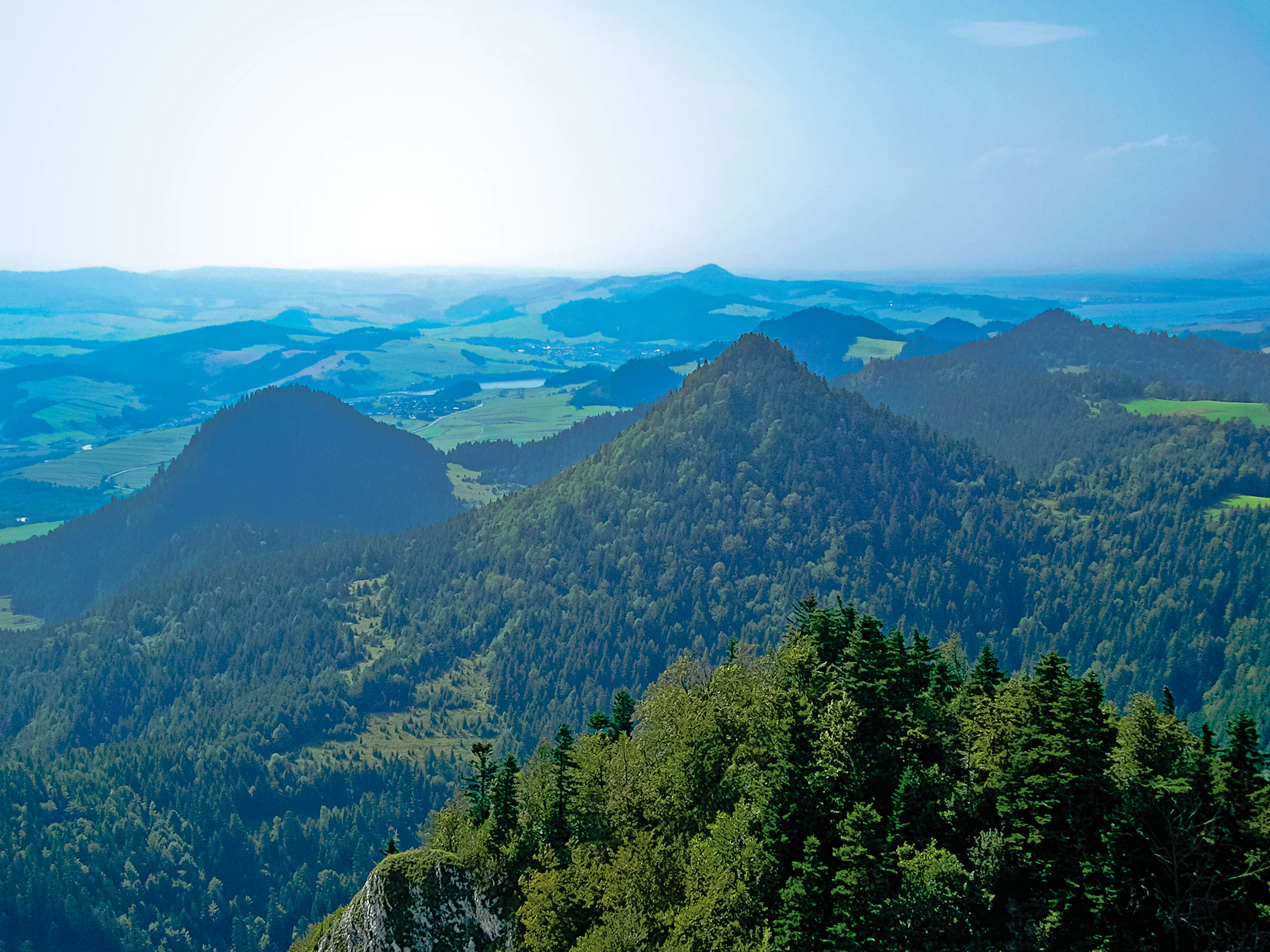
Panoramic view of forested mountains and valleys under a clear sky
Panoramic view of Pieniny National Park from Trzy Korony

Pieniny National Park history and protected-area timeline

The protection of the Pieniny region has roots extending back to the early twentieth century. In 1921, Professor Władysław Szafer of Poland's State Commission for Nature Protection first proposed protecting the Pieniny area as a unified transboundary landscape. The following year, Professor Stanisław Kulczyński developed the first protection project covering 216.5 square kilometers of the central Pieniny. After years of negotiation between Polish and Czechoslovak authorities, the first nature reserve was established on the Polish side in 1929, with the Czechoslovak side following in 1932. On July 17, 1932, the Slovak nature reserve in Pieniny was declared at Červený Kláštor, simultaneously marking the creation of Europe's first international nature park. This cross-border cooperation was groundbreaking for its era. After World War II, the Czechoslovak side created the Pieniny Nature Reserve in Červený Kláštor in 1958, and the national park was formally established on January 16, 1967, making it Slovakia's second-oldest national park after the Tatra National Park. The park underwent name changes in 1994 and border adjustments in 1997, expanding to its current extent.

Pieniny National Park landscape and geographic character

The Pieniny landscape is defined by its distinctive limestone and flysch geology, which has produced a terrain of remarkable visual drama despite the mountains' relatively modest elevation. The Dunajec River has carved a deep canyon through the mountains, with vertical gray limestone cliffs rising hundreds of meters above the water. The most spectacular section is the Prielom Dunajca (Dunajec Gorge), where the river makes four tight meanders within a dramatic canyon setting. The park also includes the Prielom Lesnickeho potoka, a nearly 300-meter-deep gorge carved through hard limestone by the Lesnicky Potok brook. The Lesser Pieniny (Malé Pieniny) forms the eastern boundary ridge between Slovakia and Poland, characterized by several rocky cliffs and the park's highest point at Vysoké skalky (1,050m). The southern boundary reaches into the Popradská kotlina basin and the Ždiarska brázda furrow, which lie at the interface between the Pieniny and the High Tatras. The landscape is heavily influenced by its karst geology, with the limestone supporting distinctive plant communities and creating unique microhabitats throughout the park.
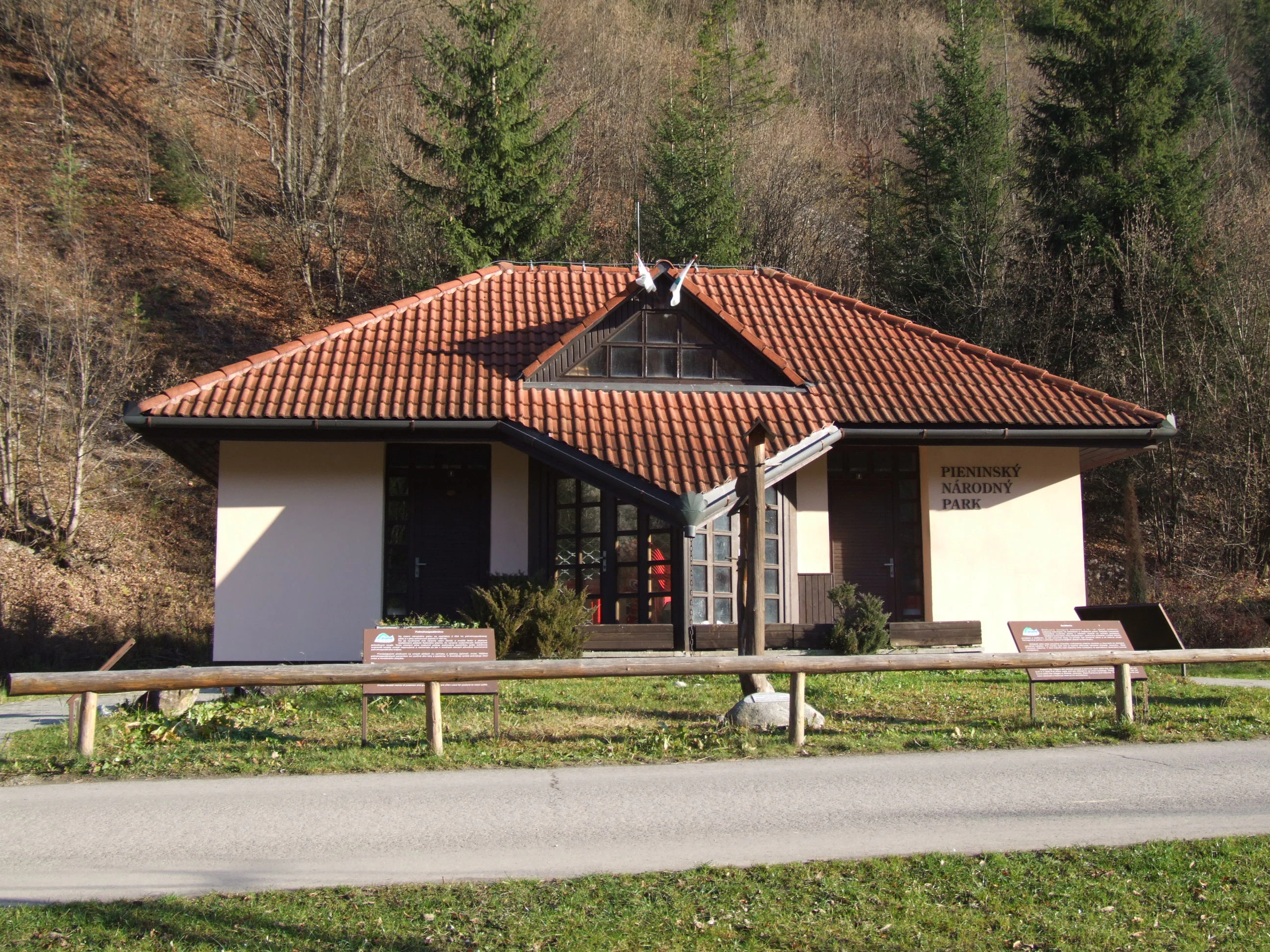
A white building with a red-tiled roof and wooden fence, situated in a forested area with trees and grass
Pieniny National Park information center building with adjacent mountain hostel

Pieniny National Park ecosystems, habitats, and plant life

The vegetation of Pieniny National Park is organized across several altitude tiers, reflecting the mountains' position at the crossroads of different climatic influences. The original forest cover would have been beech forest in the lower basins and furrows, though centuries of human activity have altered much of the landscape. The park is notable for its exceptional botanical importance, harboring numerous endemic species found nowhere else in the world. The most remarkable is Chrysanthemum zawadzkii (now Dendranthema zawadzkii), known as the Pieniny chrysanthemum, which grows only on the Polish and Slovak sides of these mountains. Another significant species is Juniperus sabina (dwarf juniper), a Tertiary relict that survives in the Pieniny at the very edge of its western Carpathian distribution. The original forest community would have been fir-beech forest, though this has been largely replaced by spruce forests with scattered beech. In rocky ridge areas, interesting lime-loving grasslands have developed on the calcareous substrate, supporting species typical of both Mediterranean and alpine origins.
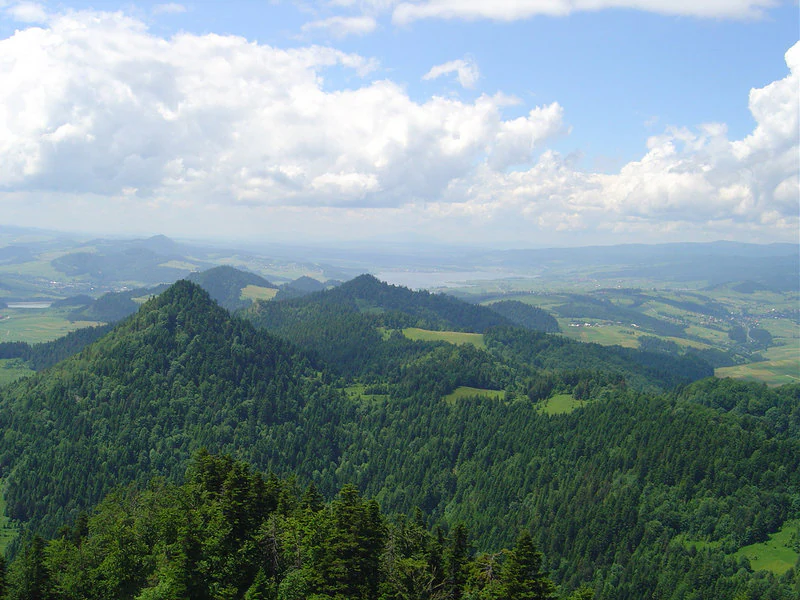
Panoramic landscape view showing rolling green mountains, dense forests, and a valley under a partly cloudy sky
Panoramic view of Pieniny National Park from Trzy Korony peak

Pieniny National Park wildlife and species highlights

Pieniny National Park supports a diverse mammalian fauna that reflects its position in the Carpathian mountain system. The park is home to several large carnivores including the brown bear (Ursus arctos), wolf (Canis lupus), and Eurasian lynx (Lynx lynx), representing the full suite of Carpathian apex predators. Alpine species such as chamois (Rupicapra rupicapra) and alpine marmot (Marmota marmota) inhabit the rocky cliff zones, while the river otter (Lutra lutra) hunts in the Dunajec and its tributaries. The avifauna includes eagles nesting on inaccessible cliff faces and white storks that breed in the region. The park's isolation and unique geological setting have also produced remarkable invertebrate diversity; studies have documented that approximately 50% of Carpathian centipede species occur here, and the region supports numerous endemic and Carpathian species including the ground beetle Cylindroiulus luridus burzeneandicus and the pygmy grasshopper Isophya pyrenea pieninensis.
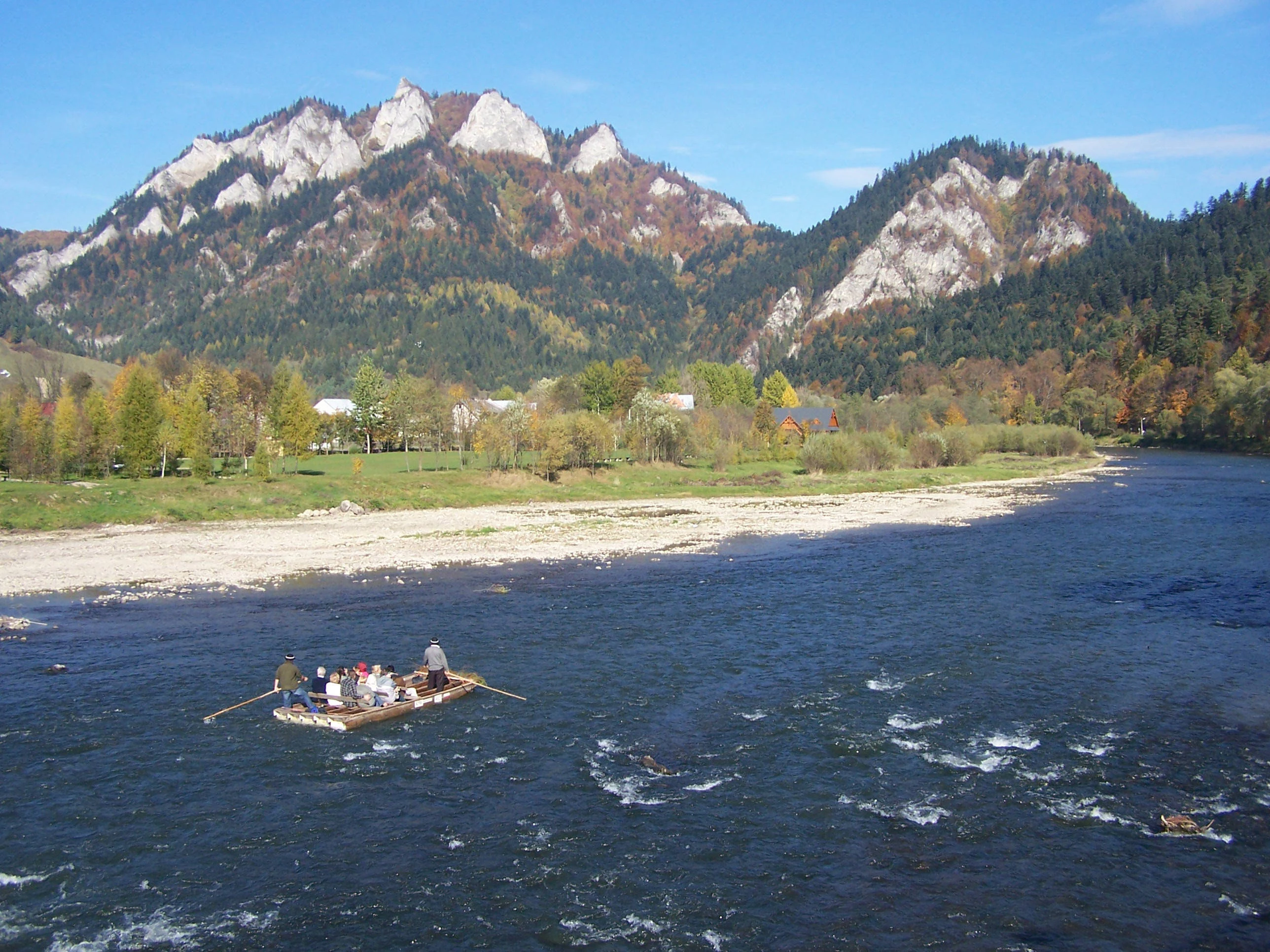
People rafting on a river with mountains and trees in the background
Rafting on the Dunajec River with mountainous backdrop in Pieniny National Park

Pieniny National Park conservation status and protection priorities

Pieniny National Park represents one of the oldest and most significant conservation achievements in Central Europe, stemming from early twentieth-century transboundary cooperation between Poland and Czechoslovakia. The 1932 establishment of protected areas on both sides of the border created Europe's first international nature park, a pioneering model for cross-border conservation. The park protects a distinctive Carpathian landscape with exceptional botanical significance, harboring species endemic to the Pieniny Mountains including the Pieniny chrysanthemum and dwarf juniper, a Tertiary relict species. The Dunajec River Gorge provides migration corridors and habitat for aquatic species, while the limestone cliffs support specialized rock-dwelling flora and nesting raptors. The park forms part of a larger protected landscape complex that includes the Polish Pieniny National Park on the opposite side of the border, ensuring continuity of protection across the international boundary.

Pieniny National Park cultural meaning and human context

The Pieniny region has been inhabited for centuries by communities whose lives have been intimately connected to the landscape. The village of Červený Kláštor serves as the park's administrative center and represents the cultural heart of the area, featuring traditional folk architecture and housing the Museum of National Culture that showcases regional heritage. The area is known for its distinctive wooden rafting tradition on the Dunajec River, a practice that has continued for generations and remains an important cultural activity and tourist attraction. The name Zamagurie refers to the broader region encompassing the Pieniny and surrounding areas, a term that reflects the shared cultural and historical identity of the borderland communities. Several villages within and adjacent to the park, including Lesnica, Haligovce, Kamienka, Lechnica, and Stráňany, maintain traditional settlement patterns and agricultural practices that contribute to the region's cultural landscape.
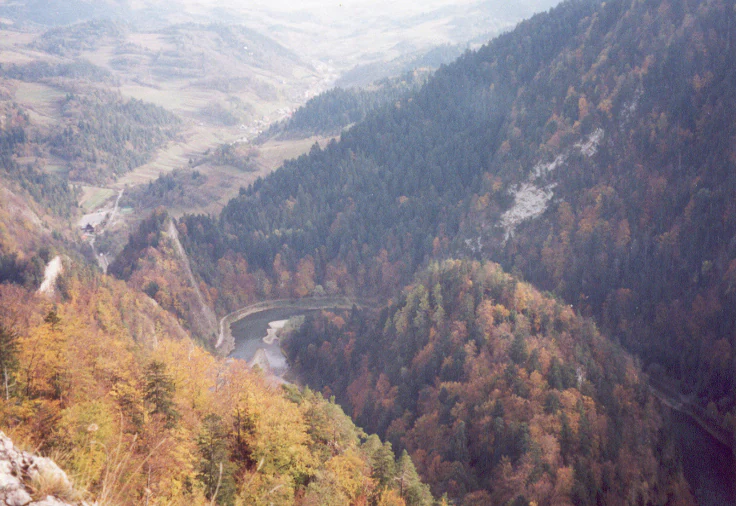
Wide landscape view of a river flowing through mountain valleys surrounded by autumn-colored forests
Dunajec River winding through the Pieniny Mountains with autumn foliage on the hillsides

Top sights and standout views in Pieniny National Park

The Dunajec River Gorge stands as the park's most spectacular feature, a dramatic limestone canyon offering world-class scenery and the traditional wooden raft rides that have defined the region for centuries. The village of Červený Kláštor provides cultural immersion through its folk architecture and the Museum of National Culture, offering insight into traditional Carpathian life. The rare endemic flora, particularly the Pieniny chrysanthemum and Tertiary-relict dwarf juniper, represents botanical significance found nowhere else on Earth. The transboundary protected landscape with Poland creates one of Europe's oldest international conservation areas, with a history dating to 1932. The park's compact size makes it highly accessible while delivering outsized natural and cultural experiences, from eagle nests on sheer cliffs to traditional wooden churches in surrounding villages.

Best time to visit Pieniny National Park

The Pieniny Mountains can be visited throughout the year, though each season offers a distinctly different experience. Summer months bring the most active period for rafting on the Dunajec River, with warm conditions ideal for exploring the gorge and hiking the trail network. The river raft rides operate from spring through autumn, with summer offering the most reliable water levels and the fullest access to the attractions. Autumn brings spectacular fall colors to the forests and often produces crisp, clear weather that showcases the limestone cliffs to best advantage. Winter transforms the landscape into a quieter, more austere environment suitable for winter hiking on maintained trails, though some routes may be closed or require caution. The shoulder seasons of spring and autumn typically offer fewer visitors while still providing comfortable conditions for outdoor activities, making them appealing for those seeking a more tranquil experience.

Park location guide

Geography guide, regional context, and park location map for Pieniny National Park

Pieniny National Park park geography, regions, and map view in Slovakia
Understand where Pieniny National Park sits in Slovakia through a broader geographic reading of the surrounding landscape, nearby location context, and its mapped position within the national park landscape.

How Pieniny National Park fits into Slovakia

Slovakia is a landlocked Central European country with a population of over 5.4 million. It became independent from Czechoslovakia in 1993 and is a member of the European Union. The country features mountainous terrain, with the Carpathian Mountains running through its territory. Bratislava serves as the capital and largest city, while Košice is the second-largest city.

Wider geography shaping Pieniny National Park in Slovakia

Slovakia is located in Central Europe, landlocked between Poland to the north, Ukraine to the east, Hungary to the south, Austria to the west, and the Czech Republic to the northwest. The territory is mostly mountainous, with the Carpathian Mountains, including the High Tatras, dominating the northern region. The Danube River forms part of the southern border with Hungary.

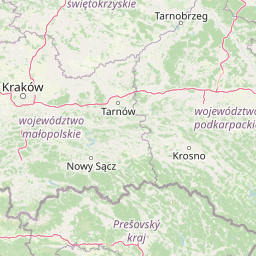
Map view of Pieniny National Park

Use this park location map to pinpoint Pieniny National Park in Slovakia, understand its exact geographic position, and read its mapped placement within the surrounding landscape more clearly.

Pigeon | © OpenStreetMap contributors

Location context for Pieniny National Park

Prešov Region

Immerse yourself in the visual identity of this Slovakian national park, showcasing its unique Carpathian terrain and protected habitats.

Pieniny National Park Photos: Explore Dramatic Limestone Landscapes and River Gorge Scenery
Browse an extensive gallery of Pieniny National Park photos to visually grasp its distinctive limestone geology, deep river canyons, and diverse park environment. These images provide essential geographic context, revealing the rugged beauty and ecological significance of one of Europe's oldest cross-border protected landscapes.

Panoramic view of forested mountains and valleys under a clear sky

A mountain peak with steep rocky cliffs surrounded by autumn-colored trees and forested hills in the background

A white building with a red-tiled roof and wooden fence, situated in a forested area with trees and grass

Panoramic landscape view showing rolling green mountains, dense forests, and a valley under a partly cloudy sky

People rafting on a river with mountains and trees in the background

Pine tree with twisted trunk growing on rocky cliff edge with mountain landscape and forested valley in background

Wide landscape view of a river flowing through mountain valleys surrounded by autumn-colored forests

Park atlas

Trace the diverse Carpathian mountain geography and connected protected landscapes surrounding Pieniny National Park.

Explore Related Protected Areas: Discover National Parks Beyond Pieniny National Park
Continue your exploration from Pieniny National Park by browsing other national parks and protected areas situated within the broader Carpathian Mountains region. Compare similar limestone gorges, river canyon landscapes, or high mountain protected areas to understand the regional geographic context and conservation efforts.
Watercolor painting showing rolling green hills, forests, and distant mountains under a pale sky
National parkLesser Poland Voivodeship

Gorce National Park: Carpathian Forest Ecosystems and Mapped Terrain in Lesser Poland

Protected landscape discovery within the Western Beskids.

Delve into the protected landscape of Gorce National Park, a key national park situated in Poland's Lesser Poland Voivodeship. This atlas entry focuses on its mapped geography, highlighting the characteristic Carpathian mountain terrain, extensive old-growth forests, and unique alpine meadows. Understand the park's protected boundaries and its significance within the regional landscape context of the Western Beskids, providing a foundation for structured geographic exploration.

Area
70.3 km²
Established
1981
IUCN
II
Visitors
80K annual
Watercolor painting of mountain ranges, forests, and a winding river
National parkLesser Poland Voivodeship

Tatra National Park: Poland's Premier Alpine National Park and Protected Landscape

Explore dramatic glacial terrain, mountain lakes, and regional geography.

Tatra National Park is the definitive Alpine protected area in Poland, located in Lesser Poland Voivodeship. It showcases unique glacial landforms, including over 30 mountain lakes and dramatic peaks like Rysy. This national park serves as a crucial habitat for endemic species and offers unparalleled opportunities for atlas exploration of its rugged, mapped terrain. Understand its geographic significance as part of the Carpathian Mountains and its role as a protected landscape.

Area
211.64 km²
Established
1954
IUCN
II
Visitors
3.9M annual
Watercolor illustration of a winding river through rolling green hills with trees in the foreground
National parkKošice Region

Slovak Paradise National Park: Protected Area Mapping & Geographic Context in Košice Region

Explore the boundaries and terrain of this national park.

Investigate Slovak Paradise National Park, a designated national park situated within Slovakia's Košice Region. This detailed entry provides essential context for understanding its protected landscape features, mapped geographic distribution, and role within regional atlas exploration. Discover its unique terrain and boundaries to build a comprehensive view of Slovak conservation areas.

Area
197.63 km²
Established
1988
IUCN
II
Relief
Mountain
National park

Low Tatras National Park: Slovakia's Vast National Park and Carpathian Protected Landscape

Explore mapped terrain and regional geographic context.

The Low Tatras National Park represents Slovakia's largest protected area, encompassing the entirety of the Low Tatras mountain range. Its landscape is defined by dramatic altitudinal diversity, from alpine summits like Ďumbier to extensive forest zones and significant karst formations with notable cave systems. This page provides detailed geographic context and map-based discovery for the park's protected boundaries and its ecological significance within the Carpathian region.

Area
728 km²
Established
1978
IUCN
II
Relief
Mountain
National parkBanská Bystrica Region

Muránska planina National Park: Discover Slovakia's Karst Plateau and Protected Natural Landscape

Explore mapped boundaries, caves, and endemic flora in Banská Bystrica Region.

Muránska planina National Park represents a significant protected landscape in central Slovakia's Banská Bystrica Region, defined by its extensive karst topography. This national park encompasses a limestone and dolomite plateau rich with geological wonders, including over 150 caves, sinkholes, and karst springs. The unique contrast between the flat plateau surface and the sharp, rocky ravines showcases a dramatic natural terrain. Explore the park's mapped boundaries and its remarkable biodiversity, highlighted by 35 endemic species and rare Tertiary relict flora like Daphne arbuscula, making it a key destination for atlas-based geographic discovery.

Area
213.18 km²
Established
1997
IUCN
II
Relief
Mountain
Watercolor illustration showing a landscape with rolling hills, green trees, and distant mountains under a light sky
National parkSubcarpathian Voivodeship

Magura National Park: Mapped Protected Landscape & Carpathian Geography Atlas

Explore unique sandstone formations and mapped natural terrain.

Magura National Park, located in the Subcarpathian Voivodeship of Poland, offers a rich focus for protected-area exploration and geographic discovery. This national park is distinguished by its dramatic sandstone rock formations, forested Carpathian ridges, and its ecological importance as a transitional zone. Users engaging with Magura National Park can examine its mapped boundaries, understand its specific landscape context, and appreciate its role within the broader regional geography.

Area
194.39 km²
Established
1995
IUCN
II
Visitors
40K annual
National parkKošice Region

Slovak Karst National Park: Premier Central European Karst Landscape and Cave Systems

Explore protected terrain and mapped underground wonders in Košice Region.

Slovak Karst National Park offers an unparalleled glimpse into a dynamic karst environment. As a designated national park and UNESCO Biosphere Reserve, it preserves a significant concentration of caves, dramatic limestone formations, and rugged canyons within its territory in southeastern Slovakia. This atlas-focused presentation highlights the park's distinctive geology, mapped landscape features, and its importance as a protected natural area within the broader geography of the Košice Region. Understand the park's surface topography and its world-renowned subterranean realms.

Area
346.11 km²
Established
2002
IUCN
II
Relief
Mountain
National park

Veľká Fatra National Park: Slovakia's Premier Protected Landscape for Geographic Discovery

Explore the park's mapped boundaries and regional natural terrain.

Veľká Fatra National Park stands as a distinct protected area, offering critical insights into Slovakia's regional geography and landscape character. This entry provides an atlas-driven perspective on its mapped boundaries and its significance as a national park. Delve into the structured geographic details and protected land context that define Veľká Fatra National Park for comprehensive discovery.

Area
403.713 km²
Established
2002
Relief
Mountain
Climate
Temperate

Common questions about visiting, size, designation, and location context for Pieniny National Park

Pieniny National Park FAQs for park facts, access, geography, and protected area context
Find quick answers about Pieniny National Park, including protected-area facts, park geography, trail and visitor context, and how the park fits into its surrounding country and regional landscape.
MoriAtlas Explorer

Continue Your Protected Areas Search Across the Global Atlas

Deepen your exploration by continuing the structured search for national parks and protected areas worldwide. Utilize the comprehensive filtering capabilities to compare different conservation landscapes and refine your understanding of global park geography. Discover more about the distribution and characteristics of protected natural areas.

Global natural geography