Why Smolenskoye Poozerye National Park stands out
Smolenskoye Poozerye is best known for its exceptional chain of 35 glacial lakes set within a pristine forest-wetland complex near the Russian-Belarusian border. The park's signature landscape is the Lake Sapsho area with its resort town of Przhevalskoye, which serves as the main recreational hub. The combination of extensive bogs, meandering rivers, and mixed forests creates a distinctive lacustrine ecosystem that is relatively rare in European Russia. The park's inclusion in the UNESCO-supported biosphere reserve network since 2002 reflects its significance as a model of integrated conservation and sustainable land use in the Sarmatic forest zone.
Smolenskoye Poozerye National Park history and protected-area timeline
The territory of Smolenskoye Poozerye has been inhabited since ancient times, with archaeological evidence scattered throughout the park demonstrating continuous human presence over millennia. The earliest evidence includes flint tools from the Mesolithic period, dating to approximately 7,000 to 8,000 BCE, representing some of the oldest human artifacts found in the region. Seventeen known Neolithic sites have been documented within the park boundaries, along with approximately 25 Bronze Age memorial sites, indicating that the lake district supported significant prehistoric communities. From the fifth century CE onward, the area developed within the Slavic cultural sphere, with agricultural and timber-based economies shaping the landscape. In modern times, researchers have documented 123 villages within the broader region, many of which predate the park's formal establishment. The park was officially created in 1992 to protect this ecologically and historically significant landscape, and in 2002 it was admitted to the international network of biosphere reserves under the Man and the Biosphere Programme, recognizing its dual role in conservation and sustainable development.
Smolenskoye Poozerye National Park landscape and geographic character
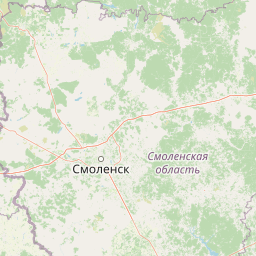
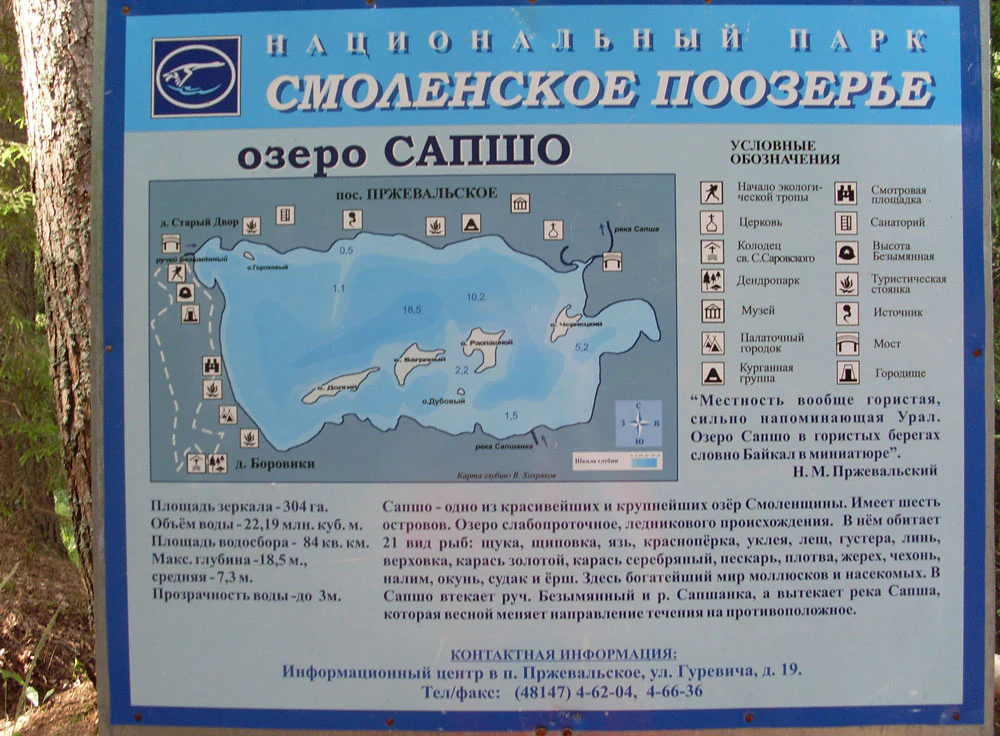
The physical landscape of Smolenskoye Poozerye is defined by its glaciated terrain of low ridges, flat floodplains, and interconnected lakes formed during the retreat of the last ice sheet. The park covers a roughly rectangular area measuring approximately 55 kilometers from east to west and 50 kilometers from north to south. Elevations within the park range from 167 meters in the lowest river valleys to 248 meters at the highest points, creating a gently undulating terrain without dramatic relief. The underlying geology features gravel moraines and glacial deposits that create a hummocky surface topology. Two main rivers, the Yelsha and the Polovya, traverse the park and connect the lake system to the broader Western Dvina watershed. The largest water body, Lake Sapsho, covers 3 square kilometers and occupies a glacial kettle basin. The landscape includes approximately 16,240 hectares of bogs, 1,608 hectares of lakes, and 468 hectares of rivers, with the remaining area consisting primarily of forested land.
Smolenskoye Poozerye National Park ecosystems, habitats, and plant life
The ecological character of Smolenskoye Poozerye reflects its position within the Sarmatic mixed forests ecoregion, a zone of coniferous and deciduous woodlands that extends from southern Sweden across the Baltic states and central eastern Europe to the Ural Mountains. The park encompasses a remarkable diversity of habitats in a relatively compact area, including pine forests, spruce forests, broadleaf forests, extensive bogs, sedge meadows along water bodies, dry meadows, and aquatic habitats. Tree species composition is dominated by birch at approximately 38 percent of forest cover, with spruce at 16 percent, pine at 12 percent, aspen at 13 percent, and black alder at 6 percent. This mix of coniferous and deciduous species creates a structurally complex forest that provides varied habitats for wildlife. The extensive bog systems represent particularly important wetland habitats within the forest matrix, supporting specialized plant communities adapted to acidic, nutrient-poor conditions.
Smolenskoye Poozerye National Park wildlife and species highlights
Smolenskoye Poozerye supports a diverse animal community across its forest, wetland, and aquatic habitats. Biological surveys have documented 54 species of mammals, 232 species of birds, and 37 species of fish within the park boundaries. The combination of old-growth forests, wetlands, and lakes creates habitat conditions suitable for a wide range of species, from large mammals like moose and wild boar to numerous waterfowl and songbirds. The extensive wetland systems are particularly important for migratory birds, and in 2012 the World Wildlife Fund initiated a dedicated conservation project focused on rare bird species in the large wetland complexes of the Smolensk Lakeland. The lake environments support fish populations that are characteristic of the Volga-Ural freshwater ecoregion, a region noted for its relatively high fish species diversity despite limited endemism.
Smolenskoye Poozerye National Park conservation status and protection priorities
Smolenskoye Poozerye holds significant conservation value as a protected area within the Sarmatic mixed forests ecoregion, a biome that has faced substantial pressure from agriculture and forestry across its range. The park's inclusion in the international biosphere reserve network since 2002 reflects recognition of its importance both as a biodiversity conservation site and as a model for sustainable human-nature coexistence in this part of Russia. The protected area preserves representative examples of the forest-wetland ecosystems that once covered much of western Russia but have been heavily modified by human activity. The park's network of lakes, rivers, and bogs maintains important ecological processes including water filtration, carbon storage, and wildlife habitat provision. Conservation challenges include balancing visitor access with habitat protection and managing the interface between protected lands and the surrounding agricultural landscape.
Smolenskoye Poozerye National Park cultural meaning and human context
The Smolensk Lakes region carries deep historical significance as one of the oldest continuously inhabited areas in western Russia. The archaeological record within the park documents human presence spanning from the Mesolithic period through the Neolithic and Bronze Age, with Slavic agricultural settlement beginning in the fifth century CE. This long history of occupation has produced a cultural landscape where natural and historical elements are intertwined. The park contains the resort town of Przhevalskoye on the shores of Lake Sapsho, which serves as the primary visitor accommodation and recreational hub. Traditional land uses including agriculture, forestry, and fishing have shaped both the natural environment and the cultural character of the region. The park maintains cultural heritage sites and offers educational programs that connect visitors to the historical significance of the area.
Top sights and standout views in Smolenskoye Poozerye National Park
The defining feature of Smolenskoye Poozerye is its exceptional chain of glacial lakes surrounded by forest and wetland, creating a landscape of outstanding natural beauty within western Russia. Lake Sapsho and its resort town of Przhevalskoye serve as the park's main attraction, offering visitors access to boating, fishing, and recreational activities in a scenic lakeside setting. The extensive network of nature trails, including a family-friendly route themed around Russian forest folklore, provides opportunities for exploring the park's diverse habitats. Birdwatching programs and guided tours to historical-cultural sites add to the visitor experience. The park's biosphere reserve status and its role in preserving representative Sarmatic forest ecosystems give it significance beyond its local context, making it a model for integrated conservation in the region.
Best time to visit Smolenskoye Poozerye National Park
Smolenskoye Poozerye experiences a humid continental climate with warm summers and cold, snowy winters typical of the western Russian interior. The summer months from June through August offer the most comfortable conditions for outdoor activities, with average temperatures reaching into the low 20s Celsius and the landscape fully green with long daylight hours. The park's wetland and lake environments are particularly appealing during the warmer months when water-based recreation is possible and wildlife viewing opportunities are at their best. Winter visitation is possible but limited by snow cover and cold temperatures that can drop well below freezing, with the park's flat terrain becoming less accessible for general tourism. Spring and autumn provide transitional seasons with their own character, though spring flooding may affect trail accessibility and autumn conditions can be variable. The park operates year-round, though the majority of its approximately 250,000 annual visitors arrive during the summer peak season.