Why Yugyd Va National Park stands out
Yugyd Va is distinguished as Europe's largest national park, a vast expanse of pristine taiga wilderness that represents one of the continent's most significant protected areas. The park protects the mostnortherly high mountains of the Ural range, including a cluster of peaks exceeding 1,600 meters that form the heart of the Polar Urals. Its inclusion in the Virgin Komi Forests World Heritage Site recognizes the outstanding universal value of its ancient, undisturbed boreal ecosystems. The park encompasses dramatic elevation gradients from valley floors to the highest Ural summits, creating a compact representation of the full spectrum of subarctic and boreal environments. Its position spanning the Europe-Asia boundary adds geographic significance, while its remote character has preserved ecological integrity despite decades of protected status.
Yugyd Va National Park history and protected-area timeline
Yugyd Va National Park was established by the Russian Government on April 23, 1994, with the dual purpose of protecting the taiga forests of the northern Urals and providing opportunities for sustainable recreational use. The creation of the park reflected Russia's growing commitment to biodiversity conservation in the post-Soviet period and recognized the exceptional ecological value of the Komi Republic's boreal forests. Within a year of its establishment, the park achieved international recognition when the encompassing Virgin Komi Forests—including both Yugyd Va and the adjacent Pechora-Ilych Nature Reserve—were inscribed as a UNESCO World Heritage Site in 1995. This designation acknowledged the area as one of the largest and most intact remaining tracts of boreal forest in Europe, representing a globally significant ecosystem. The park remained Russia's largest national park for nearly two decades until the creation of Beringia National Park in the Far East in 2013. Management of the park has focused on balancing protection objectives with limited tourism and recreation, though the remote location has naturally constrained visitation rates.
Yugyd Va National Park landscape and geographic character
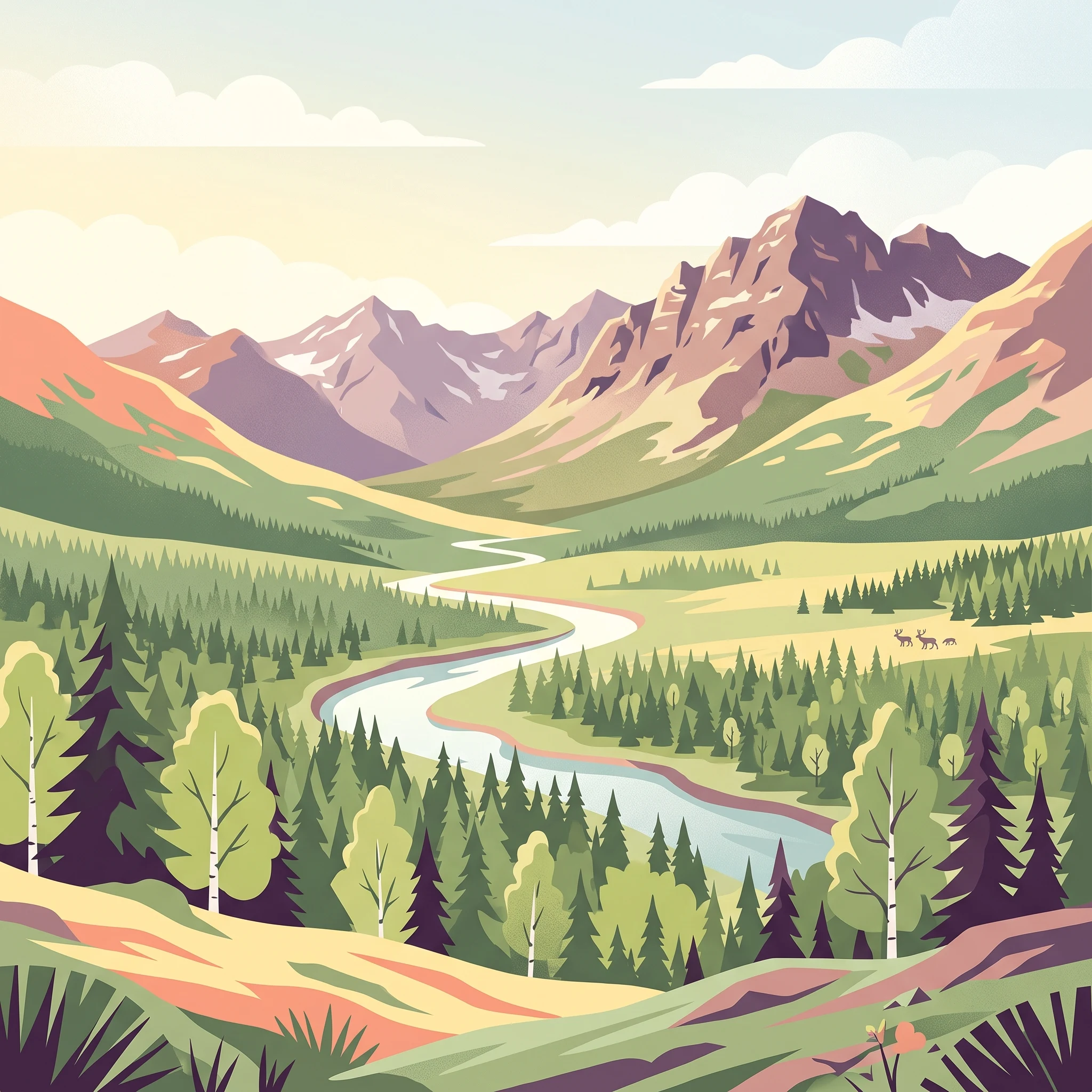
The landscape of Yugyd Va National Park encompasses a remarkable topographic range within a single protected area, from lowland river valleys to the highest peaks in the Ural Mountains. The central portion of the park contains the most elevated terrain, where the Urals reach their maximum heights in the Polar section: Mount Narodnaya rises to 1,894.5 meters, followed closely by Mount Karpinsky at 1,878 meters, the Bell Tower at 1,724 meters, and Manaraga at 1,662 meters. These granite and metamorphic peaks form a dramatic alpine landscape above the tree line, with rocky summits, steep-sided valleys, and permanent snow patches. Below the peaks, the foothills present a landscape of rounded hills, deep valleys, and forested slopes descending toward the western lowlands. The park's rivers—including the Kozhim, Bolshaya Synya, Synja, Vangir, and Kosya—have carved valleys that provide both hydrological corridors and visual breaks in the continuous forest cover. The entire territory lies within the Prepolar-Ural physical-geographical area, a region shaped by more than 200 million years of geological history that has produced the complex terrain now protected within the park.
Yugyd Va National Park ecosystems, habitats, and plant life
The ecological character of Yugyd Va National Park is defined by the transition from boreal taiga forest at lower elevations to alpine tundra at higher elevations, creating a vertical zonation of vegetation that mirrors the latitudinal progression from temperate forest to Arctic conditions. More than half of the park's vast territory is covered by taiga boreal forest, dominated by coniferous species adapted to the harsh continental climate of the Komi Republic. At higher elevations, where temperatures drop and growing seasons shorten, the forest gives way to tundra vegetation—dwarf shrubs, lichens, mosses, and alpine meadows that survive in the short summer months. The park also contains approximately 20 square kilometers of meadow ecosystems, including both alpine meadows on mountain slopes and riparian meadows along river valleys. This variety of habitats supports exceptional biodiversity, with the park serving as a critical refuge for species adapted to cold, northern conditions and providing connectivity across the Europe-Asia boundary.
Yugyd Va National Park wildlife and species highlights
The wildlife communities of Yugyd Va reflect the boreal and Arctic character of the northern Urals, with species assemblages that include both European and Asian elements. More than 180 bird species have been recorded within the park, including numerous species that breed in the tundra and taiga zones during the short summer season. The park's rivers and lakes support 20 fish species, providing important habitat for species adapted to cold, well-oxygenated waters. Among the mammals, the park supports populations of mountain hare, flying squirrel, reindeer, ermine, otter, moose, wolf, fox, wolverine, bear, pine marten, weasel, and Arctic fox. This assemblage represents a complete boreal predator-prey community, with species ranging from small furbearers to large ungulates and apex predators like wolves and bears. The presence of Arctic fox reflects the park's position at the southern edge of tundra ecosystems, while species like the flying squirrel demonstrate the presence of mature forest habitats. The diversity of mammals, combined with the richness of bird and fish communities, makes Yugyd Va one of the most ecologically significant protected areas in northern Europe.
Yugyd Va National Park conservation status and protection priorities
Yugyd Va National Park represents one of Europe's most important conservation achievements, protecting the largest intact boreal forest ecosystem on the continent. The park's inclusion in the UNESCO Virgin Komi Forests World Heritage Site, inscribed in 1995, recognizes its outstanding universal value as a representative example of the boreal forest ecosystem in its most natural and undisturbed condition. The protection of this vast territory ensures the survival of ecological processes that have operated largely without human interference, maintaining genetic diversity and evolutionary potential across numerous species. The park also serves critical hydrological functions, protecting the headwaters of rivers that flow to the Pechora and ultimately the Arctic Ocean, influencing water quality across a broad region. Its position spanning the Europe-Asia boundary adds significance for conservation of species with transcontinental distributions. Despite its protected status, the park faces ongoing challenges related to funding and management capacity, with visitor fees covering only a portion of operational costs.
Yugyd Va National Park cultural meaning and human context
The Yugyd Va National Park occupies territory within the traditional lands of the Komi people, an indigenous Uralic population whose historical presence in the region predates Russian settlement. The park's name itself derives from the Komi language, reflecting the deep connection between the landscape and the indigenous culture of the Komi Republic. While the park's primary designation focuses on ecological protection, the region has a long history of human interaction through traditional activities such as reindeer husbandry, hunting, and fishing. The Komi Republic remains home to substantial Komi-speaking populations, and the protected area exists within a broader cultural landscape where traditional land uses continue alongside modern conservation objectives. The establishment of the park represents a balance between recognition of the region's ecological significance and respect for its cultural heritage.
Top sights and standout views in Yugyd Va National Park
Yugyd Va protects Europe's largest expanse of protected taiga wilderness, a vast territory of forest, tundra, and mountain landscapes that remains largely undisturbed by human development. The park encompasses the highest peaks of the Ural Mountains, including Mount Narodnaya and Mount Karpinsky, which form dramatic alpine scenery above the tree line. Its inclusion in the Virgin Komi Forests World Heritage Site confirms its status as one of the most significant boreal protected areas globally. The park spans the boundary between Europe and Asia, adding geographic and cultural significance to its ecological value. Protected species include complete communities of boreal mammals from wolverine and wolf to moose and reindeer, alongside more than 180 bird species. The remote character of the park ensures continued ecological integrity despite relatively low visitation levels.
Best time to visit Yugyd Va National Park
The most favorable season for visiting Yugyd Va National Park occurs during the brief Arctic summer, typically from June through August, when temperatures are mildest and the landscape is most accessible for hiking and outdoor activities. During this period, the tundra blooms with wildflowers, wildlife is most active, and the midnight sun provides extended daylight for exploration. Winter visitation is possible for Nordic skiing and winter wilderness experiences, though the extreme cold and limited daylight present significant challenges. The shoulder seasons of spring and autumn offer opportunities to witness seasonal transitions but come with variable weather conditions and reduced services. The park's remote location requires careful planning regardless of season, with access typically via the town of Pechora or through specialized tour operators familiar with the region.