Why Blåfjella, Skjækerfjella National Park stands out
Blåfjella, Skjækerfjella is best known as one of Norway's last great wilderness areas, a vast expanse of relatively untouched nature that has retained its ecological integrity despite centuries of human use. The park holds exceptional significance as the site where spruce first arrived in Norway, representing a critical biogeographical landmark in the country's ecological history. It is uniquely distinguished among Norwegian mainland parks for harboring all four of the country's large predators, brown bear, Eurasian lynx, wolverine, and gray wolf, creating one of the most significant predator conservation zones in Scandinavia. The area's Sami cultural heritage, with ancient settlements and sacred sites scattered throughout the landscape, adds a profound human dimension to its wilderness character.
Blåfjella, Skjækerfjella National Park history and protected-area timeline
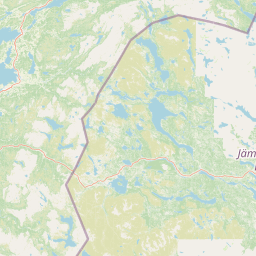
Blåfjella–Skjækerfjella National Park was officially established on December 17, 2004, when the Norwegian government designated this vast wilderness area for permanent protection under national park status. The park's creation represented the culmination of ongoing conservation efforts in the region, which had previously seen the establishment of Gressåmoen National Park in 1970. When Blåfjella–Skjækerfjella was formed, Gressåmoen was incorporated into its boundaries, expanding the total protected area to encompass approximately 1,924 square kilometers of mountainous terrain. The establishment of the park followed extensive scientific assessment and consultation with local stakeholders, reflecting Norway's systematic approach to protected area designation. The park's name reflects the Norwegianized forms of the original Sami place names for these mountain areas—Blåfjella deriving from the Sami Låarte (meaning "the blue mountains") and Skjækerfjella deriving from the Sami Skæhkere (referring to the distinctive long mountain ridges that characterize the landscape). This naming acknowledges the deep historical connection between the Sami people and this landscape, which stretches back several centuries of continuous use and habitation.
Blåfjella, Skjækerfjella National Park landscape and geographic character
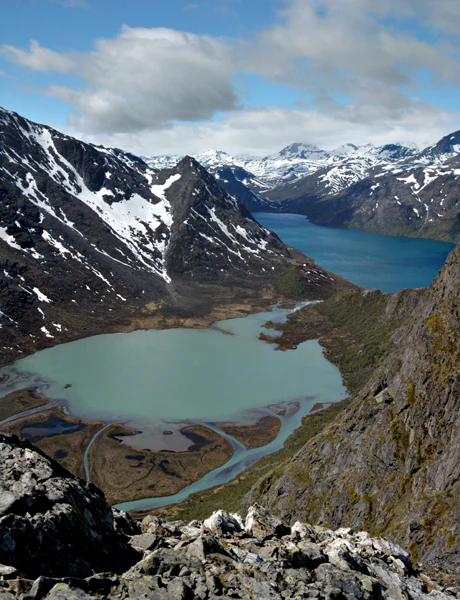
The physical landscape of Blåfjella–Skjækerfjella presents a characteristic north-central Norwegian mountain environment shaped by glacial processes and subsequent weathering. The terrain consists primarily of extensive mountain plains and plateaus, interrupted by forested valleys that descend from the higher ground. Numerous lakes are scattered throughout the park, lying in glacial hollows and valleys, their waters feeding streams that drain through the landscape. Extensive marshland areas occupy valley floors and lower slopes, creating important wetland habitat within the broader mountainous matrix. While the park lacks dramatic high peaks, several summits rise above the surrounding terrain, with Midtliklumpen reaching 1,333 meters as the highest point. The interplay between open exposed mountain terrain and sheltered forested valleys creates a landscape of considerable visual diversity. The geological foundation varies across the park, with areas of softer bedrock supporting more luxuriant vegetation while harder rock formations create more barren terrain—this geological diversity contributes to the ecological variety found within the park's boundaries.
Blåfjella, Skjækerfjella National Park ecosystems, habitats, and plant life
Blåfjella–Skjækerfjella supports an exceptional diversity of nature types within its boundaries, reflecting both its large size and the varied environmental conditions found across the mountain and valley terrain. The park holds particular botanical significance as the documented entry point where spruce first migrated into Norway—a biogeographical landmark of national importance. The flora within the park spans multiple ecological zones, including coastal species that reach their inland limits here, more typical boreal forest species, and alpine plant communities adapted to the higher elevations. Old-growth forests persist in the valley bottoms, representing some of the least disturbed forest remaining in Norway. The variation in bedrock types—ranging from softer formations that support rich plant growth to harder rock with more sparse vegetation—creates a mosaic of habitat conditions that supports this botanical diversity. Adjacent to the main park boundary, four nature reserves provide additional protection for specialized habitats: Arvasslia, Berglimyra and Klumplifjellet, Gaundalsmyra, and Storfloa, each protecting distinctive ecological communities.
Blåfjella, Skjækerfjella National Park wildlife and species highlights
The wildlife community of Blåfjella–Skjækerfjella is notably rich and includes several species of exceptional conservation significance. Twenty-eight mammal species have been documented within the park, a remarkable diversity for a Norwegian protected area. The park is particularly significant for its population of large predators, being the only mainland Norwegian national park where all four of the country's apex predators have been recorded: brown bear, Eurasian lynx, wolverine, and gray wolf. While gray wolf sightings are rare, the presence of these species establishes the park as a critical area for predator conservation in Norway. The Arctic fox, a species of conservation concern in Scandinavia, also occurs here. Three deer species are present: moose, roe deer, and red deer, forming the basis of prey populations that support the predator community. The avifauna is similarly diverse, with numerous bird species observed throughout the park. The lakes support populations of brown trout and Arctic char, providing valuable fishing resources and supporting aquatic food chains.
Blåfjella, Skjækerfjella National Park conservation status and protection priorities
Blåfjella–Skjækerfjella National Park represents one of Norway's most important conservation designations, protecting both ecological processes and cultural landscapes within a single coherent framework. The park's large size and relative wildness make it a critical area for maintaining ecological connectivity across the Scandinavian landscape, allowing natural processes to continue with minimal human interference. The presence of all four large predators distinguishes this park as uniquely important for predator conservation on the Norwegian mainland—these species require large territories and minimal human disturbance, conditions that Blåfjella–Skjækerfjella provides in abundance. The protection of old-growth forests within the park preserves carbon storage and biodiversity values that would be lost to logging or development. The Sami cultural monuments scattered throughout the park represent intangible heritage values that complement the ecological significance, creating a protected area that preserves both natural and cultural dimensions of the landscape. Four adjacent nature reserves—Arvasslia, Berglimyra and Klumplifjellet, Gaundalsmyra, and Storfloa—supplement the national park's protection, creating a network of complementary protected areas.
Blåfjella, Skjækerfjella National Park cultural meaning and human context
The human history of Blåfjella–Skjækerfjella stretches back centuries through the presence and activities of the Sami people, whose cultural heritage remains visible throughout the park landscape. The Sami have lived in and utilized this area for many generations, establishing settlements, creating gathering places, constructing burial sites, and identifying locations of spiritual significance. These cultural monuments provide tangible evidence of the long relationship between the Sami people and this mountainous landscape. The park's name itself derives from Norwegianized forms of the original Sami place names—the mountain area known as Låarte became Blåfjella ("the blue mountains"), while Skæhkere became Skjækerfjella, referring to the distinctive long ridges. This linguistic heritage reflects the deep roots of Sami presence in the region. The contemporary landscape bears the imprint of traditional Sami land use, including patterns of seasonal movement and resource utilization that shaped both the physical environment and the cultural character of the area.
Top sights and standout views in Blåfjella, Skjækerfjella National Park
Blåfjella–Skjækerfjella stands as one of Norway's last great wilderness areas, offering visitors access to extensive tracts of relatively untouched mountain landscape where natural processes continue largely unimpeded. The park's significance as Norway's premier location for observing large predators—including brown bears, lynx, wolverines, and occasionally wolves—makes it uniquely important for wildlife enthusiasts and researchers. The botanical significance of the area, particularly its role as the entry point for spruce into Norway, gives it special importance in understanding the country's ecological history. The network of hiking trails, including some marked routes and mountain cabins for overnight stays, enables exploration of this remote landscape. The rich Sami cultural heritage embedded in the terrain adds historical depth to the wilderness experience, connecting visitors to centuries of human presence in these mountains. Lakes teeming with brown trout and Arctic char provide excellent fishing opportunities in season.
Best time to visit Blåfjella, Skjækerfjella National Park
Blåfjella–Skjækerfjella offers meaningful experiences across multiple seasons, each bringing distinct character to the landscape. Summer and early autumn bring the most accessible conditions for hiking and outdoor activities, with snow-free trails allowing exploration of the mountain plateaus and valley routes. The longer daylight hours of the brief northern summer permit extended expeditions. Autumn offers excellent conditions for wildlife observation as animals become more active before winter, and the landscape displays the characteristic colors of the boreal forest. Winter transforms the park into a true wilderness experience, though conditions become more challenging and some facilities close for the season. The park's northern location means cold temperatures persist well into spring, with the snow season lasting from late autumn through spring. Those seeking solitude and a genuine wilderness experience may find the quieter shoulder seasons particularly rewarding, though all visitors should be prepared for rapidly changing weather and the need for proper equipment in this remote mountain environment.