Why Jotunheimen National Park stands out
Jotunheimen is renowned as the premier alpine hiking destination in Norway and all of Northern Europe. The park protects the three highest peaks on the continent north of the Alps, Galdhøpiggen, Glittertind, and Store Skagastølstind, making it an iconic destination for mountaineering and peak-bagging. The dramatic landscape of sharp granite peaks, glacial valleys, and pristine mountain lakes has inspired Norwegian literature for centuries, most notably in Henrik Ibsen's drama Peer Gynt, which describes the famous Besseggen ridge traverse. The park contains an extensive network of staffed tourist huts operated by the Norwegian Mountain Touring Association (DNT), making multi-day hut-to-hut hiking treks through the high mountains accessible and well-supported. The fishing in the park's lakes and rivers, particularly for trout, has been celebrated since the Victorian era, drawing anglers from across Europe.
Jotunheimen National Park history and protected-area timeline
Human activity in Jotunheimen dates back thousands of years, with archaeological evidence of Stone Age hunting camps found near lakes Gjende and Russvatnet. These hunter-gatherer sites continued through the Bronze Age and Iron Age, demonstrating continuous use of the high mountain environment well into recorded history. The high summer pastures have been used as traditional seter alpine farms for at least a thousand years, establishing patterns of seasonal mountain use that continue in surrounding areas. During the 15th century, a royal decree required residents of Lom municipality to maintain the mountain crossing passes through the Sognefjell road, enabling trade between Gudbrandsdal in the east and Bergen on the western coast. Caravans transported farm products down to the lowlands while returning with salt, iron, cloth, and lutefisk. The modern concept of Jotunheimen as a named destination emerged in the 19th century when poet Aasmund Olavsson Vinje coined the name in 1862, drawing on Keilhau's earlier "Jotunfjellene" (mountains of the giants). A memorial to Vinje was erected in 1909 at Eidsbugarden on Lake Bygdin, where he had maintained a private hut and which remains today as a significant mountain tourist centre. The Norwegian Mountain Touring Association began building huts in 1869 and now maintains an extensive network that makes the area one of Europe's best-developed trekking regions. Jotunheimen National Park was formally established by royal decree in December 1980, covering 1,145 square kilometres of the most valuable mountain terrain.
Jotunheimen National Park landscape and geographic character
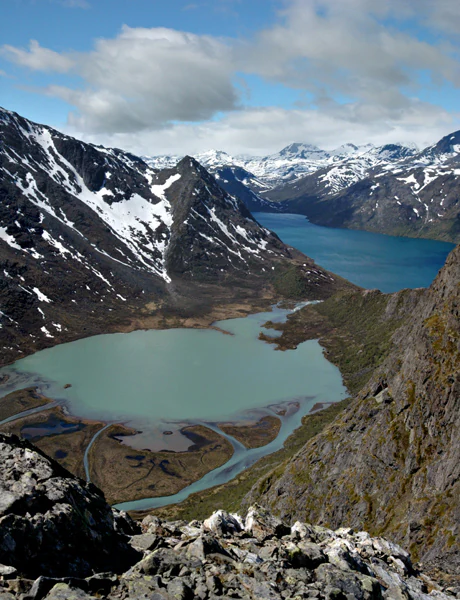
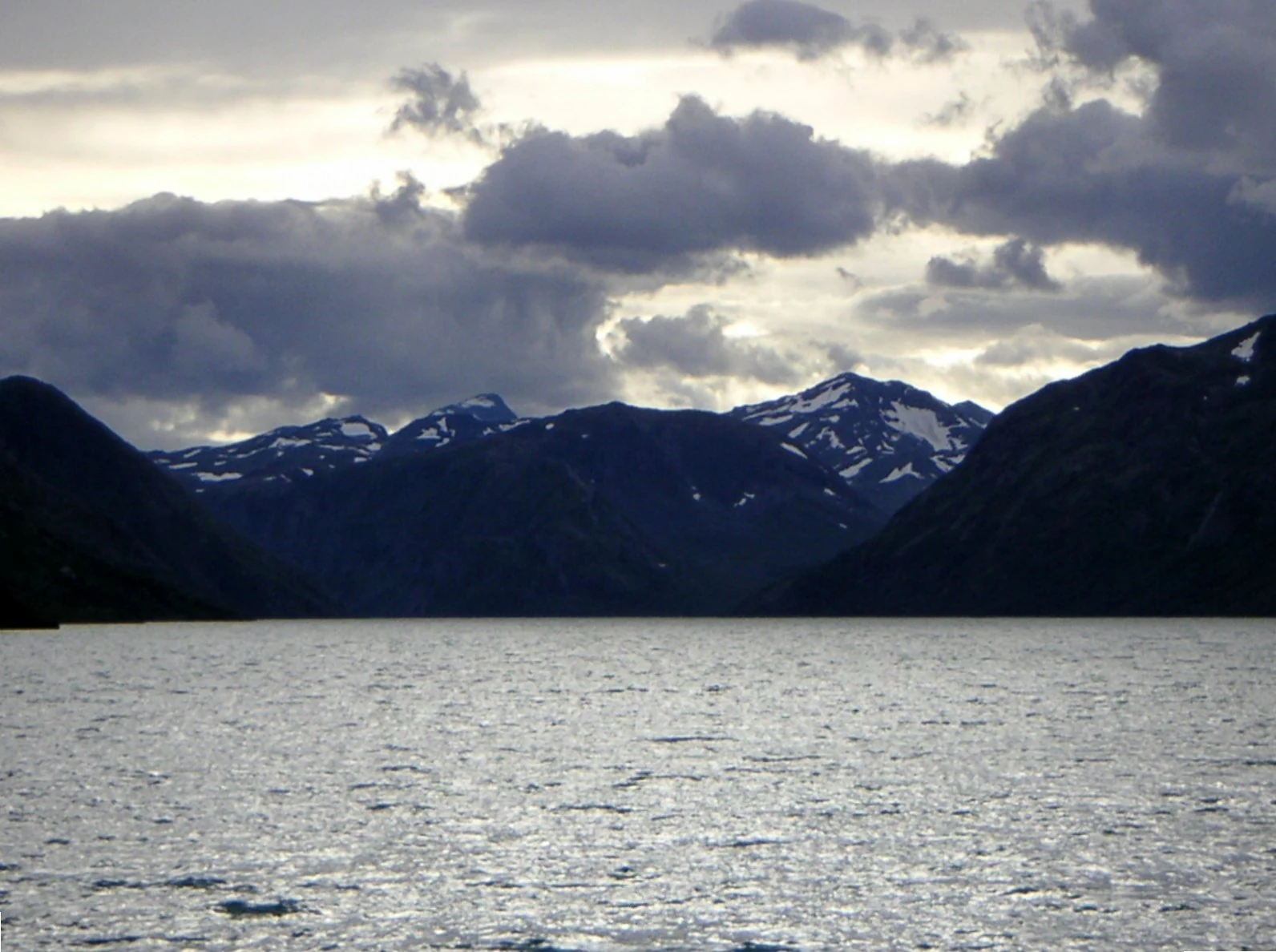
The landscape of Jotunheimen is a textbook example of alpine glaciation, with the characteristic features of a high mountain environment carved into ancient Precambrian crystalline rocks. The dominant geological material is gabbro, a coarse-grained igneous rock that forms the massive, steep-sided peaks and ridges that give Jotunheimen its distinctive silhouette. Glaciers have carved deep U-shaped valleys, sharp arêtes, and dramatic cirques, leaving behind a landscape of extraordinary topographic relief. More than 250 peaks exceed 1,900 metres in elevation, with the three highest summits in Northern Europe rising from the heart of the park. The landscape includes numerous glacial lakes, with Lake Gjende being among the most prominent, its dark waters reflecting the surrounding peaks. The terrain varies from gentle high-altitude plateaus to near-vertical rock faces, with the famous Besseggen ridge offering one of Norway's most iconic traverses. Hurrungane, at the western edge of the park, contains some of the most dramatic and challenging peaks for climbers.
Jotunheimen National Park ecosystems, habitats, and plant life
The ecological character of Jotunheimen is defined by its high-altitude alpine environment, where harsh conditions limit vegetation to specialized communities adapted to short growing seasons, extreme cold, and strong winds. The park lies within the transition zone between boreal forest and alpine tundra, with the tree line varying by exposure and topography. Below the tree line, birch woodland and scrub vegetation dominates, while the higher zones feature alpine meadows, heath, and exposed rock. The fragile alpine ecosystems are slow to recover from disturbance, making the protected status particularly important. The park forms part of a larger network of protected areas in southern Norway that connects to Utladalen Nature Reserve and extends toward the Breheimen National Park, creating a significant corridor of protected mountain habitat.
Jotunheimen National Park wildlife and species highlights
Jotunheimen supports a range of boreal and Arctic wildlife species adapted to the mountainous environment. Large mammals include the lynx, moose, Norwegian red deer, reindeer, roe deer, and wolverine, representing both forest-dwelling and open-country species. The reindeer population has historical significance, with the park's mountainous terrain providing summer grazing grounds for semi-domesticated reindeer herds. The lakes and rivers within the park hold populations of trout, which have supported fishing as a recreational activity for centuries and were celebrated in Victorian-era travel literature describing the exploits of English anglers in the region. Birdlife includes species typical of alpine and boreal environments, though the source material focuses primarily on mammalian fauna and fish. The combination of forest and alpine habitats supports a diverse community, though the harsh winter conditions limit the overall carrying capacity of the environment.
Jotunheimen National Park conservation status and protection priorities
Jotunheimen National Park is designated as an IUCN Category II protected area, reflecting its primary purpose of protecting natural ecosystems while allowing for sustainable recreation and research. The establishment of the national park in 1980 formalized protection for one of Norway's most significant mountain landscapes, preserving not only the dramatic terrain but also the ecological communities that depend on the alpine environment. The park is linked to the Utladalen Nature Reserve, creating an expanded protected area of approximately 300 square kilometres that encompasses diverse habitats. The management approach balances wilderness preservation with the long tradition of sustainable outdoor recreation, particularly the network of hiking huts that have allowed visitors to experience this landscape without the environmental impact of extensive road development or intensive tourism infrastructure. The protection of this alpine ecosystem is particularly important given the sensitivity of high mountain environments to climate change, as evidenced by the discovery of a 1,500-year-old Viking arrowhead emerging from a melting glacier in 2020.
Jotunheimen National Park cultural meaning and human context
Jotunheimen holds a special place in Norwegian cultural identity, having been immortalized in literature, music, and the broader romantic nationalist movement of the 19th century. The poet Aasmund Olavsson Vinje, a pioneer of nynorsk language and an advocate for Norwegian national identity, coined the name "Jotunheimen" in 1862, transforming the raw mountain landscape into a symbol of Norwegian natural grandeur. His poetry collection of 1864 celebrated the mountains, and his memorial at Eidsbugarden remains a site of cultural pilgrimage. Henrik Ibsen's drama Peer Gynt (1867) features the mountains prominently, with the famous scene of Peer riding a wild reindeer along the Gjendin ridge on the narrow Besseggen. The composer Frederick Delius was inspired to write his symphonic poem "On the Mountains" after a walking holiday in the Jotunheimen with Edvard Grieg and Christian Sinding in 1889. Victorian travel writers J.A. Lees and W.J. Clutterbuck documented their fishing and hunting experiences in "Three in Norway, by Two of Them," bringing international attention to the area's recreational opportunities. The tradition of mountain tourism and hut-based trekking that developed in the late 19th century remains central to how visitors experience the park today, with Eidsbugarden still serving as a mountain centre with hotel, DNT cabin, and private huts.
Top sights and standout views in Jotunheimen National Park
The crown jewels of Jotunheimen are the three highest peaks in Northern Europe – Galdhøpiggen, Glittertind, and Store Skagastølstind – which draw mountaineers and peak-baggers from around the world. The Besseggen ridge traverse, made famous in Peer Gynt, offers one of Norway's most celebrated day hikes, with views down to the contrasting waters of Lake Gjende. The extensive network of DNT mountain huts enables multi-day trekking through the high terrain, making extended wilderness exploration accessible without camping gear. Lake Gjende and Lake Bygdin provide scenic anchors for explorations, with boat access at several points. The dramatic Hurrungane peaks present challenging climbing on some of the most impressive granite in Norway. Fishing for native trout in the park's lakes has been a celebrated tradition for centuries. The memorial to poet Aasmund Olavsson Vinje at Eidsbugarden connects the landscape to Norway's literary heritage.
Best time to visit Jotunheimen National Park
The optimal visiting season for Jotunheimen runs from mid-June through September, when the mountain trails are snow-free and the DNT mountain huts are fully staffed. July and August typically offer the most reliable weather and the warmest conditions for high-altitude hiking, though afternoon thunderstorms are common in the mountains. Early September can be spectacular, with autumn colours appearing on the birch slopes and fewer crowds on the trails, though some huts begin to close for the season. Winter access is limited to cross-country skiing and snowmobile travel to facilities like Eidsbugarden, with the harsh conditions suitable only for experienced winter mountaineers. The shoulder seasons of June and September offer the advantage of fewer visitors and the possibility of experiencing the mountains in more solitude, though weather uncertainty is greater. The park's high elevation means that even summer temperatures can be cool, and visitors should be prepared for rapid weather changes regardless of the season.